The files are scattered across someone else's Figma account. The brief lives in three people's heads, not on paper. Momentum, once broken, doesn't restart on command.
For technical products, the stakes climb higher. If your new agency has to re-learn your battery chemistry, your carbon capture process, or your regulatory landscape from zero, you're not just losing time. You're paying for the same education twice.
This guide covers when a switch actually makes sense, the exact steps to pull it off cleanly, what to prepare before you say a word to your current agency, and the mistakes that turn a clean exit into a six-month fire drill.
TL;DR: key takeaways
- Secure your files, IP, and account access in writing before you notify anyone
- Time your exit to a natural milestone, not a mid-sprint panic move
- A short overlap window between agencies prevents lost context and repeated mistakes
- The real risk is picking a replacement that can't absorb a technical brief fast
1. How to switch design agencies mid-project
Rushing this process is how projects lose months. Follow it in order.
1.1 Audit your contract and asset ownership
Before anything else, pull out your original agreement and read the fine print you skimmed at signing.
- Check IP clauses - who owns the final files versus the working files versus the design tools used to make them
- Confirm termination terms - notice periods, cure periods for breach, and any kill fees attached to early exit
- Get ownership confirmed in writing - don't rely on assumptions about what "you paid for it, you own it" actually means legally
Most standard design agreements, including the widely used AIGA model contract, allow for a 25% early-termination fee when a client exits for convenience, separate from accrued project costs. That's a template clause, not a universal number, but it shows why reading your specific contract matters more than guessing.
Separate everything into two buckets: what you already own outright, and what still needs to be requested or negotiated before you walk away.
1.2 Document everything before you notify
This step happens quietly, before your outgoing agency knows a change is coming.
Build a factual log of what isn't working - missed deadlines, quality slips, scope drift. Dates and specifics, not impressions. You'll need this to justify the decision internally, especially if leadership or investors ask why the switch happened mid-stream.
Then back everything up:
- Design files - Figma, Sketch, or Adobe XD source files, not just exported PNGs
- Code repositories - if the engagement includes any development work
- Brand assets - logos, typography files, color specs, brand guidelines
- Credentials - domain registrar, hosting, CMS, and any third-party tool logins
Map what's finished, what's half-done, and what hasn't started. A design-handoff case study from UX Collective recommends keeping one current file per feature rather than scattered duplicates - useful advice whether you're handing off internally or between agencies. Nothing should exist only in someone's inbox or head.
1.3 Time and communicate the exit strategically
Timing matters almost as much as the decision itself.
Pick a transition point tied to something concrete - the end of a sprint, the delivery of a milestone deliverable - rather than cutting things off mid-build. This gives both sides a clean stopping point instead of a half-finished screen frozen in time.
Give the notice period your contract requires. Request a structured handoff instead of an immediate cutoff; most agreements include a cure period for issues, and skipping it can create unnecessary legal friction.
Keep the conversation professional. An agency that feels blindsided or attacked will usually cooperate less, while a clear, calm explanation typically gets you a faster, more complete handoff.
1.4 Select and brief a New agency for a mid-stream start
This is where most switches succeed or fail.
Vetting a new agency for a mid-project takeover is different from vetting one for a fresh start. Ask directly:
- How do they handle inheriting someone else's design decisions?
- What do they need from you to get oriented quickly?
- Can they show a process for absorbing dense technical material, not just for pitching new ideas?
Hand over everything: the original brief, brand strategy documents, technical or scientific background material, and a map of who the key stakeholders are and what they each care about.
Agencies built around absorbing technical density tend to fare better here. At What if Design, briefing starts with a stakeholder workshop that pulls in different perspectives. Those inputs become a structured brief covering objectives, scope, requirements, and competitive context. The same rigor applies whether a project starts on day one or day ninety.
For founders in climate tech or deep tech, that matters: an agency that's spent time learning carbon capture, grid interconnection, or battery systems doesn't need a science lesson before it can start designing.
1.5 Run a structured handoff and overlap period
Don't sever ties the day you sign with someone new.
💡 Working through this decision right now? If you're a climate-tech or deep-tech founder weighing this trade-off, Book a strategy call with our team, 25 minutes, no pitch, and we'll pressure-test your specific situation.
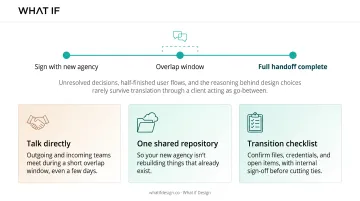
Arrange a short overlap window - even a few days - where outgoing and incoming teams can talk directly. Unresolved decisions, half-finished user flows, and the reasoning behind design choices rarely survive translation through a client acting as go-between.
Set up one shared repository for all assets so your new agency isn't rebuilding things that already exist. Before you fully cut ties with the old team, get internal sign-off on a transition checklist confirming files, credentials, and open items are all accounted for.
See how we have approached this in practice: Best UX design agencies to work with in 2026.
2. When should you switch design agencies mid-project?
Not every frustration warrants a full switch. Sometimes renegotiating scope or escalating internally solves the problem faster and with less disruption.
That said, certain signs point clearly toward replacement:
- Chronic missed deadlines that persist after direct conversations
- Declining quality compared to earlier work in the same engagement
- Poor communication or unresponsiveness from your account contact
- Technical misunderstanding of your product's complexity, with repeated off-target work
- Personnel turnover on your account, especially loss of the person who understood your project
The DBA's 2024 client survey found 66% of agency clients had concerns about staff turnover disrupting project continuity. That signal means this trigger is common, not a red flag unique to your situation.
One caution: switching right before a funding round, product launch, or major stakeholder review usually causes more disruption than it prevents. If you can push the switch past that milestone without real harm, do it.
Case study: Susteon
Susteon's carbon-capture-and-utilization work sits at the frontier of climate hardware, where the audience shifts from research partners to Fortune 500 procurement teams to strategic investors. We rebuilt their brand and website to communicate scientific depth without losing commercial legibility, a redesign that coincided with a 30% increase in career-page applicants. See the Susteon case study.
3. What you need before switching design agencies mid-project
Preparation determines whether this becomes a smooth pivot or an expensive restart.
3.1 Contractual and legal readiness
Confirm, in writing, before you act:
- Termination clauses and required notice periods
- IP transfer rights for both final and working files
- Any conditions tied to full payment before rights transfer
Don't assume verbal agreements or email threads count as documentation. Get it in the actual contract or a signed amendment.
3.2 Assets and access requirements
Compile a complete inventory before starting any conversation with your current agency:
- All design files (source format, not exports)
- Source code repositories, if applicable
- Domain and hosting login credentials
- Brand guidelines and style documentation
- Licensed stock photography, fonts, or illustration assets
3.3 Vetting the right New partner
Prioritize agencies that absorb existing context quickly over ones that only pitch greenfield concepts well. Ask how fast they can start on an active project, and look for:
- A clear handoff process for mid-project work
- Proof they can ramp on dense technical material without weeks of orientation
- Domain fluency with founder-led teams in climate tech, deep tech, or energy
Partners who already speak that domain usually produce usable work faster after the switch.
4. Common mistakes when switching design agencies mid-project
These four mistakes account for most botched transitions:
- Terminating before securing assets. Once the contract ends, access to files and credentials can disappear fast. Get everything first.
- Skipping documentation of project status. Without a clear record, your new agency guesses at decisions that were already made, and often guesses wrong.
- Switching without fixing the root cause. If the real problem was an unclear or shifting brief, a new agency inherits that same problem and repeats it.
- Underestimating ramp-up time. Technical or domain-specific work takes longer to absorb than generic brand work. Budget extra ramp-up time up front.
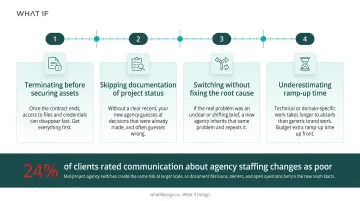
Handoff communication is a common weak point: a DBA report found 24% of clients rated communication about agency staffing changes as poor. Mid-project agency switches create the same risk at larger scale, so document decisions, owners, and open questions before the new team starts.
5. Alternatives to switching design agencies mid-project entirely
A full switch is a last resort. Try these before you pull the plug.
Renegotiate scope or request a personnel change. Worth it when the relationship is salvageable and the real issue is bandwidth, not competence. It will not fix deeper misalignment on strategy or quality.
Bring in a supplemental agency for one workstream. Useful when only part of the project is underperforming, such as brand versus product UX. You get specialized help, but coordination overhead rises and accountability can blur.
Pause the project until a natural break point. Makes sense when no hard external deadline is forcing immediate action. The cost is delayed time-to-market or fundraising milestones.
None of these work if the core problem is a fundamental capability mismatch. Then the switch is the faster path, even when it feels riskier upfront.
When the story is clear, the next conversation starts from confidence rather than explanation. Get a free strategic audit.
6. Frequently asked questions
6.1 Can AI replace designers?
No. AI speeds up prototyping and production, but it doesn't replace strategic judgment, technical context, or stakeholder navigation. NN/g's 2024 research finds current AI design tools aren't ready to replace UX professionals.
6.2 Will I lose my brand assets if I switch agencies mid-project?
It depends entirely on your original contract's IP terms. Confirm asset and IP ownership in writing before you initiate any switch, since assumptions about "who owns what" often don't match the actual clause.
6.3 Should I overlap my old and new agency during the transition?
Yes. A short overlap window lets both teams transfer files and context directly, which reduces the risk of losing decisions and reasoning that never made it into written documentation.
6.4 How do I tell my current agency I'm leaving mid-project?
Give notice that complies with your contract, keep the tone professional, and request a structured handoff rather than an abrupt cutoff. Cooperation tends to follow a calm, clear conversation.
6.5 What happens to work-in-progress files when switching design agencies?
Back up and inventory everything before you notify the outgoing agency. Access to shared drives and design tools can become difficult or impossible once the contract officially ends.
6.6 How long does it take a new agency to onboard mid-project?
It varies with project complexity, but agencies experienced in technical or domain-heavy work typically ramp up faster than generalist studios starting cold on unfamiliar material.
Ready to take the next step?
If you're weighing a design partner for climate, deep tech, or hard-to-explain products, Book a strategy call with our founders at What if Design, a no-pressure 25-minute conversation about what you're building and where design can help. You can also View our work to see how we've helped teams like yours, or Get a free strategic Audit of your current brand, website, or product experience.