This catches founders off guard more often than it should. Paying an invoice feels like it should mean you own everything created along the way. But copyright law doesn't work that way, and neither do most design contracts by default.
Clients assume payment equals full ownership. In reality, most agreements only transfer a license to use the final files. Source layers, drafts, and component libraries stay with the designer unless the contract says otherwise.
This guide breaks down the copyright basics, what you actually own versus what your designer keeps, how Figma's ownership feature really works, and how to negotiate full IP rights before you ever sign.
TL;DR: key takeaways
- Designers own source files by default; clients get a usage license, not copyright ownership.
- Fonts and stock assets keep separate licenses and rarely transfer without a new purchase.
- Figma's "Owner" role changes platform access, not legal copyright ownership.
- Only a written IP assignment clause guarantees you own everything, including source files.
- Climate and deep-tech founders need documented IP ownership for investor and grant diligence.
1. Design IP 101: copyright vs. ownership explained
Under U.S. copyright law, whoever creates an original work owns it the moment it's created. That's automatic, no registration required. Ownership only shifts to someone else through a signed, written agreement.
This matters because most people conflate "I paid for it" with "I own it." Those are two different legal questions.
1.1 Final deliverable vs. source file
A logo project typically hands over final exports like PNG and SVG files, ready to drop into a website or print run. What it usually doesn't include is the editable Figma file with every layer, every rejected direction, and every design iteration behind that final mark.
That distinction shows up constantly:
- Final deliverable: A flattened, ready-to-use export (PNG, PDF, SVG)
- Source/working file: The editable Figma, Sketch, or Illustrator file with layers, components, and version history
Most client agreements only cover the former.
1.2 Copyright vs. license to use
Owning copyright and holding a license are not the same thing. Most clients receive a license to use the final work for its intended commercial purpose, not a full copyright transfer. That license usually covers normal business use, but it is not ownership of the underlying creative work.
Third-party elements complicate this further. Many design files include commercial fonts or stock photography licensed to the designer under specific terms. Handing over the raw file could actually violate those licenses, since font and stock agreements are rarely transferable without a separate purchase.
2. What you own vs. what your designer owns
Here's where the line typically falls, assuming no explicit assignment clause exists in your contract.
2.1 What clients typically own
- Final deliverables in the agreed export formats
- Rights to use those deliverables for their intended commercial purpose
- Full ownership of anything the client originally supplied (existing logos, brand copy, product photography, and similar assets)
2.2 What designers typically retain
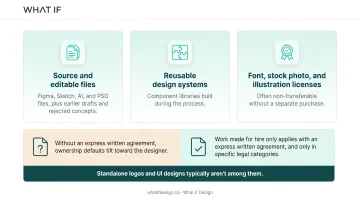
- Source and editable files (Figma, Sketch, AI, PSD), along with earlier drafts and rejected concepts
- Reusable design systems or component libraries built during the process
- Font, stock photo, and illustration licenses, which are often non-transferable without a separate purchase
You'll sometimes hear "work made for hire" thrown around as if it settles this automatically. It doesn't.
Even in jurisdictions that recognize the concept, a freelancer's work only qualifies as work made for hire with an express written agreement, and only if it falls into one of a handful of specific legal categories. Standalone logos and UI designs typically aren't among them.
Without that documentation, ownership defaults tilt toward the designer, not the client.
3. Why designers retain the working files
Agencies aren't withholding source files just to be difficult. There are three practical reasons this is the industry norm:
- Trade secret and process protection: Reusable design systems, component libraries, and grid structures take years to refine. Handing over raw files exposes that methodology to anyone who receives it, including future competitors you might hire.
- Licensing cost avoidance for the client: If you owned files with commercial fonts or stock assets, you'd need your own licenses for those elements. Keeping source files with the designer keeps that liability off your plate.
- Revision control and brand consistency: When an agency retains the working files, they can manage version history and keep the brand consistent across future updates, campaigns, or product launches, which is especially useful if you come back for round two.
💡 Working through this decision right now? If you're a climate-tech or deep-tech founder weighing this trade-off, Book a strategy call with our team, 25 minutes, no pitch, and we'll pressure-test your specific situation.
None of this locks you out forever. Access to raw files is a separate conversation from using the final deliverables you paid for.
See how we have approached this in practice: Mobile UX design.
Case study: Susteon
Susteon's carbon-capture-and-utilization work sits at the frontier of climate hardware, where the audience shifts from research partners to Fortune 500 procurement teams to strategic investors. We rebuilt their brand and website to communicate scientific depth without losing commercial legibility, a redesign that coincided with a 30% increase in career-page applicants. See the Susteon case study.
4. Figma ownership vs. legal IP ownership: what's the difference?
This is where a lot of founders get tripped up, because Figma has a feature literally called "Owner," and it sounds like it should settle the IP question. It doesn't.
Figma lets the file creator transfer the platform-level "Owner" role to another collaborator through the Share modal. Whoever holds that role can edit, manage, and share the file within Figma.
But Figma's own help documentation describes this as a permissions change, not a copyright transfer. Becoming the file's Owner changes who can manage it inside the app. That role says nothing about who legally owns the design content itself.
The difference looks like this:
| Figma "Owner" Role | Legal Copyright Ownership |
|---|---|
| Controls edit/share access within Figma | Determined by written contract terms |
| Can be transferred anytime via Share modal | Requires a signed assignment document |
| Doesn't require a legal agreement | Governed by copyright law (17 U.S. Code § 204) |
If you're negotiating with a design partner, ask for both:
- Platform-level file transfer so you can access and edit the files directly
- A written IP assignment clause in the contract for legal ownership
One without the other leaves a gap.
5. How to secure full IP ownership before you sign a contract
If clean ownership matters to you, and for most founders it should, the fix isn't complicated. It just has to happen before you sign, not after the project wraps.
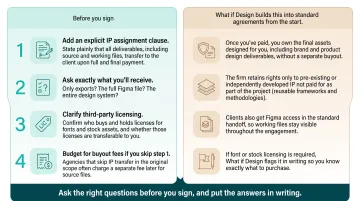
- Add an explicit IP assignment clause. State plainly that all deliverables, including source and working files, transfer to the client upon full and final payment. 2. Ask exactly what you'll receive. Only exports? The full Figma file? The entire design system?
Get the answer in writing before kickoff. 3. Clarify third-party licensing. Confirm who buys and holds licenses for fonts and stock assets, and whether those licenses are transferable to you. 4. Budget for buyout fees if you skip step 1. Agencies that skip IP transfer in the original scope often charge a separate fee later for source files, sometimes a substantial percentage of the project cost. Negotiate it upfront and you avoid that bill.
For climate tech and deep-tech founders, this isn't just tidiness. Investor due diligence and grant compliance processes often want documented, unambiguous IP ownership of your brand and product design assets before a check gets written.
What if Design builds this into standard agreements from the start. Once you've paid, you own the final assets designed for you, including brand and product design deliverables, without a separate buyout.
The firm retains rights only to pre-existing or independently developed IP not paid for as part of the project (reusable frameworks and methodologies). It licenses use of that combination to the client exclusively and on a perpetual basis.
Clients also get Figma access in the standard handoff, so working files stay visible throughout the engagement rather than locked away after delivery. If font or stock licensing is required, What if Design flags it in writing so you know exactly what to purchase.
You don't have to accept ambiguity here. Ask the right questions before you sign, and put the answers in writing.
When the story is clear, the next conversation starts from confidence rather than explanation. Get a free strategic audit.
6. Frequently asked questions
6.1 Can you transfer ownership of a Figma file?
Yes, Figma lets the file creator transfer the platform's "Owner" role through the Share modal. That only changes access and management rights inside Figma, not legal copyright, which still depends on your written contract with the designer.
6.2 Do I automatically own the copyright to a logo I paid for?
Not automatically. Clients typically receive a license to use the final logo files, not the underlying copyright or source files, unless the contract explicitly states otherwise.
6.3 What is a "buyout fee" for design files?
It's an additional fee agencies charge to hand over full source or working files and broader IP rights that weren't included in the original project scope.
6.4 Can I request the working files after my project has already ended?
Yes, you can ask anytime. If it wasn't in the original agreement, expect a buyout fee for the extra rights and files.
6.5 Does it matter if my agency used stock photos or licensed fonts in my brand assets?
Yes. These elements often carry separate usage licenses that don't automatically transfer with the design files, so you may need to buy your own license before using them freely.
6.6 What should I include in a contract to ensure I own all design IP?
Include an explicit IP assignment clause specifying exactly which files transfer, who's responsible for third-party licensing, and when the transfer takes effect, typically upon final payment.
Ready to take the next step?
If you're weighing a design partner for climate, deep tech, or hard-to-explain products, Book a strategy call with our founders at What if Design, a no-pressure 25-minute conversation about what you're building and where design can help. You can also View our work to see how we've helped teams like yours, or Get a free strategic Audit of your current brand, website, or product experience.