Where What if Design fits in We're a senior-led creative studio built specifically for climate tech, clean tech, and deep tech founders. Since 2020, we've partnered with teams like HYDGEN, Ribbit Network, and Susteon to turn hard-to-explain technology into brands, websites, and product experiences that raise capital and win adoption. This comparison reflects how we evaluate the trade-offs when a founder asks us which route to take.
If you're a climate tech or deep tech founder shopping for a design partner, you're at a disadvantage most people never talk about: you have no benchmark for what a good UX design proposal actually looks like. If you're a climate tech or deep tech founder shopping for a design partner, you're at a disadvantage most people never talk about: you have no benchmark for what a good UX design proposal actually looks like.
You can spot confident language. You can't always spot competence.
That gap gets expensive. Vague scope ("we'll improve your UX"), timelines with no real dates, and pricing wrapped in buzzwords are the most common reasons technical founders end up with a partner who doesn't understand their science or their product's complexity.
This guide breaks down every section a professional UX design proposal should include, what to expect from an agency at each stage, and the red flags worth catching before you sign anything.
TL;DR: key takeaways
- A solid UX proposal covers 6-9 sections: summary, scope, process, timeline, deliverables, team, and pricing
- Vague scope language is the single biggest predictor of budget and timeline overruns
- Realistic timelines use actual week numbers, not "a few weeks" placeholders
- Pricing in a table is clearer and easier to compare than pricing buried in paragraphs
- Client-specific proposals that couldn't be sent unchanged to another client signal real trust and preparation
1. What is a UX design proposal?
A UX design proposal is the document that bridges "we need to redesign this" and a signed contract with a start date. It outlines the problem, the proposed approach, the timeline, the deliverables, and the cost.
The confusion starts because "proposal," "design brief," and "scope of work" get used interchangeably. They aren't the same thing, and knowing the difference matters when you're evaluating what lands in your inbox.
| Document | What It Actually Does |
|---|---|
| Design brief | States the client's goals, users, and constraints, usually before any agency is involved |
| UX proposal | The agency's response: approach, scope, timeline, deliverables, and cost |
| Scope of work | The tasks and deliverables included, and what is explicitly excluded |
| Contract | The proposal plus terms and conditions; binding once both sides sign |
That proposal definition tracks IxDF's proposal content model: problem, approach, scope, timeline, deliverables, and cost in one place.
The proposal deserves extra scrutiny: it is the only one of these four documents that has to sell the work while staying technically accurate. A brief states the problem. A contract formalizes terms.
The proposal has to convince you and get the science right. That is where generic agencies start improvising when the product is genuinely hard to understand.
2. What should a UX design proposal include?
A professional proposal is built around 6-9 core sections. Each one reveals something about how the agency will actually run your project, not just how well they write.
2.1 Executive summary and problem statement
This section should reflect your specific pain points in plain language, not generic design-speak about "user-centric solutions." It should also translate those pain points into a measurable goal, whether that's a target conversion rate, a usability benchmark, or a reduction in support tickets.
For technical products, this is where an agency proves it understood your underlying science or system before proposing anything. Take an EV battery-health monitoring platform: a generic agency writes about "clean dashboards."
A proposal that actually understood the product would reference specific metrics, like state-of-health percentages or cycle counts, and frame the goal around helping users interpret that data quickly, not just look at it.
2.2 Scope of work
Scope should name exact pages, screens, flows, or systems included and excluded. Not "we'll improve your onboarding," but "we'll redesign the account setup flow across screens 1-6, excluding the payment integration."
Vague scope is the single biggest cause of budget and timeline overruns. If a proposal can't tell you what's in and what's out, assume the agency hasn't scoped the project at all. They've just estimated a number that sounds reasonable.
2.3 Process and methodology
Look for a clear phase breakdown:
- Discovery and research - interviews, competitive analysis, technical constraints
- Information architecture - user flows, navigation logic, content structure
- Wireframing - low-fidelity layouts focused on hierarchy and function
- Visual design - high-fidelity screens with brand and UI components
- Prototyping and testing - clickable prototypes validated with real users
- Handoff - developer documentation and final assets
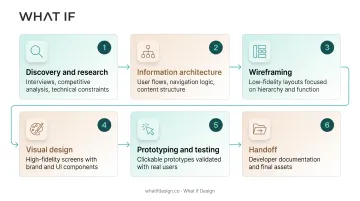
Each phase should connect to something you can actually see or approve. If a proposal describes "research" without naming a single output, that's a phase that exists on paper only.
2.4 Timeline and milestones
A trustworthy timeline uses real week numbers or dates, with built-in buffer for feedback rounds. "4-6 weeks" is useful. "As soon as possible" is not.
Discovery duration varies more than most founders expect. In an NN/g survey of 242 UX practitioners, 58% reported discovery phases lasting two weeks or less, though NN/g cautions that's too short unless users are easy to access and the problem space is small.
For climate tech and deep tech products, where the problem space usually isn't small, a two-week discovery is often a warning sign rather than efficiency.
2.5 Deliverables
This section should list exact file types and tools, not vague descriptions. Expect to see:
See how we have approached this in practice: Mobile UX design.
- Figma files (wireframes and high-fidelity screens)
- A clickable, interactive prototype
- Developer handoff documentation
- A design system or component library
- Source file ownership terms
If the proposal says "designs" without specifying format or tool, ask directly. Ambiguity here almost always turns into a dispute at delivery.
💡 Working through this decision right now? If you're a climate-tech or deep-tech founder weighing this trade-off, Book a strategy call with our team, 25 minutes, no pitch, and we'll pressure-test your specific situation.
2.6 Team and relevant experience
This section should show who is actually doing the work, plus a case study relevant to your specific problem, not a generic client logo wall.
For deeply technical categories, this matters more than it sounds. Susteon, a climate-tech incubator working across carbon capture, hydrogen production, and CO2 management, came to What if Design because its existing website couldn't explain its science to investors or partners.
Over a four-month engagement, the team rebuilt the brand identity and website, translating scientific complexity into messaging that a non-specialist audience could follow. Sudarshan Gupta, COO of Susteon Sudarshan Gupta noted the process helped the company rethink its corporate strategy and bring its messaging to the forefront.
That's the difference a technically fluent team makes: they save you from re-explaining your business at every single meeting.
2.7 Pricing, payment terms, and next steps
Pricing should be specific and easy to find, shown as fixed fee, hourly, or milestone-based, in a table or clearly labeled block rather than buried in a paragraph. This section should also spell out revision limits, IP ownership, and a clear next step for moving forward.
Watch for how IP is handled specifically. A fair structure typically grants the client ownership of final paid assets while the agency retains rights to pre-existing frameworks or components it developed independently. If a proposal is silent on IP entirely, that's worth a direct question before signing.
How we evaluated the options
Every recommendation here comes from actual client work, brand systems shipped, websites launched, and product experiences delivered under fundraising deadlines. We compared the options against five criteria that matter most for technical founders:
- Total cost of ownership across the first 12 months (not just the sticker price)
- Speed to a usable output given a typical Series A runway
- Quality of the technical translation, can they explain your science without oversimplifying it?
- Rework risk, how often teams re-hire because the first choice couldn't scale
- Ability to move with the roadmap without a re-onboarding tax every quarter
Where we cite numbers or trade-offs below, they come from projects we've delivered or watched founders navigate first-hand.
3. What should you expect from an agency's proposal process?
Turnaround time after a discovery call tells you something real. A same-day proposal for a complex, technical project is often templated rather than genuinely scoped.
A multi-week delay, on the other hand, can signal disorganization. Most credible agencies land somewhere between two days and a week.
How fast you get the document is only one signal. A realistic phased timeline inside the proposal is one of the strongest clues for how the engagement itself will run. If an agency can't estimate your project honestly at the proposal stage, they likely can't manage it honestly once it starts either.
Here's a general benchmark by project size, based on published agency models:
| Project Size | Estimated Timeline | Typical Scope |
|---|---|---|
| Small | 4-6 weeks | Landing pages, simple apps or MVPs |
| Medium | 8-12 weeks | Fully functional sites or basic web portals |
| Large | 12-20 weeks | Enterprise systems, SaaS with integrations |
These figures come from Ramotion's published UX timeline model. Treat them as a planning reference, not a universal rule. Scope and complexity shift the numbers considerably.
Beyond timing, ask about communication cadence before you sign:
- Who is your single point of contact once the project starts?
- How are feedback rounds structured, and how many are included?
- What's the update rhythm: weekly calls, async Slack updates, or something else?
Agencies vague on these questions tend to go quiet mid-project, usually right when you need them most.
4. Red flags and green flags to watch for
Use this checklist when you open a proposal. A single red flag is worth a follow-up question; several together usually mean the scope will slip.
4.1 Red flags
- Vague scope with no named pages, screens, or flows
- No phased timeline, just a single end date
- "Unlimited revisions" promised with no process or boundaries described
- Pricing buried inside paragraph text instead of clearly itemized
- No case study relevant to your specific product or technical category
4.2 Green flags
- Clearly stated inclusions and exclusions
- A phased timeline with real week numbers and checkpoints
- Pricing shown in a table or clearly labeled section
- At least one case study relevant to your industry or technical complexity
- A proposal specific enough that it couldn't be copy-pasted for a different client
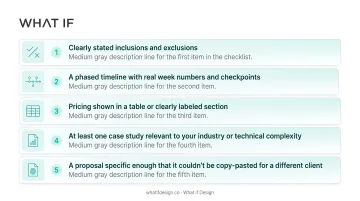
5. How we approach UX proposals for technical founders
Categories like carbon capture, green hydrogen, and grid interconnection are usually too complex for a generic UX brief to capture accurately. What if Design's proposals are built after genuinely learning the founder's science and market first, not after skimming a one-page brief and filling in a template.
That grounding shows up in the work. The team's involvement with HYDGEN, for instance, meant getting familiar with decentralized hydrogen systems using AEM and PEM electrolyzers before a single wireframe got drawn.
Founders working with What if Design get senior-level strategy and UX design without the overhead of hiring in-house, backed by a track record contributing to over $105M raised across climate tech and deep tech ventures.
Being remote-first, with a presence in San Francisco and Bangalore, lets the team scope proposals around agile startup timelines and budgets rather than rigid agency retainers. Product UX and prototype engagements typically run 4-8 weeks, built around insight sprints and iterative testing rather than a single big reveal at the end.
The same clarity in the proposal is what founders can expect throughout the engagement:
- Clear scope with defined deliverables
- Realistic timelines matched to startup pace
- Pricing without hidden surprises
Get this right and you get alignment: your team, your investors and your buyers all read the same story the same way. Get a free strategic audit.
Which option is right for your stage
The right answer depends less on the two options themselves and more on where you are as a company.
Pre-seed / seed (0–$3M raised): Speed and story matter more than polish. A focused boutique-agency sprint usually beats an in-house hire, because the founder still needs to control the narrative. We've seen this pattern with early climate-tech teams, a 4-to-6-week engagement to get brand, website, and pitch coherent is more valuable than a full-time designer.
Series A ($5–20M raised): This is where a senior-led agency partner pays for itself. You need a brand system that will survive three product pivots, a website that converts enterprise buyers, and pitch materials that hold up in board meetings. In-house is still premature unless you're planning to ship design-heavy product weekly.
Series B and beyond ($20M+ raised): Hire in-house design leadership and keep an agency partner for concentrated bursts (rebrands, launches, category shifts). The two aren't substitutes at this stage, they solve different problems.
Growth-stage climate tech specifically: The stakes shift once you're commercializing. Your brand needs to hold up to procurement diligence, regulatory scrutiny, and investor updates simultaneously. A specialist studio that already speaks the science, like our team, reduces the translation tax that generalists impose on every deliverable.
6. Frequently asked questions
6.1 What are the main sections a UX design proposal should include?
A solid proposal covers an executive summary, problem statement, scope of work, process and methodology, timeline, deliverables, team credibility, and pricing with terms. Each section should be specific to your product, not generic filler.
6.2 How long should a UX design proposal be?
Most effective proposals run one to three pages of substance. An unusually long, generic document is often a red flag for padding rather than a sign of thoroughness.
6.3 What's the difference between a UX proposal and a design brief?
A brief captures the client's needs and goals first, usually written before the agency is involved. The proposal is the agency's response, with a plan, timeline, and cost attached.
6.4 What's the best format for a UX design proposal?
A clean PDF or Word document is the safest, most consistent format. Some agencies use a short deck or Notion page instead for a more interactive walkthrough.
6.5 How long does it typically take an agency to send a proposal after a discovery call?
The typical range is two days to a week. A same-day proposal for a genuinely complex project is often templated rather than properly scoped to your product.
6.6 Should payment be upfront or milestone-based for a UX design project?
Most agencies structure payment around milestones, like kickoff, mid-project, and final delivery, rather than one lump sum. A request for full payment upfront is worth questioning closely.
Ready to take the next step?
If you're weighing a design partner for climate, deep tech, or hard-to-explain products, Book a strategy call with our founders at What if Design, a no-pressure 25-minute conversation about what you're building and where design can help. You can also View our work to see how we've helped teams like yours, or Get a free strategic Audit of your current brand, website, or product experience.