Three months later, every review cycle drags. Feedback loops stretch from days into weeks. Small design choices turn into email threads with six replies. The work isn't bad: it's just slow, tense, and exhausting to produce.
This happens more often than founders admit. Most vet agencies on price, turnaround time, and past work, rarely on whether the agency's decision-making style will mesh with their own. That gap is where partnerships quietly fail.
This guide breaks down what agency culture fit actually means, why it carries extra weight for climate tech and deep tech founders, and how to test for it before you sign anything.
TL;DR: key takeaways
- Culture fit means shared decision-making style, communication rhythm, and values, not personality or "vibe"
- A mismatch wrecks the process through slower feedback loops and mounting friction, even when deliverables still look fine
- Climate tech and deep tech founders need agencies willing to learn the science before they design
- Treat your discovery call as a live sample of the working relationship, not a sales pitch
1. What agency culture fit actually means
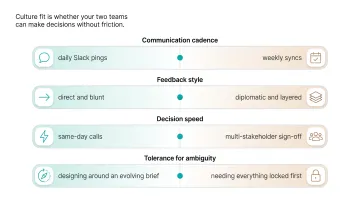
You can click with an agency's creative director over coffee and still struggle to ship work together. Culture fit is whether your two teams can make decisions without friction.
For an agency partnership, that means alignment on:
- Communication cadence: daily Slack pings vs. weekly syncs
- Feedback style: direct and blunt vs. diplomatic and layered
- Decision speed: same-day calls vs. multi-stakeholder sign-off
- Tolerance for ambiguity: comfort designing around an evolving brief vs. needing everything locked first
1.1 Vendor vs. creative partner
A vendor relationship is transactional: you hand over a brief, they hand back a deliverable. A creative partner co-creates with you, and that only works when both sides share similar working values.
AIGA's client guide to hiring a design firm puts it plainly: a design firm needs to know your business thoroughly to give valid advice, and that takes real time and commitment from both sides.
1.2 Fit vs. add
"Fit" means an agency that mirrors how you already work. "Add" means one that brings a lens or expertise your team doesn't have.
For early-stage or technical founders, add usually matters more than fit. You need an agency that pressure-tests your narrative before an investor does, not one that simply agrees with it.
1.3 The symptoms show up even when the work looks fine
A culture mismatch rarely shows up in the deliverables themselves. It shows up around them:
- Feedback loops that drag from days into weeks
- Unclear ownership over who makes the final call
- Rising tension over small, low-stakes choices
If review calls feel like negotiations instead of collaborations, that's a fit problem, not a talent problem.
2. Why culture fit matters even more for climate tech and deep tech founders
Climate tech and deep tech products rarely start as clean, sellable concepts. They start as dense engineering papers, chemistry breakdowns, or grid interconnection specs. An agency culture built for consumer brands often can't sit with that complexity long enough to design well around it.
The agency you choose needs genuine curiosity about your underlying science and market, enough to know what claims are defensible and which metrics actually matter to an investor or industrial buyer.
2.1 The stakes are higher, and the clock moves faster
Fundraising and partnership timelines in this space are unforgiving. Deep tech investors already struggle to evaluate the science itself. In a 2021 BCG and Hello Tomorrow survey of deep-tech entrepreneurs, 81% agreed that investors generally lack the scientific or engineering expertise to assess deep-tech potential.
Founders often struggle to explain what their technology means in business terms, over-indexing on features instead of applications.
That gap makes the agency's job harder, and more important. Agility, transparency, and fast trust-building matter more here than in a typical brand engagement, because there's rarely a second window to get the story right before a round closes.
2.2 Treating the work as meaningful, not "just another account"
Mission-driven founders need a partner that treats climate and deep tech work as consequential. That mindset shows up in small ways:
- How hard the agency pushes back on a brief
- How many questions it asks before pitching a solution
- Whether it treats your science as a box to check or a problem worth understanding
What if Design's four-month engagement with Susteon is a case in point. Susteon's core technology, Sustenol™, is a post-combustion CO₂-capture solvent claiming a roughly 44% cost reduction and capture rates above roughly 97% from industrial flue gas.
Translating that into a brand, website, and investor-ready story meant getting genuinely fluent in the chemistry before touching a single layout. Sudarshan Gupta, COO of Susteon, Sudarshan Gupta, described the process as "nimble, thoughtful and flexible," adding that it "forced us to reflect and rethink our corporate strategy."
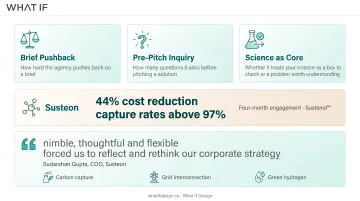
Founders in carbon capture, grid interconnection, and green hydrogen need that kind of embedded partnership: one that learns the science and market before designing. It functions like a senior in-house partner without the overhead of a full-time hire.
If your site hasn't kept pace with where the business actually is, we can show you what that's costing you. Get a free strategic audit.
3. How to evaluate agency culture fit before you sign
Treat your first discovery call like a culture-fit interview, except you're the one grading the agency.
3.1 Watch what they ask, not just what they pitch
Pay attention to whether the agency asks about your business goals, your science, and your market before jumping to aesthetics. An agency that leads with mood boards before understanding your capture rate or regulatory timeline isn't listening yet.
3.2 Ask about their decision-making process directly
Push past the pitch deck with direct questions:
- How do you handle internal disagreement on creative direction before it reaches me?
- How fast do you turn around feedback, and what does your typical revision cycle look like?
- Who owns the final call on creative direction, you or us?
3.3 Request a reference about collaboration, not just output
Ask a past client specifically about communication style, responsiveness, and how the agency handled conflict, not just whether the final deliverable looked good. A polished portfolio tells you nothing about what a Tuesday afternoon feedback call feels like.
3.4 Test their willingness to push back
Float a request that's slightly premature, maybe a rebrand before your pricing model is settled. An honest partner says "not yet" and explains why. A yes-agency agrees immediately, which should worry you more than it reassures you.
3.5 Check practical compatibility for distributed teams
If your team is remote or spread across time zones, confirm:
- Time zone overlap for live syncs
- Tools used: Slack, Zoom, Asana, Trello, or something else
- Async vs. sync preferences for day-to-day updates
Gallup's research on hybrid and remote teams found 48% of leaders cite communication and 44% cite collaboration as top hybrid-work challenges. Nearly half of hybrid workers say their teams never even discussed a collaboration plan. Don't let that be your agency relationship too.
3.6 Build a simple scorecard
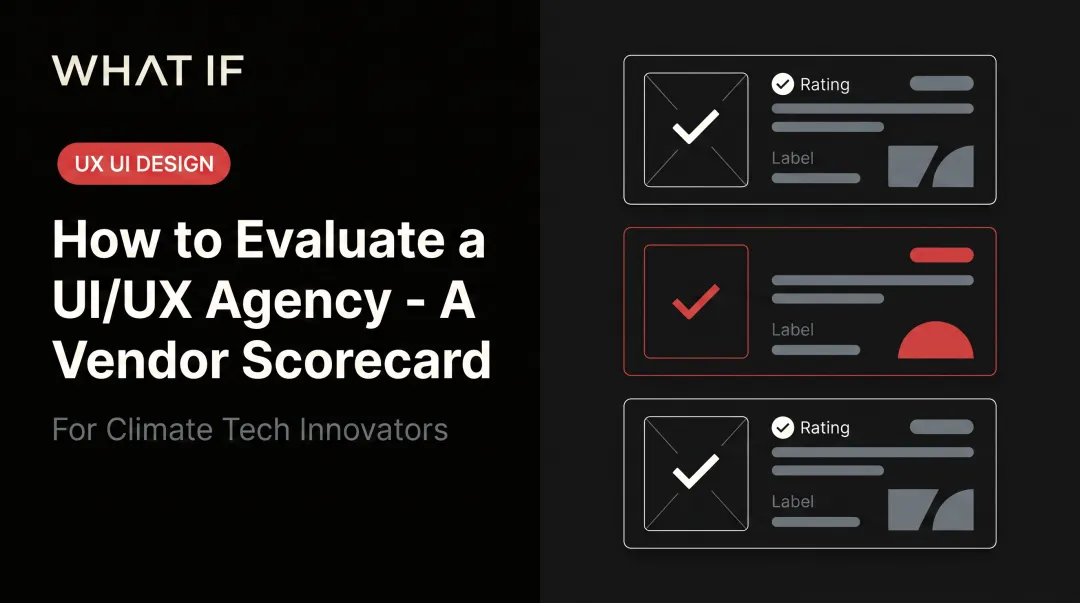
Score every agency you're considering on the same four criteria: communication style, decision speed, technical curiosity, and values alignment. It turns a gut feeling into a comparison you can actually defend to your co-founder.
4. Culture fit vs. skill fit: avoiding the bias trap
Over-indexing on culture fit has a hidden cost: it can push you toward agencies that simply resemble your own team's habits, while filtering out specialists who think differently but deliver stronger technical or strategic work.
Keep culture fit in the mix, and pair it with objective skill checks:
- Portfolio depth in your specific domain (carbon capture, batteries, grid tech)
- Technical case studies that show they've handled comparable complexity
- Outcome-based references, not just aesthetic ones
Used loosely, culture-fit screening can filter out niche expertise your team lacks. Structured skill criteria keep the process fair without discarding the cultural signals that still matter.
Founders who've built technical teams already know this: the best hire isn't always the one who feels most comfortable in a first meeting. The same logic applies to agency selection. Comfort and competence aren't the same axis.
5. Red flags and green lights in agency culture fit
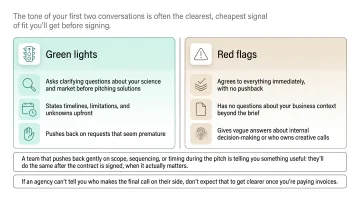
The tone of your first two conversations is often the clearest, cheapest signal of fit you'll get before signing.
Green lights:
- Asks clarifying questions about your science and market before pitching solutions
- States timelines, limitations, and unknowns upfront
- Pushes back on requests that seem premature
Red flags:
- Agrees to everything immediately, with no pushback
- Has no questions about your business context beyond the brief
- Gives vague answers about internal decision-making or who owns creative calls
A team that pushes back gently on scope, sequencing, or timing during the pitch is telling you something useful: they'll do the same after the contract is signed, when it actually matters.
If an agency can't tell you who makes the final call on their side, don't expect that to get clearer once you're paying invoices.
When the story is clear, the next conversation starts from confidence rather than explanation. Get a free strategic audit.
6. Frequently asked questions
6.1 Is hiring for cultural fit bias?
It can be, especially when fit criteria are loose or undefined. Evaluators tend to favor partners who feel familiar, which can filter out specialists who think differently. Pairing culture fit with objective, skills-based evaluation reduces that risk.
6.2 What does a culture fit interview mean?
A culture fit interview assesses shared values, communication style, and working preferences between two parties. An agency discovery call serves a similar function, revealing how a team thinks before you commit.
6.3 What is the difference between culture fit and culture add?
Fit means an agency mirrors your existing ways of working. Add means it brings a new perspective or specialized expertise you don't already have. For technical founders, add usually matters more, since it pressure-tests your narrative rather than echoing it.
6.4 How do I know if a design agency is the right culture fit for my company?
Watch for responsiveness, willingness to ask hard questions about your business, and transparency during early conversations. Agencies that push back thoughtfully in the pitch process tend to keep doing so after you sign.
6.5 What questions should I ask an agency to test culture fit?
Ask how they handle internal disagreement, how fast they turn around feedback, and who owns final creative decisions. Also ask past clients about collaboration style, not just output quality.
6.6 Can culture fit and diversity of expertise coexist when choosing an agency?
Yes, if you weigh values alignment alongside distinct technical or strategic strengths. Prioritize an agency that complements your team's gaps over one that simply feels familiar.
Related reading: 10 Best SaaS UX Design Agencies For Product Growth In 2026 and Discover the top UI/UX design agencies in Bangalore.
Ready to take the next step?
If you're weighing a design partner for climate, deep tech, or hard-to-explain products, Book a strategy call with our founders at What if Design, a no-pressure 25-minute conversation about what you're building and where design can help. You can also View our work to see how we've helped teams like yours, or Get a free strategic Audit of your current brand, website, or product experience.