Founders usually assume someone is overcharging or lowballing. Neither answer is quite right. The real explanation is the pricing model behind the number, not just the hours logged. Hourly billing, fixed-fee, retainer, and value-based pricing each answer a different question about risk, scope, and what an outcome is worth.
Domain complexity matters just as much. A fintech dashboard or a carbon-capture monitoring tool requires research before a single wireframe gets drawn, and that upfront learning curve shows up in the invoice.
This article breaks down the four pricing models agencies actually use, what pushes each one up or down, realistic cost ranges by project type, and how to pick the model that fits your budget and stage.
TL;DR: key takeaways
- Agencies typically use four models: hourly, fixed-fee, retainer, and value-based pricing
- Match the model to scope: fixed-fee for locked projects, retainers or hourly for ongoing work, value-based for high-stakes strategy
- Team seniority and domain complexity drive price gaps more than raw hours logged
- User research and testing drove a 415% three-year ROI in Forrester’s 2025 TEI study for UserTesting
- The cheapest quote often costs more once rework and skipped research surface post-launch
1. How agencies price UX work: the core pricing models
Most agencies don't have one flat "UX rate." They choose a billing model based on how well-defined the scope is, how long the engagement runs, and what kind of relationship the client wants.
1.1 Hourly billing
The agency logs actual hours worked and bills them at an agreed rate, with expenses tracked separately, according to AIGA's pricing framework for design firms. It's the go-to model when scope is genuinely unclear: early-stage exploration, discovery sprints, or a client still figuring out what they need.
The trade-off is straightforward:
- Pro: Flexible, transparent, pay only for work done
- Con: Total cost is unpredictable until the project ends
- Con: Client must track hours actively; billings may not map to business value delivered
1.2 Fixed-fee / project-based pricing
Here, the agency quotes one number for a clearly defined set of deliverables after a scoping or discovery call. AIGA notes that the proposal should spell out inclusions and exclusions upfront, with any new requests handled through a separate change order rather than folded into the original fee.
This model suits MVPs, redesigns, and audits with locked requirements. The risk sits with the agency if their estimate runs short, and with the client if requirements shift mid-project without a formal change process. That is usually where scope-creep disputes start.
1.3 Retainer / ongoing engagement pricing
A recurring monthly fee replaces one-off invoicing. This fits products with active roadmaps that need continuous design support rather than a single deliverable dropped and forgotten.
Boutique, senior-led studios often structure long-term partnerships this way. What if Design, for instance, runs subscription-style retainers such as its Design Supercharger tier, which pairs a prioritized, flexible design backlog with weekly check-ins from a senior lead.
For a climate tech company whose product evolves with new research, funding milestones, or regulatory shifts, that ongoing senior support removes the overhead of an in-house design hire while keeping design bandwidth available every month.
1.4 Value-based / outcome-based pricing
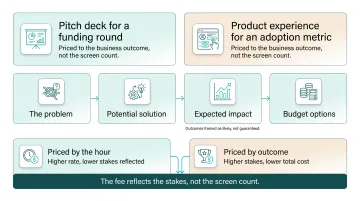
Instead of billing hours or counting screens, agencies tie price to the business outcome the design is meant to unlock: a pitch deck built to support a funding round, or a product experience meant to move an adoption metric.
Toptal's breakdown of value-based design describes proposals structured around the problem, potential solution, expected impact, and budget options, with outcomes framed as likely, not guaranteed.
This model is common among senior strategists who treat every design decision as a business decision, particularly for founders in technical or hard-to-explain categories where writing the creative brief is half the challenge. It can look expensive per hour and still be cheaper per outcome, since the fee reflects stakes, not screen count.
2. Key factors that influence how agencies set their UX pricing
Within any billing model, several variables push the final number up or down.
2.1 Project complexity and number of screens/flows
More user roles, dashboards, and system integrations mean more research questions and design decisions to work through. A five-screen marketing site and a forty-screen multi-role SaaS platform will never land on the same quote, regardless of which billing model is used.
2.2 Domain complexity and compliance needs
Technical or regulated domains (fintech, healthcare, deep tech, climate tech) require agencies to learn the underlying science, market, or compliance rules before design work can even begin. Agencies price that learning curve into the fee.
That's why specialized studios that already understand a founder's technology charge differently than generalist designers starting from zero. A generalist may need weeks just to understand what a carbon-capture dashboard is measuring; a studio already fluent in climate tech skips that ramp-up entirely.
💡 Working through this decision right now? If you're a climate-tech or deep-tech founder weighing this trade-off, Book a strategy call with our team, 25 minutes, no pitch, and we'll pressure-test your specific situation.
2.3 Team seniority and structure
Junior designer rates can run 3-5x lower than senior strategist rates. A full team (researcher, UX designer, UI designer, project manager) costs meaningfully more than a solo freelancer handling every role alone. Neither is automatically "better"; it depends on what the project actually needs.
2.4 Scope of deliverables included
Whether a quote includes UX research, prototyping, usability testing, design systems, and developer handoff materially changes the price. Quotes that cover research, testing, and a full design system run higher than screens-only work, but the fuller scope typically saves money by cutting rework later.
2.5 Timeline and urgency
Compressed deadlines add rush premiums since they force more people onto a shorter window. Longer, retainer-based engagements tend to lower the effective hourly rate, since the agency isn't re-quoting and re-onboarding for every new task.
See how we have approached this in practice: Mobile UX design.
Case study: Susteon
Susteon's carbon-capture-and-utilization work sits at the frontier of climate hardware, where the audience shifts from research partners to Fortune 500 procurement teams to strategic investors. We rebuilt their brand and website to communicate scientific depth without losing commercial legibility, a redesign that coincided with a 30% increase in career-page applicants. See the Susteon case study.
3. Typical UX design cost ranges by project type
The ranges below are illustrative benchmarks, not guarantees. Rates shift by region, agency size, and year, so use them to open budgeting conversations, not as a fixed price list.
| Project Type | Typical Range | Notes |
|---|---|---|
| Standalone UX audit | $7,000, $12,000 | Comprehensive audit at established agency rates (DesignRush, 2024) |
| Landing page / simple website UX | Below full-engagement pricing | Usually limited research, testing, and iteration |
| Early-stage MVP / startup product | Wide band by scope | Moves with research depth and number of flows |
| Mid-complexity SaaS / e-commerce | Mid-to-upper market | Scale, service scope, and web-design bundling raise cost |
| Enterprise / regulated / technical products | Top of market | Domain expertise and heavier research before design starts |
For broader context, Clutch's aggregate agency data shows reviewed UX/UI projects averaging $84,973, with most listed agencies billing $25, $49 per hour and typical timelines around 10 months.
Enterprise and regulated products sit above those averages because they need more research hours and domain expertise before design work starts, not a separate flat compliance fee.
4. Freelancer vs boutique agency vs large agency: what changes at each price point
Provider type shapes price almost as much as the billing model does.
At each tier, you typically get:
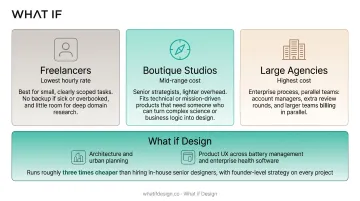
- Freelancers: lowest hourly rate; best for small, clearly scoped tasks
- Boutique studios: mid-range cost; senior strategists, lighter overhead
- Large agencies: highest cost; enterprise process, parallel teams
Freelancers offer the lowest hourly cost and work well for small, clearly defined tasks. Limits show up when work gets complicated: no backup if they get sick or overbooked, and little room for deep domain research on top of execution.
Boutique and specialized studios sit in the mid-range, built around senior strategists rather than large teams. That setup fits technical or mission-driven products that need someone who can turn complex science or business logic into design, not just push pixels.
What if Design works this way for climate tech and deep-tech founders. Two senior co-founders stay on the work, one from architecture and urban planning, the other from product UX across battery management and enterprise health software, so you get senior judgment without an in-house hire. The model runs roughly three times cheaper than hiring in-house senior designers, with founder-level strategy on every project.
Large full-service agencies cost the most because of department overhead and process layers: account managers, extra review rounds, and larger teams billing in parallel. They fit big enterprise rollouts with long timelines and big budgets, but are often slower and pricier than early-stage or niche technical products need.
5. How to choose the right pricing model (and avoid common budgeting mistakes)
5.1 Matching the model to your project
Match the model to how certain your scope is:
- Fixed-fee for defined MVPs, redesigns, or audits with a locked requirement list
- Retainer for ongoing product work with an evolving roadmap
- Hourly for small, undefined tasks or early exploration
- Value-based for high-stakes strategic work, like fundraising materials tied to a raise
Two habits protect your budget regardless of model:
- Request an itemized proposal that separates research, design, revisions, and handoff, so nothing hides inside a lump sum
- Reserve a 15-roughly 20% contingency for revisions or scope changes instead of treating the first quote as final
5.2 Common mistakes founders make
- Comparing quotes on hourly rate alone, instead of total value or business outcome delivered
- Skipping the research phase to save money upfront, which usually leads to expensive rework once the product ships. Forrester found that avoided rework alone can be worth millions in present value for a composite enterprise
- Hiring the cheapest generalist for a technical or regulated product, then paying more later for a redesign once domain gaps surface in real usage
Clarity here is what turns a defensive conversation into a confident one. Get a free strategic audit.
6. Frequently asked questions
6.1 How much does UX design cost?
Costs range from a few thousand dollars for a small audit or landing page to well over $100,000 for enterprise or highly technical platforms. Scope, team seniority, and domain complexity drive the difference.
6.2 What's the difference between hourly and fixed-fee pricing for UX work?
Hourly pricing suits unclear or evolving scope, since you pay only for time logged. Fixed-fee suits well-defined deliverables with a locked requirement list agreed before work starts.
6.3 Do UX agencies charge more for technical or regulated industries?
Yes. Domains like fintech, healthcare, and climate tech require extra research and compliance understanding before design begins, and agencies build that learning curve into their fee.
6.4 Is a retainer or project-based model better for ongoing product design?
Retainers suit products with continuous roadmaps needing steady design bandwidth month to month. Project-based pricing fits one-off, time-bound deliverables with a clear end date.
6.5 Why do some agencies charge much more than others for seemingly similar UX work?
Differences usually come from team seniority, included deliverables like research and testing, and domain expertise, not the visible screens alone. Two quotes can cover very different amounts of underlying work.
6.6 Should I choose the cheapest UX design quote?
Rarely. The lowest quote often excludes research or revisions, which leads to costly rework later. Total value and fit for your product's complexity matter more than the sticker price.
Ready to take the next step?
If you're weighing a design partner for climate, deep tech, or hard-to-explain products, Book a strategy call with our founders at What if Design, a no-pressure 25-minute conversation about what you're building and where design can help. You can also View our work to see how we've helped teams like yours, or Get a free strategic Audit of your current brand, website, or product experience.