For a climate tech founder juggling a technical product and investor reporting, that difference isn't cosmetic. Unclear pricing leads to budget overruns, scope creep, and eroded trust at exactly the moment you need to move fast.
This guide breaks down how to spot vague pricing red flags and transparent pricing green flags before you sign anything. By the end, you'll have a checklist you can run through in under 10 minutes.
TL;DR: key takeaways
- Vague pricing hides behind "it depends" or "custom quote"; transparent pricing lists deliverables, timelines, and costs upfront.
- Pricing opacity ranks as agencies' top client complaint in a 2026 Forrester study for Dentsu Creative.
- Open scope can justify an open number, but only with a clear process to lock the final price.
- Use the checklist below to compare two proposals side by side in minutes, not days.
1. Vague vs transparent design pricing: quick comparison
Before the definitions, here's how the two approaches stack up across the four areas that matter most to a founder tracking burn rate.
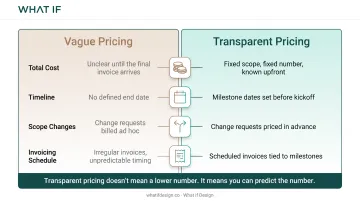
| Category | Vague Pricing | Transparent Pricing |
|---|---|---|
| Cost Structure | Broad ranges, "starting at" figures, or "contact us" with no explanation | Itemized costs tied to deliverables, or a clear duration-and-rate model |
| Scope & Change Handling | No defined process; surprise invoices appear mid-project | Documented change-order process or built-in flexibility explained upfront |
| Communication of Costs | Pricing discussed only verbally, often after several sales calls | Pricing logic shared in the first conversation or published on the site |
| Deliverable & Timeline Clarity | "A few rounds of revisions" or "ongoing support" with no caps | Specific revision counts, milestones, and delivery dates per payment stage |
Notice the pattern: transparent pricing doesn't necessarily mean a lower number. It means you can predict the number. That distinction matters more than most founders realize until they're three months into a project with no clear end date.
2. What is vague design pricing?
Vague pricing withholds the detail you need to predict total cost, scope, or timeline before you commit. It's not always malicious. "Every project is different" can be a fair statement during an initial call, when neither party has scoped the work yet.
The problem starts when that phrase persists all the way through the proposal stage, with nothing more specific ever attached to it.
Watch for these red flags:
- No written proposal, only verbal estimates
- Pricing that shifts after multiple sales calls
- Refusal to explain what's included in a cost line
- No stated number of revision rounds
- "Value-based pricing" language with zero visible logic behind it
For climate tech and deep-tech founders, this compounds an existing problem. Technical products already make for hard-to-write briefs; carbon capture, grid interconnection, and battery chemistry don't translate into a design scope easily.
Vague pricing on top of an already-fuzzy brief means double the uncertainty, right when you're trying to report clean spend to your board.
2.1 Where founders typically encounter vague pricing
Two patterns show up repeatedly:
- Freelance marketplaces and generalist agencies quote low to win the deal, then add line items once execution starts.
- Agencies unfamiliar with technical products pad their estimates to cover their own uncertainty about your brief, rather than asking better discovery questions.
This isn't just a founder complaint. On the agency side, a 2025 Ignition survey of 273 US agency owners found that 57% lose $1,000 to $5,000 a month on unbilled, out-of-scope work, and only roughly 1% manage to bill all of it.
Vague scoping hurts both sides of the table; it just tends to hurt the client's runway first.
3. What is transparent design pricing?
Transparent pricing means you understand the cost basis, whether that's a rate, a duration, or a deliverable list, before you sign. The exact final number can still flex with scope. What can't flex is your ability to see what's driving the price.
💡 Working through this decision right now? If you're a climate-tech or deep-tech founder weighing this trade-off, Book a strategy call with our team, 25 minutes, no pitch, and we'll pressure-test your specific situation.
See how we have approached this in practice: Mobile UX design.
The real benefit is how it changes the conversation. Instead of defending a number, you and the agency talk about value, timelines, and outcomes. For a founder mapping design spend against runway, that's the difference between a predictable line item and a moving target.
Common transparent pricing models include:
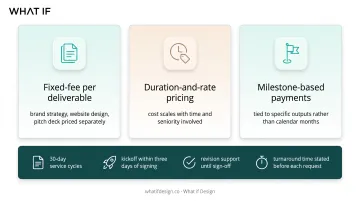
- Fixed-fee per deliverable (brand strategy, website design, pitch deck, priced separately)
- Duration-and-rate pricing, where cost scales with time and seniority involved
- Milestone-based payments tied to specific outputs rather than calendar months
Transparent doesn't mean cheapest. It means you can see exactly what's driving the cost, whether that's senior strategist time, technical research, or a longer revision cycle.
What if Design, for example, publishes its subscription tiers directly. Clients get defined 30-day service cycles, a kickoff within three days of signing, and revision support until sign-off, with turnaround time stated before each request. You know the monthly rate and working cadence before you commit a dollar.
3.1 Where transparent pricing shows up in practice
Look for these signals when evaluating a design partner:
- Published packages or rate cards. Service pages that list scope and timeline together, such as a brand identity package scoped at 4-6 weeks or a website build at 4-12 weeks, give you a benchmark before the first call.
- Separated cost lines. Proposals that split strategy, design, and production let you phase spending around a funding round instead of treating design as one lump expense.
- Clear working cadence. Defined cycles, kickoff timelines, and revision rules up front so you know how the engagement runs before money moves.
There's no single named study proving that transparent pricing alone shortens sales cycles. But the adoption data points in a clear direction.
A 2026 Forrester study for Dentsu Creative found 25% of agencies had already moved to fixed-fee pricing exclusively, and 63% of those using it reported being satisfied or extremely satisfied with the switch. Agencies aren't adopting clarity out of goodwill. It's working for them, too.
Case study: HYDGEN
HYDGEN needed a brand and website that could carry the weight of green-hydrogen infrastructure, technical enough for engineers, clear enough for policy-makers, credible enough for institutional investors. We built the brand system and website in a compressed sprint aligned to their fundraising milestone. See the full HYDGEN case study.
4. How to spot the difference: A practical checklist before you sign
Run any proposal through these six checks before signing.
Ask for a written breakdown. If the agency can't explain a cost line in one sentence, treat that as a red flag. 2. Request the revision count. Find out how many rounds are included and what happens, cost-wise, if you need more. 3. Clarify scope-change handling. Is there a documented change-order process, or just "we'll figure it out later"?
Check payment structure. Are payments tied to milestones and deliverables, or to an open-ended monthly retainer with no defined output? 5. Probe their discovery process. Transparent partners explain how they research domains like carbon capture or hydrogen, not pad the estimate to cover their own learning curve. 6. Compare two proposals side by side. Use this checklist on both and see which one gives you more predictive control over your budget.
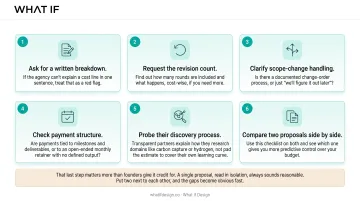
That last step matters more than founders give it credit for. A single proposal, read in isolation, always sounds reasonable. Put two next to each other, and the gaps become obvious fast.
5. Conclusion
Choose the clearest quote over the cheapest one. Every line item should have a stated reason, and every assumption should be written down instead of left implied.
For a climate tech founder, that clarity protects runway, cuts down on mid-project disputes, and frees up time you'd otherwise spend chasing invoices or re-explaining scope. Time that belongs on your product story, your investor updates, and the science you're trying to bring to market.
A site that reflects the company you have actually become is the cheapest credibility you can buy, and it puts you back in control of the first impression. Get a free strategic audit.
6. Frequently asked questions
6.1 What is transparent design pricing?
Transparent design pricing lets you see what drives the cost, whether that's deliverables, timeline, or rate, before you commit. The exact figure can still flex with scope, but the logic behind it never stays hidden.
6.2 What are some examples of transparent design pricing?
Common examples include duration-and-rate models, itemized fixed-fee packages billed per deliverable, and milestone-based payments tied to specific outputs like a completed brand system or live website.
6.3 What are common signs that a design agency's pricing is vague?
Red flags include a missing written proposal, pricing that shifts after several sales calls, and refusal to explain what a cost line includes. Undefined revision counts are another common warning sign.
6.4 Why do some design agencies avoid publishing their pricing?
Sometimes the brief genuinely isn't defined yet, so a public price would be misleading. Other times agencies keep rates private so price-sensitive leads don't filter themselves out before a sales call.
6.5 How can I make sure a design proposal has no hidden costs?
Request a written scope document, a defined revision limit, and a documented change-order process. If any of these are missing, ask for them directly before signing anything.
6.6 Is a lower price always a sign of vague or risky pricing?
No. Price level alone isn't the issue. A low quote with a clear cost breakdown can be perfectly transparent, while a high quote with no explanation is still vague.
Ready to take the next step?
If you're weighing a design partner for climate, deep tech, or hard-to-explain products, Book a strategy call with our founders at What if Design, a no-pressure 25-minute conversation about what you're building and where design can help. You can also View our work to see how we've helped teams like yours, or Get a free strategic Audit of your current brand, website, or product experience.