The trouble starts later. Forbes Advisor puts DIY builds at $0 to $450 upfront, plus $15 to $150 a month in hosting and apps, plus another $20 to $100 a year in maintenance, and that's before anyone adds ecommerce functionality or pays for a redesign. None of that shows up on the pricing page.
This article breaks down what DIY builders actually cost once time, add-ons, and future rework enter the picture, and when it's worth paying more upfront for a professional build instead.
TL;DR: key takeaways
- DIY builders advertise $10-$18/month, but apps, templates, and upgrades push real first-year spend well beyond that
- Founder and team time, not the subscription fee, is usually the biggest hidden cost
- Generic templates can undercut credibility with investors and enterprise clients
- Migrating off a DIY platform later typically costs more than building professionally from the start
- Early validation can justify a builder; professional design pays off once growth and credibility are on the line
1. How much do DIY website builders actually cost?
Every builder quotes a "starting from" price. Almost nobody pays just that.
1.1 What goes wrong when you anchor to the sticker price
Founders run into the same three problems, in roughly this order:
- Underestimating add-on costs: forms, SEO tools, and chat widgets are rarely bundled into the base plan
- Assuming free templates work "as-is": most need real design hours before they look credible
- Skipping the redesign budget: growing businesses tend to outgrow their starter plan within a year or two
1.2 Advertised vs. real cost range
| Builder | Advertised starting price | What it typically excludes |
|---|---|---|
| Wix | $17.77/month | Premium templates, most apps, ecommerce tools |
| GoDaddy | $9.99/month | Advanced SEO, marketing add-ons |
| Weebly | $10/month | Custom domain email, site statistics |
| Squarespace | $16/month | Third-party integrations, advanced commerce |
Prices reflect current annual-billing terms published by each provider.
Layer on the extras and the math changes fast. Once you add templates, apps, and ecommerce features, real first-year spend climbs well past the base subscription, and that's before anyone pays to fix design mistakes down the line.

If a redesign becomes necessary, the bill jumps again. Clutch reports web-design projects typically run $2,000 to $100,000, with most small-business rebuilds landing under $10,000. A $10/month plan that ends up needing a few thousand dollars of professional cleanup isn't the bargain it looked like on the pricing page.
What's included in a base plan: generic hosting, a shared template, limited storage, is rarely enough once a business is chasing funding or enterprise clients.
2. The hidden costs of DIY website builders
The subscription fee only buys software access. The real costs show up later, in hours lost, opportunities missed, and rework nobody budgeted for.
2.1 The time cost of "doing it yourself"
Even Wix's own team estimates a solo build takes 4 weeks to 3 months using their editor. For a funded startup, that's a month of founder hours not spent on fundraising, product development, or customer calls.
That time usually goes toward:
- Picking (and re-picking) a template that fits the brand
- Fighting drag-and-drop layouts to look intentional rather than default
- Troubleshooting when the mobile version breaks
At What if Design, most requests get turned around in 2-4 business days, with a kickoff within three days and a 30-day roadmap. That pace exists to give founders their hours back instead of losing them to a template editor.
2.2 Apps, plugins & add-on costs
"Essential" features rarely come free. A quick look at Shopify's own app store shows how fast this stacks up:
- Advanced forms: around $9.90/month
- SEO tools: $14.99 to $49.99/month depending on tier
- Live chat: roughly $25/month
- Analytics and heatmaps: about $19/month
Add three or four of these "must-haves" together, and the app bill can double the base subscription without anyone noticing until the invoice arrives.
2.3 Template limitations & the cost of looking generic
Free and startup-scale templates get reused across thousands of sites. That reuse is the business model. Visitors may not name the template, but they feel the sameness: stock hero, familiar spacing, interchangeable icons.
💡 Working through this decision right now? If you're a climate-tech or deep-tech founder weighing this trade-off, Book a strategy call with our team, 25 minutes, no pitch, and we'll pressure-test your specific situation.
When a company later needs to stand out in a crowded category, the redesign almost always costs more than a custom build would have in the first place.
See how we have approached this in practice: Why UX failures cost climate and deep-tech startups credibility.
2.4 SEO & performance constraints
Builder SEO isn't uniformly bad. A November 2025 HTTP Archive dataset found 74.86% of Wix sites and 70.39% of Squarespace sites passed Core Web Vitals. Ahrefs even calls Wix "perfectly capable" for SEO.
But limited access to underlying code can still cap technical fixes: sitemap control, multilingual URLs, and structural tweaks are harder to reach. For a business relying on organic search to grow, that ceiling often means leaning on paid ads to make up the difference.
2.5 Platform lock-in & migration costs
Wix doesn't support exporting a site to run elsewhere. Squarespace doesn't support transferring content between its own sites. Rebuilding page structures, preserving SEO equity, and re-entering years of content from scratch is a common, costly surprise once a business outgrows its platform.
2.6 Credibility cost for funding & partnerships
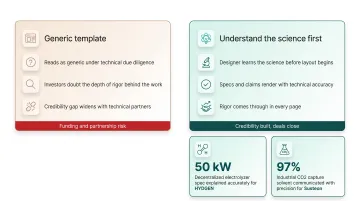
For climate tech, deep tech, and B2B startups, a generic template can raise doubts during technical due diligence. Investors and enterprise partners evaluating hard science often read website quality as a proxy for rigor.
Deep-tech and climate clients like HYDGEN (decentralized hydrogen) and Susteon (carbon capture) ran into that gap. Explaining a 50 kW electrolyzer spec or a solvent that captures over roughly 97% of industrial CO2 only works when the designer understands the technology before the layout begins.
3. DIY vs professional web design, which costs more long-term?
Comparing sticker price to total cost of ownership tells a very different story than comparing monthly fees.
| Factor | DIY Builder | Professional Design |
|---|---|---|
| Upfront cost | Low ($10, $50/month) | Higher, scoped to project |
| Time to launch | Slower, founder-led | Faster, senior-level expertise |
| Redesign frequency | Frequent, as the template gets outgrown | Built for growth from day one |
| Investor/partner credibility | Generic look can raise doubts | Reflects technical depth |
Time to launch and founder involvement is where the gap shows up fastest. Hiring one full-time senior designer can run upwards of $100,000 a year before benefits. What if Design's remote model costs about one-third of that, with a weekly Design Lead check-in for strategic support and no internal team to build.
Scalability matters just as much. When What if Design rebuilt brand and site for LabStart, a climate-tech venture studio, the four-month engagement covered strategy, logo, guidebook, video, website, and collateral. The work was built for an expanding venture-studio mission, not only the immediate ask.
LabStart's COO said the team "expanded upon our vision with ease," turning a "static, version 101 website" into a full brand identity.
Credibility with investors is the other long-term cost most founders underestimate. Susteon's site presents seven capture technologies, including a solvent that cuts costs roughly 44% while capturing over roughly 97% of flue-gas CO2. That level of technical detail needs a designer who learned the science, not someone dropping copy into a generic layout.
Factor in redesign costs, lost founder time, and missed opportunities, and DIY and professional design costs often converge. Once a company is scaling, professional design usually wins on long-term value.
4. When DIY makes sense (and when it doesn't)
DIY builders remain a smart, low-risk choice for:
- Pure idea validation before there's a product to sell
- Personal or side projects without commercial stakes
- Pre-seed testing, before brand identity carries much weight
That window closes once real money, partners, or technical credibility are on the line.
Signs it's time to move on:
- Raising a funding round where a site gets scrutinized during diligence
- Onboarding enterprise or government clients who expect polish
- Needing to explain genuinely technical or scientific work credibly
The most common budgeting mistake is comparing sticker prices instead of total cost of ownership. Factor in founder time, an eventual redesign, and credibility with investors or buyers, and the math changes fast.
5. Conclusion
DIY website builders aren't actually free. The real cost shows up in hours spent, unplanned redesigns, SEO ceilings, and credibility gaps with investors, customers, and partners.
The right choice depends on stage. Validate cheaply early. Invest in professional design once credibility and growth are genuinely on the line, not before, and not much later either.
Get this right and you get alignment: your team, your investors and your buyers all read the same story the same way. Get a free strategic audit.
6. Frequently asked questions
6.1 Are website builders really free?
Free plans exist, but they come with platform branding, limited storage, and no custom domain. For anything beyond a hobby project, they're rarely practical.
6.2 What's the biggest hidden cost of using a DIY website builder?
Founder and team time, plus the eventual redesign, typically outweigh the monthly subscription itself. The subscription is the cheapest part of the equation.
6.3 Do DIY website builders hurt SEO?
Not uniformly. Platforms like Wix pass Core Web Vitals on most sites tested. But limited code access and rigid structures can still cap organic growth compared to a custom build.
6.4 Is it cheaper to build a website myself or hire a professional designer?
DIY is cheaper upfront. Professional design often reduces total cost of ownership once you factor in credibility, scalability, and future rework.
6.5 When should a startup move from a DIY website to a custom-designed one?
Common triggers include raising a funding round, onboarding enterprise or government clients, or needing to communicate complex technical work credibly to outside stakeholders.
6.6 How much time does it really take to build a DIY website?
Estimates from builder platforms themselves range from 4 weeks to 3 months for a solo build. That's founder time diverted from fundraising, product, and customers, an often-overlooked cost.
Ready to take the next step?
If you're weighing a design partner for climate, deep tech, or hard-to-explain products, Book a strategy call with our founders at What if Design, a no-pressure 25-minute conversation about what you're building and where design can help. You can also View our work to see how we've helped teams like yours, or Get a free strategic Audit of your current brand, website, or product experience.