Cost varies based on scope, customization, industry complexity, and the type of agency you hire, whether that's a solo freelancer, a boutique studio, or an established firm with a full production team. This article breaks down pricing tiers, the factors that push costs up or down, a phase-by-phase spending breakdown, and how to budget correctly for your project.
TL;DR: key takeaways
- Website costs typically land in three tiers: $5,000: $20,000, $25,000, $50,000, and $60,000, $150,000+
- Custom work, integrations, industry complexity, and senior teams raise price; templates and tight scope lower it
- Early-stage and simple marketing sites cost less; funded technical products needing investor-grade credibility cost more
- Budget higher when the site drives fundraising, revenue, or complex technical communication
1. How much does a web design agency cost? (pricing overview)
There's no fixed per-page rate in web design. Pricing depends on scope, team structure, and what the business actually needs the site to do. A five-page brochure site and a five-page fundraising platform for a hard-tech startup can land in completely different budget tiers.
Most cost overruns come from three misunderstandings:
- Underbudgeting discovery and strategy work, then paying for rework once design starts
- Picking a template-based build when the brand actually needs differentiation to compete or raise capital
- Ignoring post-launch maintenance costs, which show up as a surprise line item months after launch
1.1 Typical cost range
| Tier | Price Range | Includes |
|---|---|---|
| Entry-level / small business | $5,000 - $20,000 | Template-based custom design, CMS, basic SEO |
| Mid-range / standard business | $25,000 - $50,000 | Discovery, custom UX, integrations, revisions |
| High-end / complex or specialized | $60,000 - $150,000+ | From-scratch UX/UI, complex backend, compliance |
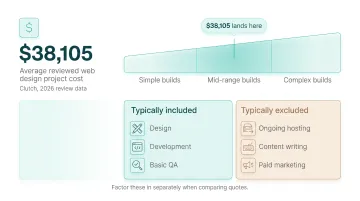
These figures roughly track what agencies report across the industry. Clutch's 2026 review data puts the average reviewed web design project at $38,105, which lands squarely in the mid-range tier once you account for the wide spread between simple and complex builds.
One important caveat: these ranges generally cover design, development, and basic QA. They typically exclude ongoing hosting, content writing, and paid marketing, so factor those in separately when you're comparing quotes.
1.2 Entry-level / small business website
This tier gets you a custom design built on a brand template, usually 5-15 core pages, a standard CMS setup, basic SEO, and contact forms. It's not a from-scratch design, but it's not a generic theme either.
Best for: service businesses, consultants, and early-stage startups that need to establish credibility quickly without a large budget.
1.3 Mid-range / standard business website
Here you're paying for deeper discovery, custom UX flows built around how your actual users navigate, third-party integrations, and more revision cycles built into the process.
Best for: growing B2B companies and funded startups that need the site to support day-to-day operations, not just serve as a digital brochure.
1.4 High-end / complex or specialized website
This tier includes custom UX/UI built entirely from scratch, complex backend logic, compliance and scalability planning, and for technical sectors, real subject-matter translation work.
Take Susteon, a carbon capture and hydrogen production company. Their site needed to explain seven distinct technologies, including a solvent achieving a roughly 44% cost reduction while capturing over roughly 97% of CO₂ from industrial flue gas, in language investors and partners could trust.
That project ran four months and covered brand strategy, logo design, visual identity, and website design together, not website design alone. That combined scope is what pushes a project into six figures.
Best for: enterprises and technical or scientific companies, climate tech and deep tech firms especially, where the site must translate complex innovation into a story investors and partners believe. It also fits VC-backed startups whose site plays a direct role in closing funding or partnerships.
We are built for this gap: we learn the underlying science before design work starts.
2. Key factors that affect web design agency pricing
Agency pricing is driven by technical scope, strategic depth, and business risk. Headcount and page count matter far less than most people assume.
2.1 Scope and website type
A landing page, a marketing website, and a full web app follow entirely different pricing logic. Here's the part that surprises people: a simple-looking five-page site handling payments or user data can cost more than a fifty-page brochure site.
That's because agencies price by the number of unique page types and interactions, not raw page count. A checkout flow, a dashboard, and a login system each require their own design and engineering work, regardless of how few pages they touch.
2.2 Level of customization and UX research
Template-based design starts from an existing layout and adjusts branding, colors, and content. Fully custom design starts from a blank canvas and builds structure around your specific users and goals.
Projects that require user research, competitor analysis, and wireframing before any visual design begins add meaningful cost, but they also reduce the odds of a redesign twelve months later.
2.3 Industry and technical complexity
Regulated industries like healthcare and fintech, along with deeply technical sectors like climate tech and hard tech, require specialized expertise that standard agencies often don't have on staff.
GoodFirms' 2026 survey identifies custom backend development, advanced UI/UX, and third-party integrations as the three leading causes of costs exceeding original estimates. Integrations routinely run 2-3 times their initial estimates.
If your site hasn't kept pace with where the business actually is, we can show you what that's costing you. Get a free strategic audit.
For HYDGEN, a hydrogen electrolysis company, the design work had to communicate AEM and PEM electrolyzer technology and differentiate 10 kW, 50 kW, and 100 kW systems. It also had to convey a 99.roughly 97% hydrogen purity metric to audiences ranging from engineers to enterprise buyers.
That kind of project needs technical illustrations, renderings, and animations most standard business sites never touch.
2.4 Integrations and advanced features
Each of the following adds setup time, testing time, or both:
- CRM integrations that sync form submissions and lead data
- Payment processing and checkout logic
- Custom APIs connecting to internal or third-party systems
- Data dashboards showing real-time metrics
For Batteryze, a circular EV-battery economy platform, the scope went beyond visual design entirely. The project included a vendor directory, risk calculator, and battery health monitoring.
That work was classified as UX design, product strategy, and MVP development combined, not a website build.
2.5 Team seniority and agency location
Hourly rates vary significantly by region, making location one of the biggest levers on total project cost:
| Region | Typical Hourly Rate |
|---|---|
| United States | $50-$149 |
| United Kingdom | $50-$100 |
| Western Europe | $25-$100 |
| Eastern Europe | $25-$100 |
| India | $10-$25 |
Senior teams cost more per hour, but they typically reduce rework and timeline risk. That often evens out the total cost compared to a cheaper team that needs three rounds of fixes.
3. Cost breakdown: what you're really paying for
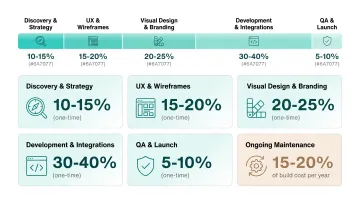
Your total agency price covers several distinct project phases, not just "design" as a single line item. Here's how that budget typically splits.
Typical split at a glance:
- Discovery & Strategy: 10-roughly 15% (one-time)
- UX & Wireframes: 15-roughly 20% (one-time)
- Visual Design & Branding: 20-roughly 25% (one-time)
- Development & Integrations: 30-roughly 40% (one-time)
- QA & Launch: 5-roughly 10% (one-time)
- Ongoing Maintenance: 15-roughly 20% of build cost per year
3.1 Discovery & strategy (one-time)
This phase covers goals, audience research, and competitor analysis. It's commonly estimated at 10-roughly 15% of total budget.
For climate and deep tech clients, it often expands into stakeholder interviews, technical product context, and mapping how engineers, investors, and other audiences will use the content.
3.2 UX & wireframes (one-time)
Structural and user-flow planning typically runs 15-roughly 20% of budget. This is where the site's skeleton takes shape before visual design begins.
3.3 Visual design & branding (one-time)
Visual design and branding usually account for 20-roughly 25% of budget. Fully custom design work, as opposed to template adaptation, pushes this share higher.
3.4 Development & integrations (one-time)
This is typically the largest cost component, running 30-roughly 40% of budget. It covers frontend build, backend logic, and third-party integrations, and it's where scope creep most often shows up.
3.5 QA, launch, and ongoing maintenance (one-time + recurring)
QA and launch typically account for 5-10% of budget. After that, ongoing maintenance becomes a recurring cost. GoodFirms' 2026 research recommends planning for 15-20% of initial build cost per year, covering hosting, security patches, CMS updates, and minor content changes.
4. startup-scale vs high-cost web design agencies, what's the difference?
Budget freelancers and startup-scale agencies aren't automatically worse than premium firms, but the trade-offs are real and worth understanding before you commit.
| Factor | startup-scale | High-cost |
|---|---|---|
| Design & UX | Template-based layouts with minimal upfront research | Custom, research-driven UX led by senior strategists |
| Process | Informal scoping; higher risk of missed timelines and scope creep | Structured project management with milestones and clear revision processes |
| Long-term value | Often needs a redesign sooner; hidden costs after launch | Built to scale; fewer fixes and stronger conversion ROI over time |
Pick the tier that matches how much strategy, reliability, and runway you need, not just the sticker price.
5. How to estimate the right budget (and avoid common cost mistakes)
The right budget is the one that fits your business goals, not the lowest quote in your inbox.
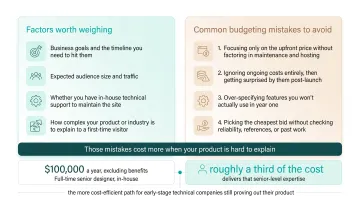
Factors worth weighing before you set a number:
- Business goals and the timeline you need to hit them
- Expected audience size and traffic
- Whether you have in-house technical support to maintain the site
- How complex your product or industry is to explain to a first-time visitor
Common budgeting mistakes to avoid:
- Focusing only on the upfront price without factoring in maintenance and hosting
- Ignoring ongoing costs entirely, then getting surprised by them post-launch
- Over-specifying features you won't actually use in year one
- Picking the cheapest bid without checking reliability, references, or past work
Those mistakes cost more when your product is hard to explain. Founders in climate tech, deep tech, and other technical fields often need a partner who understands both design and the underlying science.
Building that expertise in-house is expensive: a single full-time senior designer often costs upwards of $100,000 a year, excluding benefits. We deliver that senior-level expertise without the overhead of hiring and managing an in-house team, usually the more efficient path for early-stage technical companies still proving out their product.
Clarity here is what turns a defensive conversation into a confident one. Get a free strategic audit.
6. Frequently asked questions
6.1 How much do agencies charge for website design?
Agency pricing typically runs from $5,000 for a simple site to $150,000 or more for a complex platform. Freelancers usually charge less per hour ($50-$150) than full agency teams, but agencies offer a more structured process and accountability.
6.2 What's the difference between hourly and fixed-price agency pricing?
Hourly pricing suits projects where scope may evolve, since you pay for actual time worked. Fixed-price suits clearly defined projects and gives you cost certainty, though it requires locking down scope before work begins.
6.3 Is it cheaper to hire a freelancer or a web design agency?
Freelancers are usually cheaper for small, simple sites. Agencies cost more but carry less dependency risk, since a team backs up the work instead of relying on one person's availability.
6.4 What ongoing costs should I budget for after my website launches?
Budget for hosting, security updates, content changes, and general maintenance. A common industry benchmark is 15-roughly 20% of your original build cost per year to keep the site running smoothly.
6.5 How can I avoid overpaying a web design agency?
Clarify scope, revision limits, timeline, and ownership terms before signing any proposal. Vague contracts are where most surprise costs and scope creep show up later.
6.6 Do web design agencies charge extra for eCommerce or custom features?
Yes. Payment processing, product catalogs, and custom integrations all add cost beyond a standard marketing site. eCommerce builds commonly run $5,000 to $50,000 depending on catalog size and complexity.
Related reading: How web portal UX design gives you the edge to win deals after demos and 10 Best SaaS UX Design Agencies For Product Growth In 2026.
Ready to take the next step?
If you're weighing a design partner for climate, deep tech, or hard-to-explain products, Book a strategy call with our founders at What if Design, a no-pressure 25-minute conversation about what you're building and where design can help. You can also View our work to see how we've helped teams like yours, or Get a free strategic Audit of your current brand, website, or product experience.