This decision shapes more than visual polish. It affects your burn rate, how fast you ship, and whether your product actually clicks with a technical or specialized audience.
The global UX services market hit $6.40 billion in 2025, with a projected 36% CAGR through 2032, according to Fortune Business Insights. Design spend is only growing as a startup line item.
This guide breaks down cost, quality, communication, and domain fit for both models. It also introduces a third option gaining ground with technical founders: distributed senior design teams.
TL;DR: key takeaways
- Regional teams buy same-timezone collaboration and regulatory fluency at a premium
- Offshore agencies cost a fraction of US hourly rates, with communication friction as the tradeoff
- Neither model wins universally: fit hinges on product complexity, runway, and subject-matter niche
- Distributed senior teams combine embedded strategic ownership with global cost efficiency
- For deep tech and climate tech founders, science fluency matters as much as design skill
1. Regional vs offshore UI/UX design: quick comparison
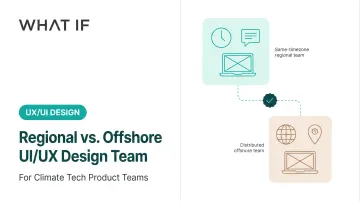
Side-by-side, the main tradeoffs look like this:
| Factor | Regional | Offshore |
|---|---|---|
| Cost | $100: $149/hour (US, Canada, Australia) | Under $25/hour (India); $25, $49/hour (Philippines, Ukraine, Mexico) |
| Talent Pool | Smaller local pool; strong for niche compliance | Large, globally vetted pool across skill levels |
| Communication | Real-time, same working hours | Async-heavy; overlap windows need planning |
| Domain Alignment | Deep local market and regulatory context | Varies by vendor; vetting matters more than geography |
| Scalability | Slower and costlier to hire | Faster to scale up or down |
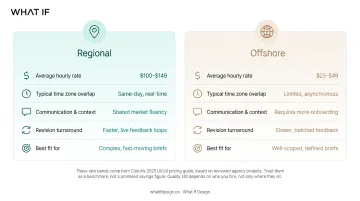
These rate bands come from Clutch's 2025 UI/UX pricing guide, based on reviewed agency projects. Treat them as a benchmark, not a promised savings figure. Quality still depends on who you hire, not only where they sit.
2. What is a regional UI/UX design team?
A regional team means designers working in your own country or timezone, whether in-house or through a local agency. The core appeal is proximity: same-day feedback loops, live whiteboarding sessions, and stakeholders who can walk into a room together.
That proximity matters most when:
- User research requires in-person sessions with hard-to-reach participants
- Compliance frameworks demand tight, documented collaboration
- Brand-defining moments need rapid, iterative in-person alignment
The tradeoff is real. You're paying US-tier rates ($100: $149/hour, according to Clutch), and your local pool of designers with niche technical or scientific fluency shrinks fast once you leave major hubs.
2.1 Use cases of regional teams
Regional teams tend to dominate in regulated fintech, healthcare, and enterprise SaaS: verticals where compliance depth and stakeholder alignment carry more weight than raw design speed.
McKinsey notes that high-performing organizations building software as a medical device embed regulatory design-control requirements directly into agile development, rather than bolting them on afterward. That daily, iterative alignment is easier to sustain when the team shares your working hours.
Remote teams can clear the same bar. Proximity just removes friction.
3. What is an offshore UI/UX design team?
Offshore teams engage design talent from another country or region, typically through agencies, staffing partners, or embedded remote hires. The draw is access to senior global talent without paying premium local-market rates.
Core operational benefits include:
- Lower design spend compared to hiring locally
- A larger global talent pool to choose from
- The ability to scale a design function up or down without in-house hiring overhead
But offshore isn't friction-free. Nielsen Norman Group's remote-design research, surveying 306 UX practitioners, found that 43% identified communication as their biggest remote-work challenge. Vendor quality also varies widely, and context can reset with every new project if the relationship isn't structured for continuity.
💡 Working through this decision right now? If you're a climate-tech or deep-tech founder weighing this trade-off, Book a strategy call with our team, 25 minutes, no pitch, and we'll pressure-test your specific situation.
3.1 Use cases of offshore teams
Offshore fits well when you need:
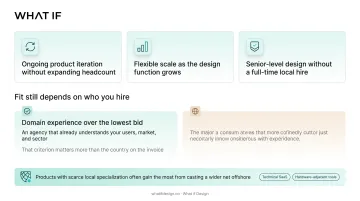
- Ongoing product iteration without expanding headcount
- Flexible scale as the design function grows
- Senior-level design without a full-time local hire
Fit still depends on who you hire. Clutch's service guide stresses domain experience over the lowest bid: an agency that already understands your users, market, and sector. That criterion matters more than the country on the invoice. Products with scarce local specialization, technical SaaS or hardware-adjacent tools, often gain the most from casting a wider net offshore.
4. Regional vs offshore: which model wins?
Neither. The right answer depends on four factors:
- Product complexity: the harder it is to explain your product, the more continuity matters
- Regulatory sensitivity: heavy compliance often favors tighter, synchronous collaboration
- Budget runway: earlier-stage startups usually can't absorb regional rates
- Domain specialization: niche technical or scientific subject matter needs a partner willing to learn it, not just execute it
- Choose regional when live co-creation and compliance depth outweigh cost
- Choose offshore when cost efficiency and scarce specialized skills matter more than same-room collaboration
But for founders whose product sits at the intersection of hard science and commercial design, both models can fall short. That's where a third option comes in.
5. The third path: distributed senior design teams
This model blends senior-level strategic ownership with global cost efficiency. Instead of junior staff rotating between projects, senior designers and strategists work remotely across regions while staying embedded with one client over time.
NN/g's research on decentralized UX teams supports this: designers who stay with the same product team build trust and product expertise rotating staff can't match. The 2025 Managed-UX Integration model links early, consistent involvement to fewer downstream conflicts and stronger shared understanding of users.
What if Design operates this way, with co-founders based across San Francisco and Bangalore working directly with climate tech and deep-tech founders rather than delegating to junior staff. Before any design work starts, they run desktop research and competitive analysis to build a grounded understanding of the client's technology and market.
This matters most when the brief itself is hard to write. If your reviewer needs to understand green hydrogen electrolysis or carbon capture economics before they can even evaluate your interface, continuity beats both a rotating local agency and a transactional offshore vendor.
5.1 Real-world example: turning dense science into a usable product
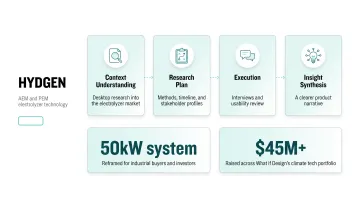
HYDGEN, a decentralized hydrogen-production company working with AEM and PEM electrolyzer technology, faced a common deep-tech problem. Its existing website was dense and text-heavy, and industrial decision-makers struggled to grasp the product's differentiation and practical impact.
What if Design's approach followed its standard research-first structure:
- Context understanding and desktop research into the electrolyzer market
- A research plan covering methods, timeline, and stakeholder profiles
- Execution through interviews and usability review
- Insight synthesis into a clearer product narrative
The result reframed complex electrolyzer technology, including a 50kW system, into a presentation industrial buyers and investors could follow.
Across its broader climate-tech portfolio, What if Design's pitch and product work has contributed to $45M+ raised for its clients. Domain fluency shows up in fundraising outcomes, not only in the interface.
If your product needs a partner who learns the science before touching a screen, book a strategy call to walk through your specific challenge.
6. Conclusion
There's no universal winner here. Match the model to your product's complexity, your budget stage, and how specialized your domain is:
- Regional when live co-creation and regulatory depth matter most
- Offshore when you need cost efficiency and scarce specialized skills
- Distributed when continuity and deep technical fluency outweigh either alternative
For climate tech and deep-tech founders specifically, prioritize a partner who invests in understanding your science or business model, not just one who executes visuals quickly. That fluency is what turns a good-looking product into a fundable one.
Clarity here is what turns a defensive conversation into a confident one. Get a free strategic audit.
7. Frequently asked questions
7.1 What is the difference between offshore and regional UI/UX teams?
Regional teams work in your country or time zone, often at a cost premium. Offshore teams work from other regions, typically through agencies or embedded hires, at significantly lower hourly rates.
7.2 Is offshore UI/UX design cheaper than hiring a regional team?
Often, yes, Clutch's What we see in practice is US rates at $100-$149/hour versus under $25/hour in India. But quality depends on vetting the specific vendor, not the location alone.
7.3 How do time zones affect collaboration with an offshore design team?
Limited overlap hours mean more async work through tools like Slack, Figma, and Loom. Teams that document handoffs clearly and schedule brief overlap check-ins mitigate most of the lag.
7.4 Can offshore designers understand a company's brand and technical context as well as a regional team?
It depends on the engagement structure, not geography. Designers embedded long-term with one client build the same trust and product knowledge that regional teams gain from proximity.
7.5 What is a distributed or hybrid UI/UX design team?
Senior designers and strategists work across regions and time zones but stay embedded with one client over time, rather than rotating between projects like a typical agency.
7.6 How should a startup decide between regional and offshore UI/UX design?
Weigh your budget runway against product complexity and domain specialization. Heavily regulated or highly technical products often need more continuity than a rotating offshore vendor can offer.
Ready to take the next step?
If you're weighing a design partner for climate, deep tech, or hard-to-explain products, Book a strategy call with our founders at What if Design, a no-pressure 25-minute conversation about what you're building and where design can help. You can also View our work to see how we've helped teams like yours, or Get a free strategic Audit of your current brand, website, or product experience.