Where What if Design fits in We're a senior-led creative studio built specifically for climate tech, clean tech, and deep tech founders. Since 2020, we've partnered with teams like HYDGEN, Ribbit Network, and Susteon to turn hard-to-explain technology into brands, websites, and product experiences that raise capital and win adoption. This comparison reflects how we evaluate the trade-offs when a founder asks us which route to take.
"UX research firm" and "design agency" get used almost interchangeably in founder conversations. They shouldn't be. One studies how people behave. The other builds the thing people use.
Confusing the two wastes budget and pushes back your launch date, especially when your product is technical enough that writing a clear creative brief feels impossible on its own.
CB Insights found that among 385 VC-backed companies that shut down since 2023 and gave a reason, 43% cited poor product-market fit as a factor in their failure (CB Insights, 2026). Nielsen Norman Group is blunter: skip user research and you ship features nobody needed.
This article breaks down what each partner actually does, when to hire which, and what to do when your product is too complex for either one alone.
TL;DR: key takeaways
- UX research firms uncover user needs; design agencies turn those insights into branded interfaces.
- Cost, timeline, and team makeup differ sharply, so budget and speed goals should drive the choice.
- Pick based on product stage, in-house capability, and how defined your users already are.
- In deep tech and climate tech, an integrated research-and-design partner often beats either option alone.
1. UX research firm vs design agency: quick comparison
| Category | UX Research Firm | Design Agency |
|---|---|---|
| Cost | Often $25, $49/hour, or scoped as standalone sprints | Project fees average roughly $84,973; some firms use monthly retainers |
| Core Focus & Deliverables | Insight reports, personas, usability findings, recommendations | Wireframes, UI kits, brand assets, functioning prototypes |
| Team Composition | Researchers, behavioral scientists, moderators | UI/UX designers, brand strategists, sometimes embedded researchers |
| Typical Timeline | Standalone sprints, often weeks | Ongoing cycles (Clutch average: ~10 months) |
| Best Fit For | Validating assumptions before you build | Executing a vision that needs to ship |
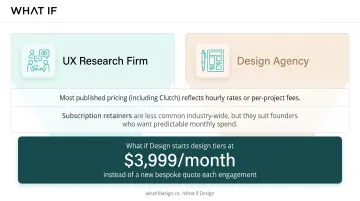
Most published pricing (including Clutch) reflects hourly rates or per-project fees. Subscription retainers are less common industry-wide, but they suit founders who want predictable monthly spend. What if Design, for example, starts design tiers at $3,999/month instead of a new bespoke quote each engagement.
2. What is a UX research firm?
A UX research firm studies how real people actually behave with your product, rather than relying on what your team assumes they'll do. That distinction matters more than it sounds. Internal assumptions feel true until they're tested against 20 actual users, and by then you've often already built the wrong thing.
Core benefits connect directly to operational outcomes:
- Fewer wasted development cycles spent building features nobody asked for
- Better feature prioritization backed by evidence instead of internal opinion
- More defensible product decisions when a stakeholder asks "why this feature?"
Not all research firms look alike. Some are large, enterprise-focused shops running multi-country studies. Others are boutique specialists: privacy-focused researchers, cross-cultural or international specialists, or human-factors experts working in regulated industries like medtech.
2.1 Use cases of a UX research firm
Standalone research firms tend to show up at specific moments:
- Early discovery before any design work starts
- Pre-redesign validation to check that a planned overhaul actually solves the right problem
- Diagnostic work when a product has high churn or low conversion and nobody knows why
They're especially common in enterprise SaaS, regulated healthcare and medtech, and large-scale consumer platforms, where the cost of building the wrong thing is high enough to justify a dedicated research phase.
A documented example: Baileigh Industrial, which sells industrial metalworking machinery, brought in research firm Marketade to test and rebuild its information architecture. Using stakeholder interviews, card sorting, and tree testing with 64 participants, the team measured findability performance jumping from 4.0 to 7.4 out of 10 across eight tasks (an 85% improvement) (NN/g, 2021).
That's the kind of measurable lift a focused research engagement can produce before a single new screen gets designed.
How we evaluated the options
Every recommendation here comes from actual client work, brand systems shipped, websites launched, and product experiences delivered under fundraising deadlines. We compared the options against five criteria that matter most for technical founders:
- Total cost of ownership across the first 12 months (not just the sticker price)
- Speed to a usable output given a typical Series A runway
- Quality of the technical translation, can they explain your science without oversimplifying it?
- Rework risk, how often teams re-hire because the first choice couldn't scale
- Ability to move with the roadmap without a re-onboarding tax every quarter
Where we cite numbers or trade-offs below, they come from projects we've delivered or watched founders navigate first-hand.
3. What is a design agency?
A design agency takes a concept, product, or complex technology and makes it usable and clear, for the customers who adopt it and the investors who fund it. For founders sitting on deep science or hard-to-explain tech, this translation work is often the difference between a stalled pitch and a closed round.
💡 Working through this decision right now? If you're a climate-tech or deep-tech founder weighing this trade-off, Book a strategy call with our team, 25 minutes, no pitch, and we'll pressure-test your specific situation.
Business outcomes typically include:
- Faster fundraising conversations when investors can grasp the value in one look
- Clearer market positioning against competitors
- Improved usability and conversion on the actual product
Design agencies split roughly two ways: full-service shops covering brand, web, and product together, and specialized outfits that focus narrowly on branding, development, or subscription-based UI work.
See how we have approached this in practice: User research in UX design.
3.1 Use cases of a design agency
Design agencies show up across a founder's journey: MVP builds, brand and website launches, investor materials, and product refreshes. They're most often hired at early-stage startups, rebrands, and fundraising-stage companies, where speed and polish matter as much as function.
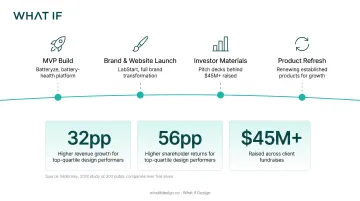
The business case for strong design is well documented. McKinsey tracked 300 public companies across five years and found top-quartile design performers posted 32 percentage points higher revenue growth and 56 percentage points higher shareholder returns than industry peers (McKinsey, 2018).
That's a correlation, not proof that any single agency hire caused the gains, but the pattern holds.
What if Design's own client work reflects the same pattern at startup scale: an MVP build for battery-health platform Batteryze, a full brand transformation for LabStart, and pitch decks that have contributed to $45M+ raised across client fundraises.
4. UX research firm vs design agency: which should you choose?
Three questions decide this for most founders:
- What stage is your product at: are you validating an idea or building something that needs to ship?
- Do you already have in-house design or research capability to act on what the other side produces?
- How well-defined is your target user right now?
If you can't write a clear brief, you likely need research-informed design before either service alone will help.
4.1 Situational recommendations
- Choose a UX research firm if you need deep behavioral insight and already have a design team ready to act on the findings.
- Choose a design agency if you need insight turned into a shippable interface or brand, and lack bandwidth to run research and design as separate workstreams.
- Choose an integrated partner if the product is too technical to brief cleanly, and you need research and design handled as one workstream.
4.2 Real-world example: when neither option alone is enough
Climate tech and deep tech founders hit a problem the frameworks above don't quite solve. The science is often so specialized that defining "the user" or writing a workable brief is hard before research or design can start.
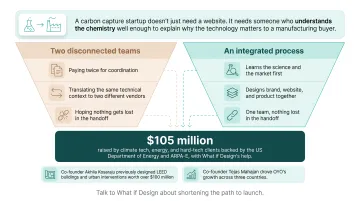
A carbon capture startup doesn't just need a website. It needs someone who understands the chemistry well enough to explain why the technology matters to a manufacturing buyer.
That's usually the moment founders stop trying to hire a research firm and a design agency separately. Stitching together two disconnected teams means paying twice for coordination, translating the same technical context to two different vendors, and hoping nothing gets lost in the handoff.
What if Design built its model around this gap. Co-founder Akhila Kosaraju previously designed LEED buildings and urban interventions worth over $100 million. Co-founder Tejas Mahajan leads product and UX for software companies, designing for adoption, retention and the metrics that drive growth, across battery management systems, fleet platforms and ESG tools.
Together they run an integrated process: learn the science and the market first, then design brand, website, and product together instead of in sequence. The firm's climate tech, energy, and hard-tech clients (including companies backed by the US Department of Energy and ARPA-E) have collectively raised over $105 million with What if Design's help.
For products this technically dense, an integrated research-and-design partner removes friction a pure research firm or pure design agency can't solve alone. If that sounds like your product, talk to What if Design about shortening the path to launch.
Which option is right for your stage
The right answer depends less on the two options themselves and more on where you are as a company.
Pre-seed / seed (0–$3M raised): Speed and story matter more than polish. A focused boutique-agency sprint usually beats an in-house hire, because the founder still needs to control the narrative. We've seen this pattern with early climate-tech teams, a 4-to-6-week engagement to get brand, website, and pitch coherent is more valuable than a full-time designer.
Series A ($5–20M raised): This is where a senior-led agency partner pays for itself. You need a brand system that will survive three product pivots, a website that converts enterprise buyers, and pitch materials that hold up in board meetings. In-house is still premature unless you're planning to ship design-heavy product weekly.
Series B and beyond ($20M+ raised): Hire in-house design leadership and keep an agency partner for concentrated bursts (rebrands, launches, category shifts). The two aren't substitutes at this stage, they solve different problems.
Growth-stage climate tech specifically: The stakes shift once you're commercializing. Your brand needs to hold up to procurement diligence, regulatory scrutiny, and investor updates simultaneously. A specialist studio that already speaks the science, like our team, reduces the translation tax that generalists impose on every deliverable.
5. Conclusion
There's no universal winner. Match the partner to your situation:
- Mature product with in-house design: A dedicated research firm feeding the team evidence
- Full execution needed: A design agency for brand, website, and product, shipped end to end
- Brief still unclear: Technically ambiguous products usually need research and design working as one team
Getting this right isn't just an organizational preference. It shortens time-to-insight, cuts wasted design and development cycles, and helps technical founders explain their value faster to investors and customers who don't share their PhD.
If you're commercializing climate or deep tech and still shaping the brief, What if Design partners on that full path, from brand through product.
Get this right and you get alignment: your team, your investors and your buyers all read the same story the same way. Get a free strategic audit.
6. Frequently asked questions
6.1 What are the different types of UX research?
UX research covers qualitative and quantitative methods, plus attitudinal and behavioral approaches. Common methods include usability testing, interviews, surveys, card sorting, and field studies, each suited to a different stage of product decisions.
6.2 Is UX researcher the same as UX designer?
No. Researchers focus on understanding user behavior and needs; designers focus on creating the interface or experience itself. Some professionals and agencies do both, but the skill sets and daily work are distinct.
6.3 Is UX research still in demand?
Yes. Nielsen Norman Group notes that AI growth and more complex products are increasing demand for research that reduces build risk, even as AI tools begin supporting parts of the process.
6.4 Should I hire a UX research firm or a design agency first?
It depends on whether you already understand your users. If you don't, research-first (or an integrated partner) is the safer starting point than jumping straight into design.
6.5 Can a design agency also conduct UX research?
Many full-service design agencies embed research into their process instead of treating it as a separate phase. What if Design, for example, runs stakeholder interviews and market research before design work begins.
6.6 How much should I budget for UX research versus design work?
Research-only and design-only engagements use different pricing models, so a clean split is hard to standardize. Integrated partners often offer bundled monthly pricing, which is usually more predictable than combining two separate vendor quotes.
Ready to take the next step?
If you're weighing a design partner for climate, deep tech, or hard-to-explain products, Book a strategy call with our founders at What if Design, a no-pressure 25-minute conversation about what you're building and where design can help. You can also View our work to see how we've helped teams like yours, or Get a free strategic Audit of your current brand, website, or product experience.