Getting this wrong creates a disconnect between how your company looks and how your product actually works. That gap slows fundraising, stalls adoption, and pushes back launch timelines. It's especially costly for technical or deep-tech companies, where the underlying story is already hard to tell.
This guide compares both models across cost, team structure, and use case. Then it walks through a real climate-tech example to show the decision in practice.
TL;DR: key takeaways
- Full-service studios own brand and product under one accountable team; UX studios specialize narrowly in product craft
- Early-stage, fundraising, or narrative-heavy companies benefit most when brand and product launch together
- Bring in a UX studio once a product exists and usability or retention is the main business risk
- Expect bundled project scope from full-service teams and premium specialist rates from UX studios
- Many companies use both in sequence, not as an either/or choice
1. Full-service branding vs UX studio: quick comparison
Here's how the two models compare side by side.
| Dimension | Full-Service Branding | UX Studio |
|---|---|---|
| Cost | Project-based pricing that bundles brand strategy, identity, website, and product design into one scope | Premium hourly or retainer rates for senior, specialist-only talent |
| Team Structure | Small, senior, cross-disciplinary team (strategist, designer, UX lead) that follows the project from start to finish | Flat teams of researchers, interaction designers, and UI specialists with narrow focus |
| Deliverables | Brand strategy, visual identity, website, pitch decks, and product UX/UI as one connected system | User research, wireframes, prototypes, usability testing, and interface design |
| Best Suited For | Companies that need brand and product to tell one coherent story, especially at fundraising stage | Companies with an established brand solving a specific usability or adoption problem |
| Client Access | Direct access to founders and strategists across both brand and product decisions | Direct access to senior designers and researchers, scoped mainly to product screens |
The pattern is simple: full-service consolidates decision-making, while UX studios go deep on one layer of the experience.
2. What is full-service branding?
Full-service branding means one team handles identity, visual systems, and the digital product together, whether that's a website, app, or platform. Instead of a logo package landing in one inbox and interface files landing in another, the same people are responsible for both.
Why this matters: a single point of accountability eliminates the miscommunication that happens when a branding agency's guidelines don't translate cleanly into a separate UX team's interface decisions. When strategy and product design sit under one roof, brand voice and product experience inform each other in real time instead of being handed off across a gap.
Not every "full-service" studio goes equally deep, though. Some focus mainly on marketing collateral with basic web design bolted on. Others extend genuinely deep into UX and product design, closing the perception-versus-interaction gap entirely.
2.1 How full-service teams handle technical complexity
This distinction matters most for technical or scientific companies. For example, we work with climate tech and deep-tech founders by starting with a strategist who learns the underlying science before any design work begins.
That process includes:
- Design-led customer storytelling and competitive research
- Data-driven audience insights
- 90-minute stakeholder-alignment exercises to validate positioning before it's designed
- A complete system: messaging hierarchy, value-proposition frameworks, visual identity, and a WCAG-AA color palette
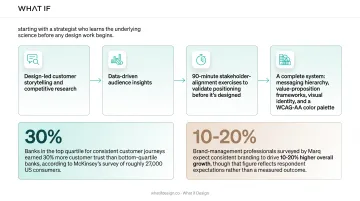
Brand consistency isn't cosmetic. Banks in the top quartile for consistent customer journeys earned 30% more customer trust than bottom-quartile banks, according to McKinsey's survey of roughly 27,000 US consumers.
Separately, brand-management professionals surveyed by Marq expect consistent branding to drive 10-20% higher overall growth, though that figure reflects respondent expectations rather than a measured outcome.
2.2 When full-service makes the most sense
This model fits best when a company is fundraising, rebranding, or launching a website and product at the same time, with no room for a disjointed presentation across touchpoints.
It shows up most often in:
- Carbon capture and CO2 utilization
- Green hydrogen production
- Grid infrastructure and interconnection
- Other hard-science industries where the brief itself is difficult to write because the underlying technology is unfamiliar
Susteon is one example: a four-month What if Design engagement covering brand strategy, brand design, a website redesign, development, and marketing assets. The goal was to make deeply technical climate technology legible to investors and partners.
💡 Working through this decision right now? If you're a climate-tech or deep-tech founder weighing this trade-off, Book a strategy call with our team, 25 minutes, no pitch, and we'll pressure-test your specific situation.
In another case, a carbon capture startup needed a web application for real-time monitoring of large operational datasets. A UX audit and redesigned dashboard delivered a roughly 30% increase in operational efficiency and a shorter learning curve for non-technical users.
See how we have approached this in practice: 10 Best SaaS UX Design agencies for product growth in 2026.
3. What is a UX studio?
A UX studio specializes narrowly in the craft of digital product design: user research, information architecture, interaction design, and interface design.
Nielsen Norman Group defines UX as "all aspects of the end-user's interaction with the company, its services, and its products," a scope that includes far more than visual polish.
This depth matters once usability, not perception, becomes the primary business risk.
Core advantages of the model:
- Senior researchers and designers focus exclusively on how real users behave inside your product, reducing onboarding friction and churn
- Flat team structures give founders and product leads direct access to the people doing the work, not an account manager relaying updates
- Engagements can run as embedded, ongoing product teams on retainer, or as defined projects like a single redesign or MVP sprint
The tradeoff is real, though. UX studios rarely touch brand identity or marketing collateral. A company without an established brand will likely still need a separate partner for that layer.
On results, the clearest benchmark is a 2008 Nielsen Norman Group study of 72 usability-redesign cases. It found an average 83% improvement in KPIs after redesign, excluding the roughly 12% of projects with outlier 10x-plus gains.
The study is dated, but it remains the strongest evidence that fixing usability problems moves real business metrics.
3.1 When a UX studio makes the most sense
This model fits companies where the interface itself is the core product experience:
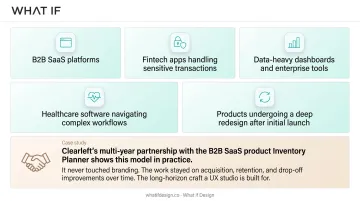
- B2B SaaS platforms
- Fintech apps handling sensitive transactions
- Data-heavy dashboards and enterprise tools
- Healthcare software navigating complex workflows
- Products undergoing a deep redesign after initial launch
Clearleft's multi-year partnership with the B2B SaaS product Inventory Planner shows this model in practice. It never touched branding. The work stayed on acquisition, retention, and drop-off improvements over time. The long-horizon craft a UX studio is built for.
4. Which one is right for you?
The decision comes down to a handful of factors:
- Company stage: pre-launch and fundraising, or post-launch with real usage data?
- Launch dependency: do brand and product need to go live together, or does one already exist?
- Narrative complexity: is your technology or business model hard to explain at a glance?
- In-house capability: do you already have design leadership internally?
- Budget structure: do you prefer one bundled scope or specialist hourly rates?
Choose full-service branding if you're early-stage, preparing to fundraise, or building a company where complex science or technology has to land clearly with investors and customers.
Choose a UX studio if your brand is already established and the real risk is usability, adoption, or retention rather than perception.
Many growing companies don't pick one forever. A common path is starting with a full-service partner to build brand and product foundations together, then bringing in a specialized UX studio later for deep iteration once real users generate real data.
Match the model to your immediate problem: coherence across brand and product, or craft depth on a product that already exists.
5. Real-world example: full-service branding in climate tech
HYDGEN, a decentralized hydrogen technology company, shows what full-service branding fixes when the science is strong but the story is hard to follow.
The challenge: HYDGEN's previous website was dense and text-heavy. It held real technical depth but lacked structure, visual hierarchy, and storytelling.
Industrial buyers evaluating hydrogen solutions could not quickly see what set HYDGEN apart: its technology, products, or potential impact. The substance existed; the presentation blocked fast evaluation.
That pattern is common with DOE- and ARPA-E-adjacent technologies: the science is defensible, but a non-specialist still cannot assess it in five minutes.
What if Design ran brand strategy, website design, and UX as one scope instead of splitting identity and interface work across two vendors. The redesign turned dense content into a navigable experience for enterprise buyers and partners, covering:
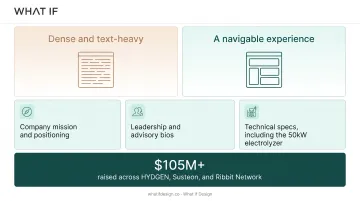
- Company mission and positioning
- Leadership and advisory bios
- Technical specs, including the 50kW electrolyzer
Across What if Design's climate tech portfolio: HYDGEN, Susteon, and Ribbit Network, the firm has contributed to more than $105M raised by its clients.
When the brief is hard to write because the technology is unfamiliar, a partner that learns the science before designing outperforms separate branding and UX vendors.
If you're a climate tech or deep-tech founder trying to align brand and product from day one, talk to What if Design.
Get this right and you get alignment: your team, your investors and your buyers all read the same story the same way. Get a free strategic audit.
6. Frequently asked questions
6.1 What is the difference between a branding agency and a UX studio?
A branding agency shapes how a company is perceived through identity, visual systems, and messaging. A UX studio shapes how a digital product is actually used, through research, interaction design, and interface craft.
6.2 Can a branding agency also do UX design?
Some branding agencies extend into UX and product design as full-service partners, while others stick strictly to identity and marketing collateral. Check their actual deliverables, not just their title.
6.3 How much does full-service branding cost compared to a UX studio?
Full-service partners typically bundle pricing across disciplines into one project scope. UX studios often bill at premium specialist rates for narrower, deeper engagements. Neither model is inherently cheaper across the board.
6.4 Do climate tech and deep-tech startups need branding or UX first?
Most need both at the same time. Investors and early customers form an opinion of your brand and your product in the same meeting, so a sequential approach often costs you time you don't have.
6.5 Can I hire both a branding agency and a UX studio for the same project?
Yes, but it requires careful handoff. Without close coordination, identity guidelines and product interface decisions can drift apart and undercut the coherence you were trying to build.
6.6 How do I know if my startup needs a full-service partner or a specialized UX studio?
Ask what your immediate problem is. If it's coherence between how you're perceived and how your product works, go full-service. If it's usability or retention on a product that already exists, go with a UX studio.
Ready to take the next step?
If you're weighing a design partner for climate, deep tech, or hard-to-explain products, Book a strategy call with our founders at What if Design, a no-pressure 25-minute conversation about what you're building and where design can help. You can also View our work to see how we've helped teams like yours, or Get a free strategic Audit of your current brand, website, or product experience.