Picking the wrong one is expensive. You can end up with a beautifully branded product that still confuses users, or a deep UX overhaul when what you actually needed was a coordinated launch campaign. Many founders struggle with this exact mismatch, often after the budget is already spent.
This article breaks down the real differences, where each model fits, and includes a live example from a climate-tech founder who had to choose between the two.
TL;DR: key takeaways
- Agencies cover breadth: brand, marketing, and multi-channel campaigns under one roof
- Studios go deep on product usability, interaction design, and senior-led problem-solving
- Team structure matters as much as the label: hierarchical accounts versus direct designer access
- Match the partner to the problem type, not the price tag alone
- Specialized studios (climate tech, fintech, deep tech) handle briefs generalists struggle to write
1. UI/UX agency vs. product studio: quick comparison
| Dimension | UI/UX Agency | Product Studio |
|---|---|---|
| Primary Focus | Breadth across brand, marketing, and digital channels | Depth in product usability, interaction, and UX craft |
| Team Structure | Hierarchical, departmentalized; account managers as main contact | Flat, senior specialists with direct access to designers/researchers |
| Engagement Model | Project-based or hour-banking retainers spanning marketing tasks | Dedicated product-focused retainers, often functioning as an extension of the internal team |
| Cost Structure | Lower blended rate, but more billed hours due to junior execution layers | Higher rate per hour reflecting senior-only talent, often resolving problems faster |
| Best Suited For | Multi-channel brand launches, rebrands, high-volume asset production | SaaS platforms, MVPs, deep redesigns, technical/niche domains |
Cost is driven more by complexity, team size, and scope than by the agency-vs-studio label. Clutch's 2025 UI/UX agency directory shows most listed projects fall between $10,000 and $50,000.
Some studios, including What if Design, price as monthly retainers instead of per-project quotes, which changes the comparison entirely.
2. What is a UI/UX agency?
A UI/UX agency is a full-service digital or marketing shop where UX/UI is one department among several, sitting alongside branding, content, paid media, and sometimes development. If your project needs coordinated output across multiple disciplines, this structure earns its keep.
Core benefit: a single point of contact. Instead of managing five vendors for a rebrand, a website, and a campaign launch, you manage one account team that keeps messaging and visuals consistent across every touchpoint.
Not all agencies look alike. Full-service digital agencies combine design, development, and marketing under one contract. Boutique branding agencies treat UX as an add-on layered onto brand identity work.
2.1 Where a UI/UX agency fits
Agencies dominate when the challenge is coordination, not complexity:
- Launching a new consumer brand that needs a website, ad campaign, and social presence simultaneously
- Enterprise rollouts spanning multiple regions or languages
- Seasonal or event marketing microsites with tight, recurring deadlines
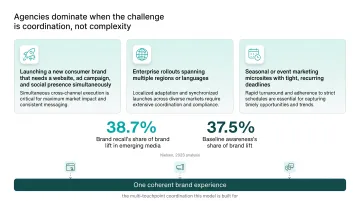
Brand consistency across channels matters for recall. Nielsen's 2023 analysis found that brand recall drove 38.7% of brand lift in emerging media, ahead of baseline awareness at 37.roughly 5%.
An agency's job is turning that channel-by-channel recall into one coherent brand experience. The multi-touchpoint coordination this model is built for.
3. What is a product studio?
A product studio is a smaller, senior-led team focused on user research, interaction design, and interface craft, not broad marketing services. When your core challenge is whether users can actually use the thing, this focus matters more than campaign coordination ever will.
Core benefit: direct access to senior designers and researchers, which typically means faster iteration cycles, fewer costly rebuilds, and design decisions handled as business decisions rather than aesthetic ones.
Some studios go further and specialize by vertical. What if Design, for instance, works with climate and deep-tech teams to turn dense science (carbon capture, green hydrogen, grid tech) into usable products and clear investor-facing communication. Most general studios skip that niche, because you cannot write the brief without understanding the technology first.
💡 Working through this decision right now? If you're a climate-tech or deep-tech founder weighing this trade-off, Book a strategy call with our team, 25 minutes, no pitch, and we'll pressure-test your specific situation.
3.1 Where a product studio fits
See how we have approached this in practice: 10 Best SaaS UX Design agencies for product growth in 2026.
Studios tend to win in situations where the problem is technical or structural:
- SaaS and complex B2B platforms needing usability overhauls
- MVP validation for early-stage startups
- Structural redesigns of underperforming products
Documented examples from What if Design's climate-tech work:
- Carbon capture (Susteon): made a technically dense carbon-capture and hydrogen mission legible to investors and partners
- Green hydrogen (HYDGEN): replaced generic corporate styling with a technical, credible identity presenting products like a 50 kW electrolyzer
- Battery management (Batteryze): turned a battery-health dashboard for the circular EV economy into something non-experts could actually read
- ESG tools (Vested Futures): built a user-centric vendor-sourcing dashboard for corporate sustainability teams
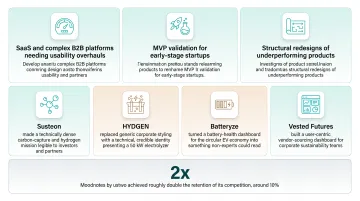
On outcomes, one of the stronger documented studio cases comes from ustwo: Moodnotes, a mental-health journaling app built with clinical professionals, achieved roughly double the retention of its competition, around 10%. Senior-only staffing is not the sole cause, yet it is a concrete signal of what focused product work can deliver.
4. UI/UX agency vs. product studio: which one is right for you?
Weigh four factors before signing anything:
- Project complexity: is the brief mostly about coordination, or does it require subject-matter understanding first?
- Internal gaps: do you already have brand and marketing covered, but lack product UX depth (or vice versa)?
- Timeline: agencies often run parallel workstreams faster; studios go deep but sequentially.
- Budget structure: fixed project fee versus ongoing retainer.
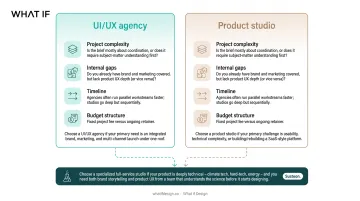
Choose a UI/UX agency if your primary need is an integrated brand, marketing, and multi-channel launch under one roof.
Choose a product studio if your primary challenge is usability, technical complexity, or building/rebuilding a SaaS-style platform.
Choose a specialized full-service studio if your product is deeply technical: climate tech, hard-tech, energy, and you need both brand storytelling and product UX from a team that understands the science before it starts designing.
That third path is clearest in deep-tech work, where the brief is hard to write until someone understands the science. Susteon is a useful example.
4.1 Real-world example: Susteon
Susteon, a climate-tech company working across carbon capture, hydrogen production, and CO₂ management, had a familiar deep-tech problem: their website didn't communicate what they actually did. The technology was too complex for a generic template, and the brief itself required subject-matter understanding first.
That's the trigger point for choosing a specialized studio over a generalist agency, Susteon didn't need more marketing execution volume. It needed designers willing to learn the underlying chemistry and engineering before touching a single wireframe.
What if Design ran a four-month engagement covering brand strategy, website design and development, UX design, visual identity, event collateral, and pitch decks.
The resulting positioning centered on "creating a regenerative carbon ecosystem." Sudarshan Gupta, COO of Susteon, Sudarshan Gupta, said the process "accurately translated our vision to creatively visualize our deeply scientific work."
If your product's technology is the hardest part of your pitch, you need a studio built for that problem. Book a strategy call if that sounds like where you're stuck.
5. Conclusion
Neither model is objectively better. The real question is whether your challenge is marketing breadth or product depth. If you need coordinated campaigns across five channels, an agency's departmentalized structure earns its cost. If you need users to actually understand and adopt something complicated, a senior-led studio's focus will get you there faster.
Get the diagnosis right, and the rest follows:
- Fewer billed hours wasted on the wrong problem
- Faster iteration where it counts
- A design partner whose model actually matches what you're trying to build
When the story is clear, the next conversation starts from confidence rather than explanation. Get a free strategic audit.
6. Frequently asked questions
6.1 How much do UI/UX agencies charge for design?
Clutch's 2025 data shows most UI/UX projects fall between $10,000 and $50,000, though rates vary by region, team seniority, and project scope. Some firms bill hourly, others use fixed project fees or monthly retainers.
6.2 How do I choose the best agency for UI/UX design?
Review portfolios for relevance to your industry, check client testimonials, and confirm the agency's process and revision policy upfront. Request a detailed estimate tied to your specific requirements before committing.
6.3 What is the difference between a UI/UX agency and a product studio?
Agencies offer breadth: brand, marketing, and multi-channel execution through a hierarchical team. Studios offer depth through senior-led product usability and interaction design, with direct designer access.
6.4 Which is better: UI/UX or product design?
Neither is universally better. UI/UX addresses interface and usability specifically, while product design covers broader strategy and business outcomes. Pick based on whether your gap is interface-level or strategic.
6.5 Can a product studio also handle branding and marketing?
Most studios stay narrowly focused on product UX. Some specialized full-service studios extend further. What if Design, for example, also builds brand identity, websites, and investor pitch decks for technical founders.
6.6 Is a product studio more expensive than a UI/UX agency?
Studios often charge higher rates for senior-only talent, but that can mean fewer billed hours and faster resolution overall. No reliable public data confirms one model is categorically cheaper, so compare team composition and scope directly.
Ready to take the next step?
If you're weighing a design partner for climate, deep tech, or hard-to-explain products, Book a strategy call with our founders at What if Design, a no-pressure 25-minute conversation about what you're building and where design can help. You can also View our work to see how we've helped teams like yours, or Get a free strategic Audit of your current brand, website, or product experience.