Where What if Design fits in We're a senior-led creative studio built specifically for climate tech, clean tech, and deep tech founders. Since 2020, we've partnered with teams like HYDGEN, Ribbit Network, and Susteon to turn hard-to-explain technology into brands, websites, and product experiences that raise capital and win adoption. This comparison reflects how we evaluate the trade-offs when a founder asks us which route to take.
Remote-first work changed how founders build products, and one of the first big decisions they face: hire a US design agency or an India-based one? For climate tech, SaaS, and deep-tech founders, this isn't just a branding question.
It affects your burn rate, how fast you get to market, and whether your product makes sense to the investors and buyers you're trying to reach. Many founders struggle to weigh cost savings against the risk of losing nuance in translation, especially when the product itself is hard to explain.
US and India-based agencies each carry real trade-offs. Hybrid agencies with teams in both ecosystems are closing that gap. This article breaks down what matters when you're choosing.
TL;DR: key takeaways
- US agencies charge more but deliver full-day overlap and a native feel for domestic buyers
- India-based studios offer meaningful cost savings with design quality that now rivals many US shops
- Time zones and domain fluency cause more friction than actual design skill
- Hybrid agencies combine Silicon Valley strategy with India-based execution speed
- The right pick depends on your runway, product complexity, and where your buyers sit
1. US vs India UI/UX agencies: quick comparison
Cost gets the most attention in US vs. India agency debates. The decision usually turns on five factors: pricing, talent, time zones, process maturity, and engagement flexibility.
1.1 Cost & pricing models
US agencies typically bill based on time-and-materials or fixed-fee structures that reflect higher local overhead, senior salaries, and office costs. India-based studios tend to offer the same contract types at meaningfully lower rates, largely because operating costs and design salaries are lower.
There's no single reliable industry-wide "X% cheaper" figure you can bank on. Every quote depends on scope, seniority, and revisions. What matters more:
- Get a clear scope document before comparing quotes
- Ask how change orders are priced under fixed-fee contracts
- Compare deliverables, not just headline day rates
1.2 Talent pool & domain expertise
The US market for digital interface design is growing steadily. The Bureau of Labor Statistics projects Web and Digital Interface Designer employment to grow 7% between 2024 and 2034, adding roughly 9,000 jobs. That growth is concentrated in senior, industry-specialized roles.
India's talent pool is larger and growing faster in raw numbers. It has historically been stronger on execution than on upfront research. That gap has narrowed considerably in the last five years as more studios adopt discovery-led processes.
1.3 Communication & time zone compatibility
This is where most friction actually lives. India sits roughly 9.5 to 13.5 hours ahead of US time zones, depending on daylight saving and coast, based on standard IST-to-US offset data. That's a real scheduling challenge, not a minor inconvenience.
US agencies offer full real-time overlap with your product and engineering team. India-based teams lean on async tools:
- Loom videos for design walkthroughs instead of live calls
- Figma comments for asynchronous feedback loops
- Structured Slack updates that keep progress visible overnight
Done well, this can mean work continues around the clock instead of stalling between sessions.
1.4 Design process maturity
Nielsen Norman Group's UX maturity model ranks organizations from "Absent" to "User-Driven," based on how deeply research and testing are embedded in the process. US agencies have historically skewed toward the higher end, with formal discovery phases baked into every engagement.
India-based studios were once seen as execution-first. That's changing. Hybrid and India-headquartered agencies increasingly run full discovery-to-delivery processes, matching the rigor once considered a US-only advantage.
1.5 Scalability & engagement flexibility
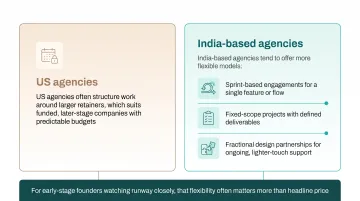
US agencies often structure work around larger retainers, which suits funded, later-stage companies with predictable budgets. India-based agencies tend to offer more flexible models:
- Sprint-based engagements for a single feature or flow
- Fixed-scope projects with defined deliverables
- Fractional design partnerships for ongoing, lighter-touch support
For early-stage founders watching runway closely, that flexibility often matters more than headline price.
2. Core characteristics: US-based vs India-based agencies
US-based and India-based UI/UX agencies differ in market proximity, cost structure, and how they handle cultural context. Here’s what each model means in practice.
2.1 What is a US-based UI/UX agency?
A US-based UI/UX agency is a design partner headquartered in the United States, with an instinctive read on US market expectations, investor aesthetics, and compliance norms. They've sat in enough board meetings and pitch rehearsals to know what makes a VC lean forward.
That instinct removes a layer of cultural translation. You're not explaining why a certain visual metaphor won't land with a US enterprise buyer; the agency already knows.
Best fit: VC-backed startups preparing pitch decks or launches that need to land precisely with Silicon Valley or US enterprise stakeholders, where getting the nuance right matters more than saving on the invoice.
💡 Working through this decision right now? If you're a climate-tech or deep-tech founder weighing this trade-off, Book a strategy call with our team, 25 minutes, no pitch, and we'll pressure-test your specific situation.
2.2 What is an India-based UI/UX agency?
An India-based UI/UX agency is a design partner headquartered in India, giving founders access to a large, increasingly research-driven talent pool at a fraction of US overhead. Many of these studios now run structured discovery processes that rival what you'd get from a US shop.
The core benefit is straightforward: senior-level design output without building an in-house team, which stretches your runway further.
Best fit: Early-stage or bootstrapped founders, plus global enterprises building offshore design pods for ongoing product work.
See how we have approached this in practice: 10 Best SaaS UX Design agencies for product growth in 2026.
How we evaluated the options
Every recommendation here comes from actual client work, brand systems shipped, websites launched, and product experiences delivered under fundraising deadlines. We compared the options against five criteria that matter most for technical founders:
- Total cost of ownership across the first 12 months (not just the sticker price)
- Speed to a usable output given a typical Series A runway
- Quality of the technical translation, can they explain your science without oversimplifying it?
- Rework risk, how often teams re-hire because the first choice couldn't scale
- Ability to move with the roadmap without a re-onboarding tax every quarter
Where we cite numbers or trade-offs below, they come from projects we've delivered or watched founders navigate first-hand.
3. US vs India: which one should you choose?
Base the decision on four factors: available budget, product complexity, your need for real-time versus async collaboration, and where your primary buyer sits.
- Choose a US-based agency if: you need tight real-time collaboration and a strong feel for US buyers, and budget isn't your main constraint
- Choose an India-based agency if: extending runway and skilled talent at lower cost matter most, and your team can work async
- Prioritize domain specialization over geography if: your product involves deeply technical or "hard-to-brief" subject matter, such as climate tech, deep tech, or regulated industries
For growth-stage or technically complex startups, a hybrid agency often beats picking a side, pairing onshore strategic thinking with offshore execution speed so you don't have to trade one for the other.
4. The hybrid model in action: A real-world example
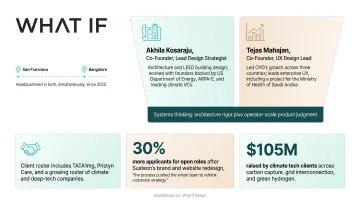
we have been headquartered simultaneously in San Francisco and Bangalore since it was founded in 2020, rather than picking one side of the US-India divide.
That structure exists because of a problem the founders kept running into: climate tech and deep-tech products where the brief itself is hard to write. You can't design a green hydrogen dashboard or a carbon capture monitoring tool without first understanding the underlying science, the regulatory context, and how technical stakeholders actually make decisions.
Founders in this space kept hitting the same trigger point: they needed senior-level design strategy without the cost or delay of hiring an in-house team. The hybrid model meets that need through two complementary founders:
- Akhila Kosaraju brings architecture and LEED building design experience, plus work with founders backed by the US Department of Energy, ARPA-E, and leading climate VCs
- Tejas Mahajan leads product and UX for software companies, designing for adoption, retention and the metrics that drive growth, across battery management systems, fleet platforms and ESG tools.
One concrete example: after a full brand and website redesign, climate tech company Susteon saw 30% more applicants for open roles than in prior hiring cycles. Its COO noted the process pushed the whole team to rethink corporate strategy.
Across the firm's climate tech client base, design work has contributed to over $105M raised by ventures working on carbon capture, grid interconnection, and green hydrogen.
For founders weighing US versus India agencies, a firm built across both ecosystems can eliminate that trade-off entirely. If you're building something technical and hard to explain, connect with What if Design to talk through a climate tech or deep-tech design partnership.
Which option is right for your stage
The right answer depends less on the two options themselves and more on where you are as a company.
Pre-seed / seed (0–$3M raised): Speed and story matter more than polish. A focused boutique-agency sprint usually beats an in-house hire, because the founder still needs to control the narrative. We've seen this pattern with early climate-tech teams, a 4-to-6-week engagement to get brand, website, and pitch coherent is more valuable than a full-time designer.
Series A ($5–20M raised): This is where a senior-led agency partner pays for itself. You need a brand system that will survive three product pivots, a website that converts enterprise buyers, and pitch materials that hold up in board meetings. In-house is still premature unless you're planning to ship design-heavy product weekly.
Series B and beyond ($20M+ raised): Hire in-house design leadership and keep an agency partner for concentrated bursts (rebrands, launches, category shifts). The two aren't substitutes at this stage, they solve different problems.
Growth-stage climate tech specifically: The stakes shift once you're commercializing. Your brand needs to hold up to procurement diligence, regulatory scrutiny, and investor updates simultaneously. A specialist studio that already speaks the science, like our team, reduces the translation tax that generalists impose on every deliverable.
5. Conclusion
There's no universal winner between US and India-based UI/UX agencies. The right choice depends on your budget, product complexity, and collaboration needs, or a hybrid partner that covers both without the usual tradeoffs.
Judge any option by outcomes that matter: longer runway, faster fundraising conversations, and a product experience that wins over technical and non-technical stakeholders alike.
Clarity here is what turns a defensive conversation into a confident one. Get a free strategic audit.
6. Frequently asked questions
6.1 Is UI/UX in demand in the USA?
Yes. The Bureau of Labor Statistics projects Web and Digital Interface Designer roles to grow roughly 7% from 2024 to 2034, adding around 9,000 jobs.
6.2 Is UI/UX in demand in India?
Yes. India has more than 200,000 DPIIT-recognized startups as of late 2025, and a growing digital user base keeps demand high for product design talent and outsourced design services.
6.3 How much does it cost to hire a US vs an India-based UI/UX agency?
Pricing varies too widely by scope and seniority to quote a reliable range. Generally, India-based agencies offer significant savings over comparable US agencies, but always compare deliverables and revision terms, not just headline rates.
6.4 Can an India-based agency work effectively with US time zones?
Yes, with the right setup. Tools like Loom, Figma comments, and structured Slack updates let India-based teams keep projects moving overnight, often producing faster turnaround than fully synchronous workflows.
6.5 Which is better for a climate tech or deep-tech startup. A US or India-based UI/UX agency?
Domain expertise in translating complex science matters more than geography here. Hybrid agencies with a presence in both the US and India are particularly well suited to these technical, hard-to-brief products.
6.6 What is a hybrid UI/UX agency model?
A hybrid agency has founders or teams operating across both the US and India, combining onshore market fluency and strategic thinking with offshore, cost-efficient execution. You get both without choosing one over the other.
Ready to take the next step?
If you're weighing a design partner for climate, deep tech, or hard-to-explain products, Book a strategy call with our founders at What if Design, a no-pressure 25-minute conversation about what you're building and where design can help. You can also View our work to see how we've helped teams like yours, or Get a free strategic Audit of your current brand, website, or product experience.