Introduction
A brilliant carbon-capture process or a breakthrough battery chemistry means nothing if investors can't grasp why it matters in the first ten seconds of a pitch.
Deep-tech founders face a harder design problem than most startups: they must explain the underlying science, prove commercial viability, and still look credible to engineers who will spot any oversimplification immediately.
India's deep-tech ecosystem has grown large enough that generic branding no longer cuts it. Nasscom and Zinnov report more than 4,200 Indian deep-tech startups, with over 550 founded in 2025 alone and $2.3 billion raised that year.
The sector now spans climate tech, energy, EVs, biotech, AI, advanced materials, robotics, and industrial technology. Each sub-sector demands different communication skills.
This shortlist evaluates agencies on technical fluency, strategic depth, brand and digital capability, startup-stage fit, and documented experience with Indian or globally operating deep-tech teams.
Key Takeaways
- Deep tech design must simplify complexity without diluting scientific or engineering credibility
- Strong partners cover brand, messaging, UX, website, and investor communications in one engagement
- What if Design leads this list for climate tech, energy, and investor-grade storytelling
- Compare agencies by case studies and process, not portfolio aesthetics alone
- Verify India delivery and pricing before assuming a global agency serves Indian founders
Overview of Deep-Tech Design Agencies in the Indian Market
A deep-tech design agency is a strategic partner that helps science- and engineering-led companies communicate, launch, and refine products across branding, websites, UX, and commercial touchpoints.
Unlike conventional startup branding, the work has to explain both what the technology does in the market and how it actually works, for audiences that range from highly technical to completely non-technical.
A single design system usually needs to serve:
- Investors assessing whether the commercial opportunity justifies the technical risk
- Technical partners validating engineering credibility and feasibility claims
- Enterprise buyers weighing adoption risk against measurable outcomes
- Early users trying to understand a genuinely new product category
Climate tech alone has drawn approximately $12.8 billion in cumulative funding across 1,583 Indian companies, with annual investment reaching $2.6 billion in 2025, according to Tracxn. Add EV infrastructure, industrial systems, biotech, and AI, and design requirements multiply quickly across the Indian market.

Not every agency on this list suits every founder. Match the agency to your startup's stage, technical category, and the specific milestone you're designing for, whether that's a fundraise, a pilot launch, or enterprise sales.
Best Design Agencies for Deep Tech Startups in 2026
This shortlist is built on publicly verifiable 2026 evidence: named case studies, documented services, and confirmed geography. Each entry compares specialisation, deliverables, and startup-stage fit so founders can assess real alignment, not marketing language.
What if Design: Best for Climate Tech, Deep Tech, and Technical B2B Storytelling
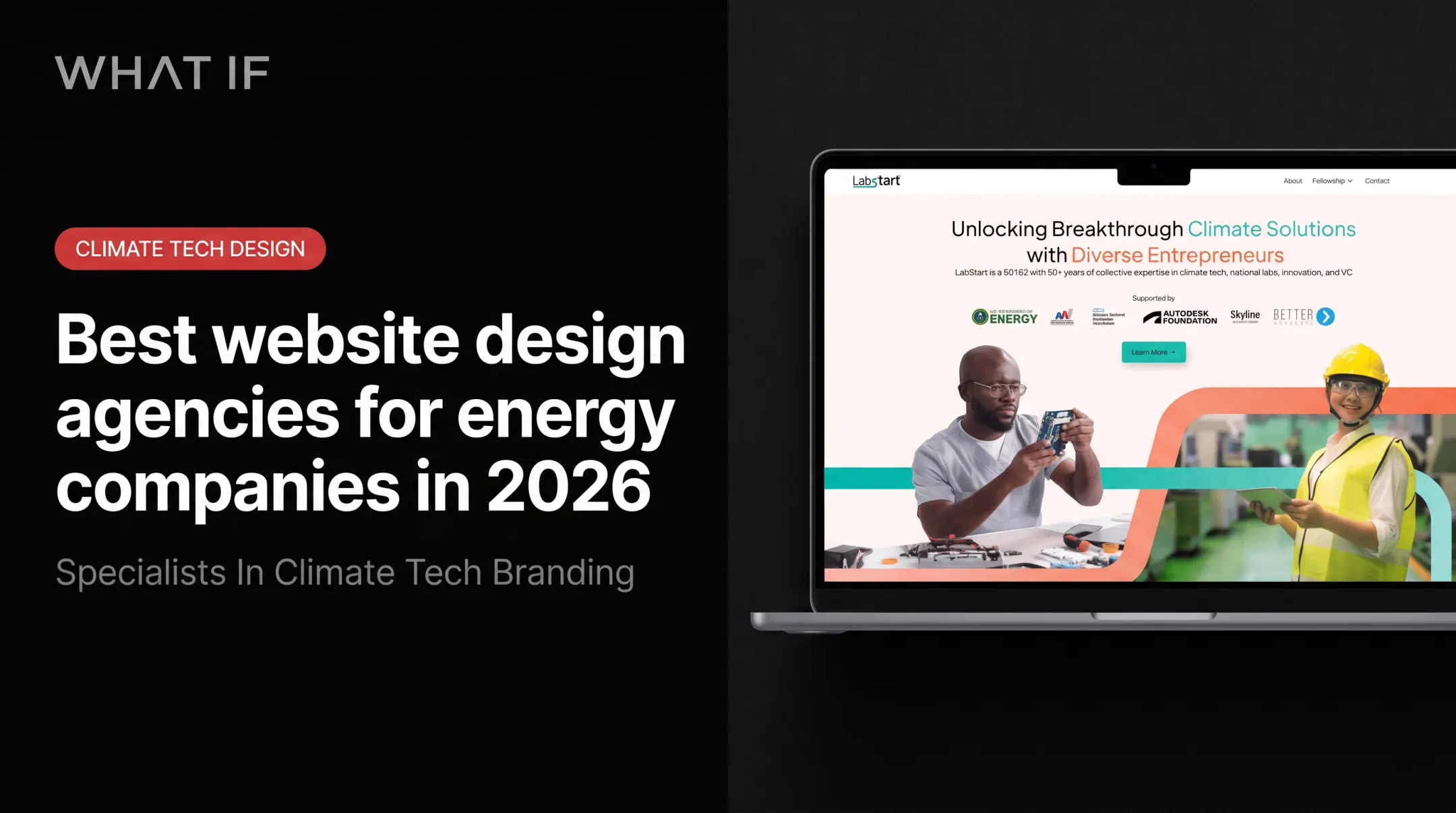
What if Design builds brand strategy, messaging, visual identity, websites, UX, product design, and pitch communications specifically for companies working on hard scientific and engineering problems. Its portfolio includes HYDGEN (decentralised hydrogen), Susteon (carbon capture and utilisation), LabStart (a climate-tech venture studio), and Batteryze (a circular EV battery-health dashboard).
The agency's point of difference is depth in one category rather than breadth across many.
Co-founder Akhila Kosaraju has worked with teams backed by the US Department of Energy and ARPA-E across carbon capture, grid interconnection, and green hydrogen, contributing to over $105 million raised.
Co-founder Tejas Mahajan leads product UX, with experience spanning battery management systems, fleet platforms, and ESG tools.
Comparison snapshot:
- Best fit: Indian or globally operating climate-tech, clean-tech, frontier-tech, EV, carbon-capture, and ESG startups that need strategy plus brand, website, or product design under one roof
- Relevant deliverables: Brand positioning (including stakeholder-alignment workshops), visual identity with WCAG-AA accessible colour systems, Webflow websites, product UX sprints, pitch decks, and technical storytelling collateral
- India relevance and model: Remote-first, closest to San Francisco and Bangalore; brand foundations in 4-6 weeks, websites in 4-12 weeks; free 30-minute consultation before any proposal
Bolder: Best for Specialist Technology Branding Across AI, Robotics, Energy, and Deep Tech
Bolder runs a dedicated deep-tech practice covering advanced materials, semiconductors, space technology, advanced manufacturing, and quantum, alongside broader work in robotics, AI, biotech, and energy.
Its named case for Attero, India's critical-minerals recovery company headquartered in Noida, is a rare example of a verified Indian client relationship rather than an unverified "global reach" claim.
Its Riverkin case (high-resolution water-sensor networks) shows the same pattern: strategy, identity, website, and go-to-market collateral built around a hard technical narrative.
Comparison snapshot:
- Best fit: Companies at any stage from first institutional raise to commercial scale, particularly in materials science and hardware
- Relevant deliverables: Brand strategy, positioning, messaging, visual identity, website, and ongoing design subscriptions; product UX is not a clearly documented core service
- Geography and pricing: Offices in San Francisco, New York, Berlin, and London; no stated India office. Published starting rate is $15,000 for a focused brand foundation, with full deep-tech engagements typically running $15,000-$200,000 depending on scope
Wunderdogs: Best for Deep-Tech Brand Translation and Layered Communication
Wunderdogs has some of the most technically specific case studies on this list: Efficient Computer (processor and chip systems), Enveda Biosciences (AI-driven drug discovery), Phytoform Labs (gene editing for crop traits), and Entact Bio, whose rebrand launched alongside an $81 million Series A.
Its approach layers content so a website can serve a casual visitor and a technical due-diligence reviewer at the same time, without resorting to generic "innovation" language.
Comparison snapshot:
- Best fit: Companies ranging from seed-stage biotech and hardware startups through to later-stage fundraising and brand partnerships
- Relevant deliverables: Brand strategy and naming, messaging frameworks, identity, Webflow/WordPress websites, product design, data visualisation, and investor fundraising collateral
- Geography and pricing: Based in San Francisco; the team works across time zones, but no India-specific delivery is documented. Pricing is not publicly listed and requires a direct quote
Metabrand: Best for Early-Stage Technology, SaaS, and Fintech Brand Foundations
Metabrand positions itself squarely around SaaS, AI, and fintech, serving founders from pre-seed through Series B.
Named clients like DeltaGen (B2B AI SaaS) and Jump Point (AI-enabled insurance) show real software depth, but the portfolio doesn't yet establish comparable experience with semiconductors, robotics, or advanced materials.
For a deep-tech startup whose core challenge is software-adjacent, that's less of a gap. For one built on frontier hardware, it's worth asking directly for relevant case studies before committing.
Comparison snapshot:
- Best fit: Early-stage AI, SaaS, and fintech companies needing a founder-led identity upgrade rather than deep physical-science translation
- Relevant deliverables: Brand audit and strategy, identity and guidelines, pitch-deck materials, and a Webflow website with a Figma UI kit
- Geography and pricing: Registered in Limassol, Cyprus, with fully remote delivery. Published packages include $4,490 for brand identity, $4,490 for a Webflow website, and $8,390 combined; broader custom engagements start around $15,000
The Branx: Best for B2B Technology Identity Systems and Fast-Moving Startup Brands
The Branx centres its practice on AI, SaaS, and B2B technology, with an industrial-cleantech portfolio that includes Furanova (bio-based plastics and green hydrogen, documented as a pre-seed engagement) and Featherless, an AI-infrastructure brand built at Series A.
Its strength is a structured, repeatable identity process: discovery, positioning, visual system, and an implementation-ready guidelines book with editable Figma files.
Comparison snapshot:
- Best fit: AI, SaaS, and industrial-technology startups needing a fast, systemised identity build rather than extended brand strategy work
- Relevant deliverables: Discovery and messaging, identity (logo, colour, typography, iconography), motion, brand guidelines, and websites; a dedicated product-UX offering isn't clearly documented
- Geography and pricing: Based in Cádiz, Spain; serves US, UK, Canadian, and EU clients asynchronously. Identity from €20,000 (~3 weeks), landing pages from €5,000, full websites from €12,500

How We Chose the Best Agencies
This list is built on first-party evidence, named case studies, service pages, and credible third-party sources. Verified facts stay separate from editorial judgement.
We prioritised agencies with genuine deep-tech relevance over those using generic "innovation" language. That meant checking for real scientific, engineering, climate, biotech, or industrial work. It also meant confirming the agency can explain the underlying business problem, not just the aesthetic output.
What we evaluated:
- Strategic and communication capability — positioning, audience mapping, messaging hierarchy, and the ability to translate technical mechanisms into commercial value
- Execution depth — brand identity, website performance, product UX, design systems, accessibility, and pitch materials
- Business fit — senior involvement, budget transparency, handoff process, and alignment with the startup's current stage
The Design Business Association's agency-selection guide recommends checking case studies against similar-sized projects and client types. It also stresses testing communication and business understanding in meetings. We applied the same standard here.
Common mistakes to avoid:
- Choosing by aesthetics alone, rather than technical case-study relevance
- Accepting vague "innovation" claims without named client evidence
- Ignoring stakeholder and approval processes that will matter mid-project
- Comparing quotes for non-equivalent scopes
- Assuming a global agency has an India presence without checking

Conclusion
The right design agency for an Indian deep-tech startup makes the technology easier to understand without stripping away the precision technical audiences expect. That balance is harder to find than it sounds, and most agencies lean too far in one direction.
Before comparing proposals, define your immediate milestone: fundraising, a pilot launch, enterprise sales, or product adoption. Then assess each agency on more than a polished portfolio:
- Scalability for your next growth stage
- Senior involvement on the work
- Documented deliverables with clear scope
- Real implementation support after handoff
If you're a climate-tech or deep-tech founder weighing brand strategy, technical storytelling, website, UX, or product design support, What if Design works remotely with teams across India. Book a free 30-minute consultation to scope the right starting point for your stage.
Frequently Asked Questions
What makes a design agency suitable for a deep tech startup?
It needs technical fluency, strategic positioning skills, and the ability to layer communication for investors, technical partners, and buyers at once. Look for sector-relevant case studies, not generic technology portfolios.
How much does deep tech branding or website design cost in India?
Published international rates translate to roughly ₹3 lakh for a single deliverable to ₹1.5 crore+ for full brand-and-product engagements, but India-specific benchmarks aren't publicly documented. Always request an itemised quote for your exact scope.
What services do deep tech design agencies offer?
Common services include brand strategy, messaging, visual identity, website design, UX/UI, product design, pitch decks, infographics, and design systems. Exact scope varies significantly between agencies.
Should a deep tech startup hire a branding agency or a product design agency?
It depends on whether your core problem is market comprehension, product usability, or both. Integrated agencies that cover brand, website, and UX typically suit early-stage deep tech teams juggling multiple priorities at once.
How early should a deep tech startup invest in design?
Start as soon as positioning, investor communication, or product validation becomes a bottleneck, often before a formal fundraise. Scope the engagement to match your stage rather than over-building too early.
How do I choose the right design agency for my deep tech startup?
Compare relevant case studies, technical understanding, process transparency, senior involvement, and pricing clarity. Ask for references and confirm post-launch support before signing anything.