Where What if Design fits in We're a senior-led creative studio built specifically for climate tech, clean tech, and deep tech founders. Since 2020, we've partnered with teams like HYDGEN, Ribbit Network, and Susteon to turn hard-to-explain technology into brands, websites, and product experiences that raise capital and win adoption. This comparison reflects how we evaluate the trade-offs when a founder asks us which route to take.
Climate tech, deep tech, and software founders are racing to build investor-ready products on tight runway. Somewhere in that race, a resourcing question sneaks up: hire UX in-house, or bring in an outsourced agency?
Get it wrong, and the fallout is real. Slow hiring cycles push back your fundraising deck. Idle in-house hires burn cash before product-market fit even exists. Inconsistent UX during a critical growth phase confuses investors and users alike.
This article breaks down in-house UX teams versus outsourced UX agencies across cost, speed, expertise, and control. We'll also walk through a real climate tech case study showing how one company solved this exact problem, without pausing to hire.
TL;DR: key takeaways
- In-house UX teams bring deep product context and consistency, but slow hiring and fixed overhead hold you back
- Outsourced UX agencies ramp fast with senior expertise, and costs flex with actual design demand
- Product maturity, budget runway, and how often UX hits your weekly roadmap should drive the choice
- Many startups pair a lean internal product lead with an agency for execution
1. In-house UX team vs outsourced UX agency: quick comparison
Here's how the two models stack up on cost, speed, expertise, control, and scale:
| Factor | In-House Team | Outsourced UX Agency |
|---|---|---|
| Cost & Budget | Fixed salary, benefits, and overhead regardless of workload | Pay-for-scope or retainer; cost scales with actual demand |
| Speed to Start | Weeks to months to recruit, plus a notice period | Typically days to a few weeks |
| Expertise & Skill Range | Limited to the hired individual's background | Broader bench of senior, niche specialists |
| Control & Communication | Sits inside daily standups, absorbs context naturally | Needs structured briefs and a defined cadence |
| Scalability | Slow to flex; carries hiring and layoff risk | Scales up or down quickly for launches or sprints |
Speed is where the gap shows up fastest. Employ's 2024 Recruiter Nation Report found the average time to fill a role dropped to 41 days in 2024, down from 48 in 2023. That figure doesn't include the standard two-week notice most new hires serve before their first day.
An outsourced agency, by contrast, can typically start within days of signing.
2. What is an in-house UX team?
An in-house UX team is made up of full-time UX/UI designers on your payroll. They sit inside your company's culture, attend daily standups, and shape the product roadmap from within.
That proximity is the whole point. Institutional knowledge compounds over time. A designer who's sat through every sprint planning meeting for a year doesn't need a fresh brief each time a feature ships. They already know why last quarter's onboarding flow underperformed.
That consistency comes at a fixed price. The U.S. Bureau of Labor Statistics puts the median annual wage for web and digital interface designers at $98,090 as of May 2024, and that's before benefits, payroll taxes, equipment, and tools.
Industry benchmarks put base pay for a senior in-house product designer at $100,000 or more annually, before those extras stack on.
2.1 When does an in-house UX team make sense?
In-house hiring earns its keep once product-market fit is confirmed and UX decisions shape the roadmap every sprint. At that point, you need someone who lives inside the product, not someone briefed on it weekly. It tends to fit:
- Consumer-scale products with a high release cadence, where design touches every weekly ship
- Businesses that can comfortably absorb a fixed salary regardless of week-to-week workload swings
- Teams where UX collaborates daily with engineering and product, not just at milestones
Regulated categories like health tech and fintech often lean toward keeping design close for oversight reasons, though the right structure still depends on your specific compliance requirements.
How we evaluated the options
Every recommendation here comes from actual client work, brand systems shipped, websites launched, and product experiences delivered under fundraising deadlines. We compared the options against five criteria that matter most for technical founders:
- Total cost of ownership across the first 12 months (not just the sticker price)
- Speed to a usable output given a typical Series A runway
- Quality of the technical translation, can they explain your science without oversimplifying it?
- Rework risk, how often teams re-hire because the first choice couldn't scale
- Ability to move with the roadmap without a re-onboarding tax every quarter
Where we cite numbers or trade-offs below, they come from projects we've delivered or watched founders navigate first-hand.
3. What is an outsourced UX agency?
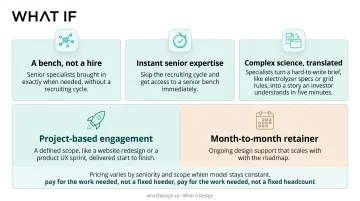
An outsourced UX agency is an external design partner brought in on a project or retainer basis to handle UX/UI strategy and execution. Instead of hiring one person, you're hiring a bench of specialists, exactly when you need them.
The advantage is instant access to senior-level expertise without a recruiting cycle. Boutique agencies focused on technical domains like climate tech bring something a generalist can't. They've already learned how to translate a hard-to-write brief: carbon capture chemistry, electrolyzer specs, grid interconnection rules, into a product experience an investor can understand in five minutes.
💡 Working through this decision right now? If you're a climate-tech or deep-tech founder weighing this trade-off, Book a strategy call with our team, 25 minutes, no pitch, and we'll pressure-test your specific situation.
Pricing varies by seniority, specialization, and scope, so a single "agency rate" doesn't really exist. What stays consistent is the model: pay for the work needed, not a fixed headcount. Some engagements are project-based: a website redesign or a product UX sprint. Others run as month-to-month retainers for ongoing design support.
3.1 When does outsourcing UX make sense?
Outsourcing tends to fit early- and mid-stage startups moving fast on fundraising decks, MVPs, or investor-facing product experiences. There's no time for a three-month hiring search when a term sheet deadline is six weeks out. It's especially valuable when:
- Technical or novel problems (carbon capture, green hydrogen, grid interconnection) that need a partner who learns the science before wireframing
- Senior strategic thinking without a long-term headcount commitment
- Pre-product-market-fit stages where full-time hiring would burn unrecoverable runway
Companies working in decentralized hydrogen or carbon management often face this exact tradeoff: the science is the hard part, and design needs to catch up without slowing the raise.
4. Real-world example: outsourcing UX for a climate tech startup
Susteon is a climate-tech incubator developing decarbonization technologies across carbon capture, hydrogen production, and CO₂ management. Its science was solid. Its website wasn't doing that science justice.
Investors, partners, and prospective hires landed on the site and struggled to understand what Susteon actually did, or why it mattered. That's a common bind for deep-tech founders. The harder the science, the harder it is to explain in thirty seconds, and thirty seconds is often all an investor gives you.
Susteon didn't have internal design bandwidth to fix this on its own. Like many small climate-tech teams, its focus was the technology, not building out a design function it might only need for a few months. That's the scenario where outsourcing tends to win: senior strategic design, fast, without a hiring detour.
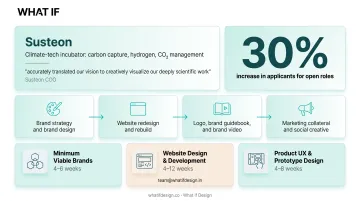
What if Design took on the full scope over a four-month engagement:
- Brand strategy and brand design
- Website redesign and rebuild
- Logo, brand guidebook, and brand video
- Marketing collateral and social creative
The team used visual storytelling, interactive technology explanations, and simple animations to make the science legible to a broader audience.
Sudarshan Gupta, COO of Susteon summed it up: the team "accurately translated our vision to creatively visualize our deeply scientific work."
The result was measurable. The redesigned site drove a 30% increase in applicants for open roles compared with the previous version, alongside clearer messaging for investors and partners. That project sits in What if Design's broader climate portfolio: hydrogen, carbon capture, and related deep tech, with clients backed by the U.S. Department of Energy, ARPA-E, and leading climate VCs.
This path fits founders who need investor-ready design now, not after a hiring cycle they don't have time for.
If you're a climate tech or deep-tech founder facing this resourcing question, we offer three focused engagements:
- Minimum Viable Brands (4 to 6 weeks)
- Website Design & Development (4 to 12 weeks)
- Product UX & Prototype Design (4 to 8 weeks)
Reach out at team@whatifdesign.in to talk through what your product needs before your next raise.
5. In-house vs outsourced UX: which one should you choose?
Before deciding, weigh four factors:
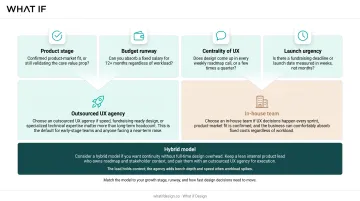
- Product stage: Confirmed product-market fit, or still validating the core value prop?
- Budget runway: Can you absorb a fixed salary for 12+ months regardless of workload?
- Centrality of UX: Does design come up in every weekly roadmap call, or a few times a quarter?
- Launch urgency: Is there a fundraising deadline or launch date measured in weeks, not months?
Choose an outsourced UX agency if speed, fundraising-ready design, or specialized technical expertise matter more than long-term headcount. This is the default for early-stage teams and anyone facing a near-term raise.
Choose an in-house team if UX decisions happen every sprint, product-market fit is confirmed, and the business can comfortably absorb fixed costs regardless of workload.
Consider a hybrid model if you want continuity without full-time design overhead. Keep a lean internal product lead who owns roadmap and stakeholder context, and pair them with an outsourced UX agency for execution. The lead holds context; the agency adds bench depth and speed when workload spikes.
Match the model to your growth stage, runway, and how fast design decisions need to move. Get that fit right and you reduce burn, clear fundraising cycles faster, and ship a consistent product experience instead of one patched together under deadline pressure.
A site that reflects the company you have actually become is the cheapest credibility you can buy, and it puts you back in control of the first impression. Get a free strategic audit.
Which option is right for your stage
The right answer depends less on the two options themselves and more on where you are as a company.
Pre-seed / seed (0–$3M raised): Speed and story matter more than polish. A focused boutique-agency sprint usually beats an in-house hire, because the founder still needs to control the narrative. We've seen this pattern with early climate-tech teams, a 4-to-6-week engagement to get brand, website, and pitch coherent is more valuable than a full-time designer.
Series A ($5–20M raised): This is where a senior-led agency partner pays for itself. You need a brand system that will survive three product pivots, a website that converts enterprise buyers, and pitch materials that hold up in board meetings. In-house is still premature unless you're planning to ship design-heavy product weekly.
Series B and beyond ($20M+ raised): Hire in-house design leadership and keep an agency partner for concentrated bursts (rebrands, launches, category shifts). The two aren't substitutes at this stage, they solve different problems.
Growth-stage climate tech specifically: The stakes shift once you're commercializing. Your brand needs to hold up to procurement diligence, regulatory scrutiny, and investor updates simultaneously. A specialist studio that already speaks the science, like our team, reduces the translation tax that generalists impose on every deliverable.
6. Frequently asked questions
6.1 Should you do UX in-house or outsource it?
It depends on product stage and how often UX shapes daily decisions. Early-stage and fundraising-focused teams usually benefit from outsourcing. Mature products with constant design needs justify an in-house hire.
6.2 What does an outsourced UX agency actually do?
They handle research, wireframing, UI design, prototyping, and iteration based on shared context, product notes, and stakeholder feedback, and revise until the work matches your goals.
6.3 How much does it cost to outsource UX design compared to hiring in-house?
A senior in-house product designer typically costs $100,000 or more annually before benefits. Agency engagements are scoped and priced per project or retainer, so you pay for the work delivered, not a fixed headcount.
6.4 Can a startup switch from outsourced UX to an in-house team later?
Yes, this is a common trajectory as companies scale past product-market fit. Plan for a short knowledge-transfer window so the incoming hire inherits research, design files, and decision history.
6.5 What are the risks of outsourcing UX design?
Harvard Business Review has flagged misaligned objectives as a recurring risk in design outsourcing. Clear briefs, shared tools, and a defined communication cadence close that gap.
6.6 How do you choose the right outsourced UX agency for a technical or climate tech product?
Look for agencies with proven work in your specific domain, such as hydrogen, carbon capture, or ESG, plus a process for learning the science before designing, not just general branding experience.
Ready to take the next step?
If you're weighing a design partner for climate, deep tech, or hard-to-explain products, Book a strategy call with our founders at What if Design, a no-pressure 25-minute conversation about what you're building and where design can help. You can also View our work to see how we've helped teams like yours, or Get a free strategic Audit of your current brand, website, or product experience.