Where What if Design fits in We're a senior-led creative studio built specifically for climate tech, clean tech, and deep tech founders. Since 2020, we've partnered with teams like HYDGEN, Ribbit Network, and Susteon to turn hard-to-explain technology into brands, websites, and product experiences that raise capital and win adoption. This comparison reflects how we evaluate the trade-offs when a founder asks us which route to take.
Every founder building a product eventually hits the same wall: who designs the brand, the website, the product experience? An in-house hire, an agency, or a freelancer from Upwork or Toptal?
For technical and deep-tech founders, this decision carries extra weight. If you're building a green hydrogen electrolyzer or a carbon capture platform, the design brief itself is hard to write.
Get the hiring call wrong, and you either burn runway waiting for someone to learn your industry, or you ship a website that undersells years of hard science.
This guide breaks down cost, speed, expertise, and control across all three models, so you can choose with confidence based on where your company actually stands.
TL;DR: key takeaways
- In-house delivers the deepest brand and product ownership, at the highest fixed cost and longest ramp.
- Agencies bring senior, multi-disciplinary expertise fast without payroll cost, ideal when racing to funding.
- Upwork and Toptal fit narrowly scoped tasks, but you own strategy and quality control.
- Best-fit model depends on funding stage, budget, urgency, and how defined your brief is.
- Many growing startups blend models: one internal owner plus an outsourced specialist partner.
1. In-house vs agency vs upwork/toptal: quick comparison
Here's how the three models compare on the factors founders weigh when choosing a design partner.
| Factor | In-House | Agency | Upwork/Toptal |
|---|---|---|---|
| Cost | Highest fixed cost: salary, benefits, tools, management overhead | Predictable monthly or project retainer covering a full team | Lowest upfront cost, priced per task or hour |
| Speed to start | Weeks to months for hiring plus ramp-up | Days to a couple weeks with existing processes | Almost immediate once you select a freelancer |
| Expertise & strategy | Deep product knowledge, often narrower skill range | Senior, cross-disciplinary expertise plus strategic input | Variable depth; strategy stays your responsibility |
| Scalability | Fixed capacity; scaling means new hires | Flexes up or down with project needs | Easy to add freelancers, hard to coordinate several |
| Accountability | Full accountability sits inside the company | Shared ownership of outcomes, not just deliverables | Responsibility for the result stays mostly with you |
2. Understanding your three hiring options
Design hiring usually comes down to three models: in-house, agency, or freelance marketplaces. Each trades cost, speed, and strategic ownership differently.
2.1 In-house design teams
An in-house designer is a full-time employee dedicated entirely to your brand, product, and roadmap. Once you have enough steady, high-volume design work to keep someone busy every week, this model starts to make financial sense.
The core benefit is continuity. In-house designers accumulate deep product and market knowledge over time, so their output gets tighter and aligns faster with your roadmap the longer they stay on.
Best fit: later-stage companies, typically post-Series A or B, with enough ongoing design demand to justify a full salary.
The trade-off is cost and ramp time. Glassdoor's 2025 data puts median total pay for a senior US product designer at $210,000, with base salary alone ranging $112,000 to $189,000, before benefits, equipment, software, and management hours to onboard them.
Add a standard hiring cycle of sourcing, interviews, and negotiation, and months can pass before that designer ships anything meaningful on a technical product.
2.2 Design agencies (full-service partners)
Agencies are external teams that deliver senior, multi-disciplinary expertise across brand, web, and product, without the overhead of a full-time hire. They bring process and strategic thinking, which matters most when the brief itself is technically complex: translating climate science or hard-tech mechanics into a brand and website that closes funding.
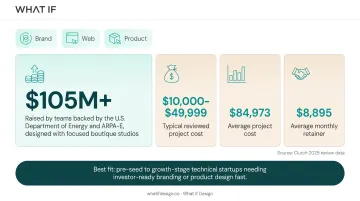
Boutique agencies illustrate this well. What if Design, for instance, works exclusively with climate tech, deep tech, and sustainability-focused founders. Its co-founders have helped teams backed by the US Department of Energy and ARPA-E raise more than $105 million collectively, largely because the team learns the underlying science first, rather than treating a carbon capture startup like a consumer app.
Cost-wise, agencies sit in a middle tier. Clutch's 2025 review What we see in practice is reviewed UX/UI agency projects typically running $10,000 to $49,999, with an average project cost near $84,973 and average monthly retainers around $8,895. That often costs less than one fully loaded senior in-house hire, while covering an entire team's worth of skills.
Best fit: pre-seed to growth-stage technical startups needing investor-ready branding or product design fast, without a multi-month hiring detour.
2.3 Freelance marketplaces (upwork/toptal)
These platforms connect businesses directly with independent contractors for scoped, task-based work. The core benefit is low upfront cost and fast turnaround on a clearly defined, contained deliverable.
Best fit: a single well-scoped task. Think resizing a logo across formats, or a landing page mockup, where you already know exactly what "good" looks like.
Speed here can be impressive. Toptal reports matching clients with a designer in under 24 hours on average and completing a hire within about 48 hours, while screening out more than 97% of applicants to maintain that bar.
Upwork lists product designers at roughly $20 to $50 an hour, with small fixed-price projects running $200 to $1,500.
💡 Working through this decision right now? If you're a climate-tech or deep-tech founder weighing this trade-off, Book a strategy call with our team, 25 minutes, no pitch, and we'll pressure-test your specific situation.
The trade-off: you own the strategy. Upwork's own client guidance recommends writing a detailed brief, reviewing portfolios, interviewing candidates, and setting milestones, revisions, and ownership terms upfront. For a logo tweak, that's manageable. For a complex product with a technical audience, it becomes a second job.
See how we have approached this in practice: 10 Best SaaS UX Design agencies for product growth in 2026.
How we evaluated the options
Every recommendation here comes from actual client work, brand systems shipped, websites launched, and product experiences delivered under fundraising deadlines. We compared the options against five criteria that matter most for technical founders:
- Total cost of ownership across the first 12 months (not just the sticker price)
- Speed to a usable output given a typical Series A runway
- Quality of the technical translation, can they explain your science without oversimplifying it?
- Rework risk, how often teams re-hire because the first choice couldn't scale
- Ability to move with the roadmap without a re-onboarding tax every quarter
Where we cite numbers or trade-offs below, they come from projects we've delivered or watched founders navigate first-hand.
3. Which option is best for your stage?
Choosing well means weighing four factors:
- Budget: can you absorb a six-figure salary plus benefits, or does cost need to stay tied directly to output?
- Urgency: do you need something live in two weeks, or can you wait three months for the right hire?
- Brief clarity: do you already know exactly what you need, or does someone need to help you figure it out first?
- Internal bandwidth: does anyone on your team have time to manage a freelancer day-to-day?
From there, the recommendation is clear:
- Go in-house once you have consistent, high-volume design work and the budget to keep a full-time designer fully occupied. Five to ten design requests a week, every week, is usually the tipping point.
- Pick an agency when you need senior strategic thinking and full-service execution fast. This fits especially well when you're translating complex science or product mechanics into a story investors and customers can grasp quickly.
- Use Upwork or Toptal when the task is narrow, well-scoped, and low-risk, and you have time to manage it directly.
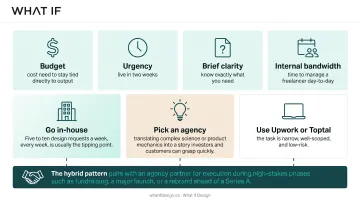
The hybrid pattern: many growing companies don't pick just one lane. A founder or product lead owns the vision internally, then pairs with an agency partner for execution during high-stakes phases such as fundraising, a major launch, or a rebrand ahead of a Series A. That combination delivers continuity without the fixed cost of a full internal team.
4. Real-world example: choosing the right partner under pressure
Susteon, a climate-technology incubator working across carbon capture, hydrogen production, and CO2 management, faced a familiar deep-tech problem. Its website wasn't communicating the science clearly enough to engage investors, partners, or job candidates.
The gap wasn't substance. Susteon had the technology. The gap was translation, turning genuinely complex chemistry and engineering into a brand and website that a non-specialist could grasp in minutes.
Climate tech founders in this position often face a specific bind. Hiring a full-time designer takes months they don't have. Most freelancers on general marketplaces haven't worked inside decarbonization or hard-science industries before.
That mix of tight timelines and a knowledge gap is exactly where a specialized agency earns its retainer.
What if Design ran a four-month engagement covering:
- Brand strategy, logo, and a full brand guidebook
- A brand video and marketing collateral
- A complete website redesign with visual storytelling and interactive animations
The result: Susteon's redesigned site generated 30% more applicants for open career roles compared to its previous listings. Sudarshan Gupta, COO of Susteon, Sudarshan Gupta, said the team "brought our company messaging to the forefront" and "accurately translated our vision."
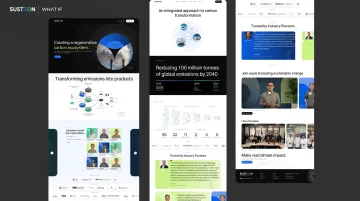
For technically complex, high-stakes design briefs, a specialized full-service agency can move faster and align better than a hiring search or a patchwork of freelancers. The learning curve on the science is already climbed.
That is the filter climate tech and deep-tech founders can use when weighing in-house, marketplace freelancers, and an agency like What if Design for branding or product design under time pressure.
Which option is right for your stage
The right answer depends less on the two options themselves and more on where you are as a company.
Pre-seed / seed (0–$3M raised): Speed and story matter more than polish. A focused boutique-agency sprint usually beats an in-house hire, because the founder still needs to control the narrative. We've seen this pattern with early climate-tech teams, a 4-to-6-week engagement to get brand, website, and pitch coherent is more valuable than a full-time designer.
Series A ($5–20M raised): This is where a senior-led agency partner pays for itself. You need a brand system that will survive three product pivots, a website that converts enterprise buyers, and pitch materials that hold up in board meetings. In-house is still premature unless you're planning to ship design-heavy product weekly.
Series B and beyond ($20M+ raised): Hire in-house design leadership and keep an agency partner for concentrated bursts (rebrands, launches, category shifts). The two aren't substitutes at this stage, they solve different problems.
Growth-stage climate tech specifically: The stakes shift once you're commercializing. Your brand needs to hold up to procurement diligence, regulatory scrutiny, and investor updates simultaneously. A specialist studio that already speaks the science, like our team, reduces the translation tax that generalists impose on every deliverable.
5. Conclusion
There's no single "best" model here. The right choice depends on your company's stage, budget, urgency, and how technically complex your design brief actually is. A pre-seed founder with a groundbreaking but hard-to-explain technology needs something different than a Series B company with a steady stream of product design requests. Revisit the decision as you grow rather than treating it as a one-time call.
Choosing well affects cost efficiency, time-to-market, and, for technical founders especially, whether investors and customers actually understand what you've built. Get the model right, and design becomes leverage toward your next raise.
Clarity here is what turns a defensive conversation into a confident one. Get a free strategic audit.
6. Frequently asked questions
6.1 Agency vs freelance platform: which is better for hiring?
An agency is better when you need consistent quality, strategic ownership, and one accountable partner. Freelance platforms suit one-off, well-scoped tasks where you can brief tightly and manage the work yourself.
6.2 How much does it cost to hire a design agency versus an in-house designer?
A senior in-house designer's base pay alone runs $112,000 to $189,000 in the US, before benefits and tools. Agency retainers often land in the $3,000 to $9,000 monthly range, often below a fully loaded internal hire in the early stages.
6.3 When should a startup hire an in-house designer instead of an agency?
In-house makes sense once your design workload is high and consistent enough to keep a full-time hire fully utilized. That's typically post-Series A or B, once ongoing product and brand needs justify a full salary.
6.4 Is upwork or toptal better for finding a startup designer?
Toptal screens harder and costs more; Upwork is broader and cheaper but needs more vetting from you. Either fits narrow tasks like a logo resize or one landing page, neither replaces ongoing strategic design support.
6.5 What are the risks of using freelance marketplaces for complex design work?
Quality varies widely, and strategic ownership stays with you. You also own project management: writing the brief, vetting portfolios, and running revisions.
6.6 Can a design agency work like an in-house extension of my team?
Many agencies, especially specialized boutique ones, integrate closely through weekly check-ins, shared design backlogs, and async feedback via tools like Figma and Slack. This offers senior-level partnership without payroll overhead.
Ready to take the next step?
If you're weighing a design partner for climate, deep tech, or hard-to-explain products, Book a strategy call with our founders at What if Design, a no-pressure 25-minute conversation about what you're building and where design can help. You can also View our work to see how we've helped teams like yours, or Get a free strategic Audit of your current brand, website, or product experience.