Without a plan, brand, product, and investor-facing design end up built in silos. Marketing hires one agency for the website. The product team builds screens ad-hoc. Someone pulls together a pitch deck the week before a board meeting. The result: inconsistent signals to investors and customers, right when consistency matters most.
This guide borrows a framework founders already understand: investment planning. Stages, categories, allocation rules, time horizons. Applied to design, these principles help Series B+ teams stop treating design as a series of emergencies and start treating it as a staged, multi-year investment that scales with each funding round.
TL;DR: key takeaways
- Stage the design roadmap to company growth instead of locking one static plan
- Split design spend across categories, like a diversified investment portfolio
- Use 10/5/3-year horizons so design stays tied to fundraising milestones
- Treat the execution model (in-house, fractional, or agency) as equal to the plan itself
1. Why Series B+ startups need to treat design as a staged investment
Series B+ is an inflection point. Teams grow, product lines multiply, and investors start scrutinizing brand and UX as closely as they scrutinize the cap table. But the growth curve isn't as tidy as founders assume.
Carta's 2024 compensation data found that median SaaS Series C headcount fell from 131.7 to 86.5 between H1 2022 and H1 2024: a 34.5% decline driven by leaner, more capital-efficient scaling. The old assumption of a steady headcount ramp between rounds no longer holds. That unpredictability is exactly why design needs a flexible, staged plan rather than a one-time deliverable.
1.1 The single-project trap
Most founders treat brand or website work as a finished project, not an evolving system. They launch a site at seed stage, never touch it again until it visibly embarrasses them, then scramble.
LabStart, a climate-tech venture studio, described its starting point as a "static, version 101 website" before What if Design rebuilt it into a complete brand identity over a four-month engagement. That gap between "shipped once" and "systemized" is where fragmentation creeps in as companies expand into new markets or verticals.
1.2 A 5-stage design maturity framework
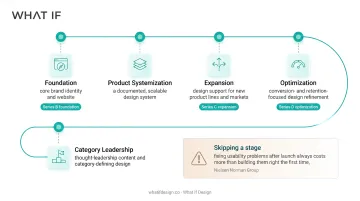
Borrowing from classic investment planning (goal-setting, risk assessment, allocation, execution, review), a design roadmap can follow five sequential stages:
- Foundation: core brand identity and website
- Product Systemization: a documented, scalable design system
- Expansion: design support for new product lines and markets
- Optimization: conversion- and retention-focused design refinement
- Category Leadership: thought-leadership content and category-defining design
Skipping stages is where the trouble starts. Jumping straight to "optimization" without a systemized foundation forces teams to rebuild brand and UX standards mid-flight. Nielsen Norman Group's research on UX debt notes that fixing usability problems after launch always costs more than building them right the first time.
Tying each stage to a funding milestone (Series B foundation, Series C expansion, Series D optimization) keeps design work directly supporting the story you're telling your next round of investors.
2. The 7 design investment categories every Series B+ roadmap should cover
Think of these as asset classes in a design portfolio. Each plays a different role, and neglecting any one creates a gap that shows up at the worst possible time: usually during due diligence.
- Brand identity & positioning: A scalable brand system (not just a logo) prevents a costly rebrand at every pivot or adjacent-market move. Susteon's rebrand produced a documented 30% increase in applicants.
- Website & digital presence: Your site has to flex for product launches, funding news, and SEO across multiple years. HYDGEN's redesign made dense technical claims: 10 kW and 100 kW electrolyzers, 99.roughly 97% purity, easy to understand.
- Product UX/UI systemization: Moving from ad-hoc screens to shared components, tokens, and UI guidelines speeds engineering and protects retention as the product team grows.
- Investor & pitch collateral: Pitch decks and data rooms are recurring investments tied to each round, not a one-off task. What if Design's decks have contributed to over $25M raised across its client base.
- Sales & partnership collateral: Case studies, one-pagers, and proposal templates need to scale as enterprise and utility-scale deal cycles get more complex.
- Employer branding & recruiting assets: Design-forward careers pages and culture decks matter once you're competing for scarce technical and climate-science talent post-Series B.
- Design systems & operations infrastructure: Brand guidelines, component libraries, and asset management make every other category faster and cheaper to run: and one integrated team beats hiring brand, product, and collateral roles separately.
💡 Working through this decision right now? If you're a climate-tech or deep-tech founder weighing this trade-off, Book a strategy call with our team, 25 minutes, no pitch, and we'll pressure-test your specific situation.
See how we have approached this in practice: Mobile UX design.
3. Budget allocation and time-horizon rules for your design roadmap
3.1 Applying a balanced allocation rule to design spend
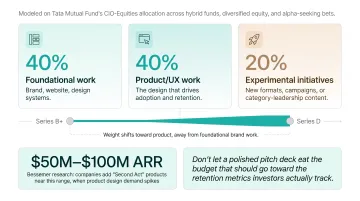
A practical starting point is a 40-40-20 style split. In investing, Tata Mutual Fund's CIO-Equities uses a version of this across hybrid funds, diversified equity, and alpha-seeking bets to balance stability with upside. The same logic maps cleanly onto design budgeting.
Applied to a Series B+ design budget, that might look like:
- roughly 40% foundational work: brand, website, design systems
- roughly 40% product/UX work: the design that drives adoption and retention
- roughly 20% experimental initiatives: new formats, campaigns, or category-leadership content
As you move from Series B toward Series D, weight should shift toward product and away from foundational brand work. Your brand system is built; your product surface area is growing.
Bessemer's research on cloud companies found that businesses tend to add "Second Act" products once they approach $50M, $100M in ARR, which is exactly when product design demand spikes. Don't let a polished pitch deck eat the budget that should go toward the retention metrics investors actually track.
3.2 Structuring the roadmap across a 10/5/3 time horizon
Borrowed from the investing "10/5/3 rule" (a rough long-term planning heuristic, not a guaranteed return), the same structure works for design:
- 10-year vision: defines category-leadership ambitions
- 5-year roadmap: sets major design system and brand milestones
- 3-year plan: details concrete execution tied to your current and next funding round
Revisit the 3-year plan annually. Revisit the 5-year roadmap after every major funding round. This structure also gives founders a ready answer when a board member asks how design strategy supports the company's growth trajectory, instead of a shrug.
4. Choosing the right execution model for your design roadmap
In-house teams offer full-time focus, but they come with real costs. A senior in-house designer typically runs more than $100,000 annually before benefits. Most small-to-mid-size teams still end up with one or two designers who are already stretched thin.
A remote-first, senior-level partner that specializes in your sector can execute a multi-year roadmap without that overhead. We give you that senior capacity at startup cost, without the commitment of an equivalent in-house hire, and we focus on climate tech, carbon capture, and hard-tech companies, sectors where the brief is often hard to write because the science is complex.
Susteon's four-month engagement is a useful example of coordinated delivery:
- Brand strategy and brand design
- Website redesign
- Brand guidebook and brand video
- Marketing collateral
That work shipped as one body of output rather than five separate vendor relationships.
Whichever model you choose, assign clear internal ownership. A founder, Head of Marketing, or product lead should manage the roadmap and coordinate with any outside partner, even fully outsourced execution needs someone internally who owns the plan.
5. Common pitfalls that derail multi-year design roadmaps
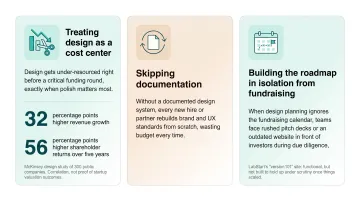
Treating design as a cost center. This leads to under-resourcing right before a critical funding round, exactly when polish matters most. McKinsey's design study of 300 public companies found top-quartile design performers posted 32 percentage points higher revenue growth and 56 percentage points higher shareholder returns over five years.
That's correlation from public companies, not proof of startup valuation outcomes. Still, it's a strong signal design isn't a line item to cut.
Skipping documentation. Without a documented design system, every new hire or partner rebuilds brand and UX standards from scratch. That's wasted budget, every single time.
Building the roadmap in isolation from fundraising. When design planning ignores the fundraising calendar, you end up with rushed pitch decks or an outdated website in front of investors during due diligence. LabStart's "version 101" site is a familiar version of this story: functional, but not built to hold up under scrutiny once things scaled.
Clarity here is what turns a defensive conversation into a confident one. Get a free strategic audit.
6. Frequently asked questions
6.1 What are the 5 stages of investing?
The classic framework covers goal-setting, risk assessment, allocation, security selection, and monitoring/rebalancing. Those same functions map onto a startup's design maturity journey: foundation, systemization, expansion, optimization, and category leadership.
6.2 What are the 7 types of investments?
The SEC names three core asset classes; FINRA lists eleven product categories. For design, a comparable seven-category structure works well: brand, website, product UX, investor collateral, sales collateral, employer branding, and design operations infrastructure.
6.3 What is the 40-40-20 rule in investing?
One documented approach splits a portfolio roughly 40% hybrid funds, roughly 40% diversified equity, and roughly 20% higher-risk alpha bets. Applied to design, that means roughly 40% foundational work, roughly 40% product/UX, and roughly 20% experimental initiatives.
6.4 What is the 10/5/3 rule of investment?
This long-term planning heuristic uses rough historical return averages (about 10% equities, roughly 5% fixed income, roughly 3% cash) as expectation anchors, not guarantees. For design, it becomes a 10-year vision, 5-year roadmap, and 3-year execution plan.
6.5 How much should a Series B+ startup budget for design?
No single percentage fits every company. Scale budget with headcount, product complexity, and funding stage, and use a split like 40-40-20 as a starting point, not a rigid rule.
6.6 How often should a startup update its design roadmap?
Review the 3-year execution plan annually. Revisit the 5-year roadmap after each major funding round, when new capital and priorities reshape what comes next.
Ready to take the next step?
If you're weighing a design partner for climate, deep tech, or hard-to-explain products, Book a strategy call with our founders at What if Design, a no-pressure 25-minute conversation about what you're building and where design can help. You can also View our work to see how we've helped teams like yours, or Get a free strategic Audit of your current brand, website, or product experience.