The stakes are higher now because the money is tighter. Climate tech VC funding across North America and Europe fell to $24 billion across 1,314 deals in 2024, more than 17% below 2023. That is nowhere near the $41 billion raised in 2021. Fewer dollars means every pitch gets scrutinized harder.
Branding spend reflects that reality. Some founders pay a few thousand dollars for a logo and one-pager. Others invest well over $50,000 in a full identity, website, and investor communication system.
This guide breaks down typical spend by stage, what drives cost up or down, and how to budget in a way that actually earns its keep before you raise.
TL;DR: key takeaways
- Climate tech branding spend ranges from roughly $3,000 pre-seed to $100,000+ pre-Series B, scaling with technical complexity and audience.
- Underbudgeting on a logo-only approach and overspending before validating your story are the two most common mistakes.
- Technical complexity, deliverable scope, and team structure drive cost more than company size alone.
- Treat branding as deal-insurance for fundraising and partnerships, not a discretionary marketing line item.
1. How much should climate tech startups spend on branding pre-Series B?
There's no fixed number here. Spend scales with funding stage, how technically hard your science is to explain, and what the branding actually needs to accomplish: usually translating deep tech into language investors and buyers trust.
Three mistakes show up repeatedly:
- Logo-only underbudgeting that falls apart when diligence hits carbon capture, hydrogen electrolysis, or battery chemistry.
- Premium agency overspend on polish before the story has been stress-tested with real investors.
- Treating the pitch deck as an afterthought expense instead of the fundraising asset it actually is.
1.1 Pre-seed / seed stage
Typical range: $3,000, $15,000
What's included:
- Basic logo and simple visual identity
- One-pager or simple deck
- Early messaging framework
Best for: validating an idea and early, informal investor conversations.
That scope matches a 4 to 6 week minimum viable brand package at What if Design: narrative and messaging hierarchy, visual identity, and a compact guidelines mini-book. Nothing that needs a rebuild in six months.
1.2 Series A stage
Typical range: $15,000, $50,000
Clutch's verified-review data on general agency work offers a useful benchmark: most branding projects fall between $10,000 and $49,999, with website builds often landing in a similar range. Climate tech projects tend to sit toward the higher end of that band once technical translation work is added.
What's included:
- Full brand identity system
- Scalable website
- Sales collateral
- Branded templates for decks and one-pagers
Best for: companies with initial traction preparing to raise a larger round.
1.3 Series A to pre-Series B stage
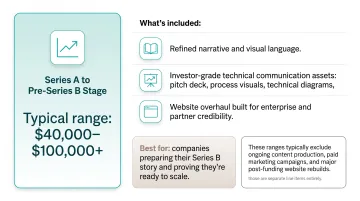
Typical range: $40,000, $100,000+
What's included:
- Refined narrative and visual language
- Investor-grade technical communication assets: pitch deck, process visuals, technical diagrams
- Website overhaul built for enterprise and partner credibility
Best for: companies preparing their Series B story and proving they're ready to scale.
These ranges typically exclude ongoing content production, paid marketing campaigns, and major post-funding website rebuilds. Those are separate line items entirely.
2. Key factors that affect climate tech branding costs
Climate tech branding costs hinge on technical, operational, and investor-facing factors that consumer and SaaS brands rarely face.
Complexity of the technology. Carbon capture, green hydrogen, grid interconnection, and battery chemistry are hard to explain. A strategist has to understand cryogenic hydrogen storage or solid-state battery interfaces well enough to turn them into a clear diagram, not just a pretty one. That translation work raises cost compared to simpler climate products like a consumer solar app.
Scope of deliverables. Cost multiplies as scope expands:
- Logo only
- Full identity
- Identity + website
- Identity + website + pitch deck + sales collateral
Each addition compounds the strategist and design hours required, not just the design files delivered.
Team structure chosen. Most climate tech startups run lean on marketing:
- Pre-seed: typically zero in-house marketing or design headcount
- Series A: often zero to one person, frequently a generalist
- Approaching Series B: one to two people, still stretched thin
💡 Working through this decision right now? If you're a climate-tech or deep-tech founder weighing this trade-off, Book a strategy call with our team, 25 minutes, no pitch, and we'll pressure-test your specific situation.
That gap is why budget usually flows to freelancers or specialized agencies rather than a full-time hire. There simply isn't enough volume yet to justify a $100K+ salary line.
Level of customization. Off-the-shelf template branding costs less upfront but rarely holds up once a technical investor starts asking questions. A bespoke visual language, built around your specific technology and market story, costs more but tends to survive contact with due diligence.
Investor and partner audience requirements. Companies targeting government programs, climate VCs, or enterprise pilot partners need more rigorous communication. Government funding reviews, for instance, weigh scientific and technical merit alongside team qualifications and management plan soundness, not just a compelling story. That level of scrutiny justifies strategist-led branding over a generic design shop.
See how we have approached this in practice: Climate tech brand messaging.
3. What's included in a climate tech branding budget
Total branding spend goes well beyond a logo or a single design file. Here's how the budget typically breaks down:
| Item | One-Time / Recurring | Description |
|---|---|---|
| Brand identity & strategy | One-time | Naming, visual system, and messaging that turns technical differentiation into a clear story |
| Website design & development | One-time / Periodic | The primary trust-builder for investors, buyers, and partners researching before they ever talk to sales |
| Pitch deck & investor collateral | Periodic | A high-stakes asset tied directly to fundraising milestones |
| Ongoing content & collateral refresh | Recurring | Case studies, sales decks, and social templates that keep the brand consistent as you scale toward Series B |
The identity and website work tends to be the heaviest lift. When we rebuilt LabStart's brand and website after three years on what founders called a "version 101" site, the project ran four months. It covered the logo, brand video, guidebook, website, and marketing collateral, because the old assets could no longer support a scaling fellowship program.
Pitch decks deserve their own line item too. Susteon, a carbon capture and utilization company, needed its deeply scientific work translated into a visual system that positioned the company within a regenerative carbon economy, not just a nicer-looking slide deck. Its COO later said the process "forced us to reflect and rethink our corporate strategy," which shows the branding work went well beyond decoration.
4. DIY vs freelancer vs specialized agency: which fits your budget?
Founders typically weigh three routes before Series B. Here's how they compare:
| Route | Cost & Speed | Technical Credibility | Long-Term Reusability |
|---|---|---|---|
| DIY / templated tools | Lowest cost, fastest start | Risks undervaluing deep science in front of technical investors | Often needs a costly redo before a raise |
| Freelancers | Mid-cost, faster turnaround | Variable; depends on the individual's climate fluency | Inconsistent quality from project to project |
| What if Design (specialized climate studio) | Higher than DIY; a lead strategist plus UX lead model costs well under a $100K+ in-house senior designer, with no hiring overhead | Learns the science before designing. Work spans hydrogen (HYDGEN), carbon capture (Susteon), and climate observability (Ribbit Network) | Assets built to compound across decks, websites, and partner conversations without a pre-raise redo |
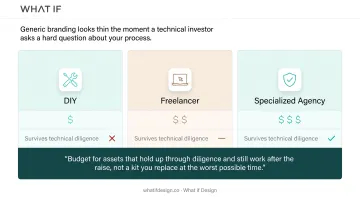
Generic branding looks thin the moment a technical investor asks a hard question about your process. Budget for assets that hold up through diligence and still work after the raise, not a kit you replace at the worst possible time.
5. How to estimate the right branding budget for your stage
The right budget is the one that fits your upcoming milestone, not the lowest price you can find.
Factors to weigh:
- Timeline to your next fundraising milestone and what investors will scrutinize closely
- How technically complex your story is to explain to a non-expert partner or generalist VC
- Current in-house design or marketing capacity and where the real gaps are
- What comparable companies in your niche invest in visual communication
- Runway available, and how branding spend trades off against engineering or hiring budget
VCs read pitch decks fast, and every detail can push them to double down on a startup or pass on it entirely. Treat branding as deal insurance, not overhead: a weak deck doesn't just look bad, it costs you a meeting.
Common mistakes to avoid:
- Focusing only on logo cost while ignoring the website and pitch deck, which do most of the heavy lifting
- Waiting until right before a raise to start the branding process instead of building it in early
- Over-hiring in-house talent before validating the brand strategy itself
A site that reflects the company you have actually become is the cheapest credibility you can buy, and it puts you back in control of the first impression. Get a free strategic audit.
6. Frequently asked questions
6.1 How much does it cost to do branding?
Costs vary widely based on scope: logo-only versus full identity, website, and pitch deck, and on whether you go DIY, freelancer, or agency. Climate tech projects often need higher investment because of the technical translation involved.
6.2 What's a realistic branding budget for a pre-seed climate tech startup?
Expect roughly $3,000 to $15,000. That typically covers a basic logo, simple visual identity, and a one-pager or early messaging framework, enough for informal investor conversations.
6.3 Should a climate tech startup hire an in-house designer or work with an agency before Series B?
Most pre-Series B startups have zero to one in-house marketing hire, which rarely covers strategy, identity, and website work. Specialized agencies fill that gap without the $100K+ cost of a full-time senior hire.
6.4 What's typically included in a climate tech brand identity package?
A full package usually includes brand strategy and identity, website design and development, pitch deck and investor collateral, and ongoing content refresh as the company grows toward Series B.
6.5 Is branding spend worth it before Series B, or should all budget go to r&d?
Branding protects your fundraising and partnership timelines; it is not a discretionary expense competing with R&D. A weak deck or website can cost you a meeting before the science even gets a hearing.
6.6 How long does a climate tech branding project typically take?
Most identity and messaging projects run 4 to 6 weeks, while a fuller rebrand with a website redesign can take up to four months. Start well before your raise, not the month before it.
Ready to take the next step?
If you're weighing a design partner for climate, deep tech, or hard-to-explain products, Book a strategy call with our founders at What if Design, a no-pressure 25-minute conversation about what you're building and where design can help. You can also View our work to see how we've helped teams like yours, or Get a free strategic Audit of your current brand, website, or product experience.