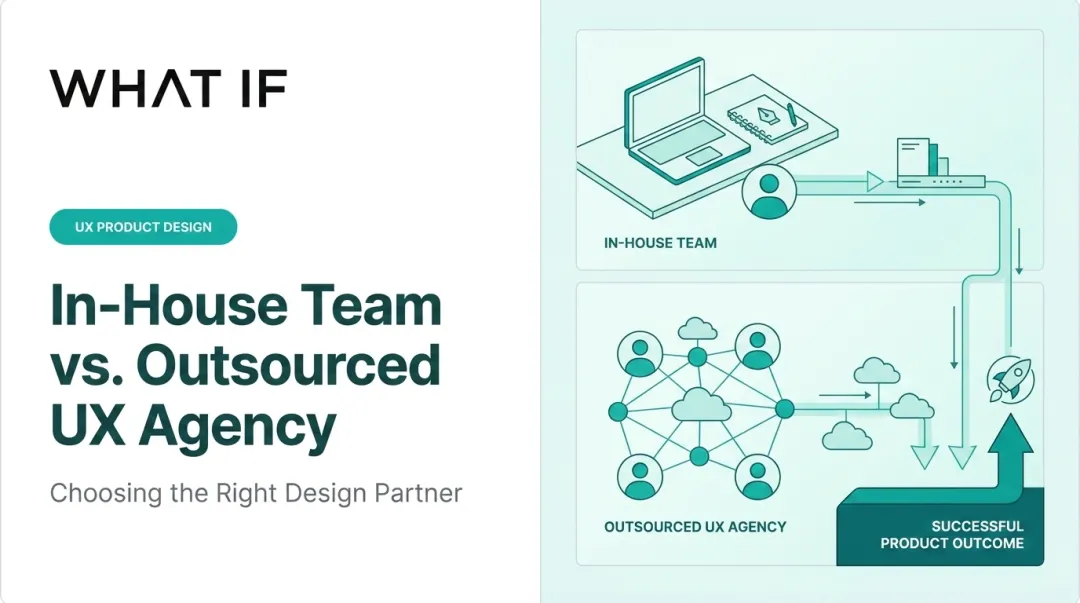
This is the choice nearly every climate tech, deep tech, and hard-tech founder eventually faces: hire an in-house designer, or bring in a specialized studio.
The decision shapes your runway, your speed to the next fundraising milestone, and whether your science reads as credible to the people writing checks.
Timing makes this harder than it looks. Climate tech Seed and Series A investment dollars fell 20% and 7% in 2025, with deal counts down 19% and 22% respectively, according to CTVC's 2025 climate investment analysis. Fewer deals means every pitch and product experience has to work harder.
Here's how the two paths actually compare.
TL;DR: key takeaways
- In-house means payroll, benefits, and fixed capacity; agencies bill for scope, not headcount
- A senior product designer's compensation alone can run six figures, before tools or overhead
- Specialized studios can often start in days; a hiring search usually takes weeks
- Climate and deep tech founders often need science-to-brand translation ahead of a raise more than a year-round design hire
- Pick based on design volume and runway. The smaller line item is not always the lower-cost path
1. Building in-house vs partnering with a design agency: quick comparison
1.1 Cost
In-house compensation for senior design talent isn't cost-effective, and the number you see in a salary survey is only part of the bill.
US senior product designers earn a median total compensation of $210,000 (25th percentile $160,000, 75th percentile $307,000), according to Levels.fyi's 2026 compensation data. In India, the median comes in at roughly INR 3,985,241.
Neither figure includes benefits, recruiting fees, design tools, or workspace costs, so your actual annual spend runs higher than the headline number.
Agencies price differently. Clutch's 2025 review What we see in practice is:
| Engagement type | Typical range |
|---|---|
| Branding project | $10,000, $49,999 |
| Branding package/retainer | $1,000, $15,000/month |
| US hourly rate | $100, $149 |
| India hourly rate | $25, $49 |
You're paying for a defined scope, not a year-round seat.
1.2 Time-to-launch
Sourcing, interviewing, and closing a senior design hire is rarely fast. In niches like climate or deep tech, candidates who understand both design craft and technical subject matter are scarce.
Agencies skip that runway entirely. What if Design's own onboarding moves from first conversation to a 30-day roadmap within three days, with initial design work landing in 2 to 4 business days. The team, tools, and process already exist.
1.3 Expertise & specialization
In-house constraints:
- Limited to one person's background, seniority, and bandwidth
- Breadth depends entirely on what you can afford at your current stage
Agency advantages:
- Multi-disciplinary bench covering brand strategy, UX, and technical translation in one engagement
- Pattern recognition across industries, including niche work like carbon capture or hydrogen brand translation
1.4 Scalability & flexibility
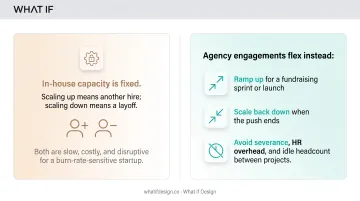
In-house capacity is fixed. Scaling up means another hire; scaling down means a layoff. Both are slow, costly, and disruptive for a burn-rate-sensitive startup.
Agency engagements flex instead:
- Ramp up for a fundraising sprint or launch
- Scale back down when the push ends
- Avoid severance, HR overhead, and idle headcount between projects
2. What is building an in-house design team?
An in-house design team means one or more full-time employees dedicated to your brand, product, or marketing design. Founders typically consider this once design work stops being occasional and becomes something the company needs every week.
Two benefits stand out:
- Product fluency: Deep knowledge of your roadmap and tech speeds up day-to-day iteration once design work is continuous
- Incentive alignment: Equity and long-term tenure matter more when design volume is steady enough to justify a dedicated seat
Many startups start with one generalist hire, then build out specialized sub-teams (brand, product, marketing) as needs diversify.
2.1 Use cases of in-house design teams
In-house hiring fits best where design demand is predictable, high-volume, and constant:
- SaaS or consumer platforms running continuous product sprints
- Companies producing frequent marketing collateral on a weekly cadence
- Teams where design has become a permanent function, not a project
First Round Review's founding-designer research frames the role as owning everything from interaction design to team-building once design has a seat at the table. That kind of ownership pays off when you need it daily, not occasionally.
💡 Working through this decision right now? If you're a climate-tech or deep-tech founder weighing this trade-off, Book a strategy call with our team, 25 minutes, no pitch, and we'll pressure-test your specific situation.
3. What is partnering with a design agency?
Partnering with a design agency means engaging an external, specialized team, such as What if Design, for brand, website, or product design on a project or retainer basis, instead of adding headcount.
See how we have approached this in practice: Mobile UX design.
Two benefits matter most for early-stage founders:
- Senior expertise without the overhead: brand strategy, UX, and technical translation without full-time salaries and benefits
- Speed to market: a pre-assembled team you can deploy ahead of a fundraise or launch date
- Spend that scales with need: project or month-to-month retainer fees instead of fixed headcount cost
Engagement models vary widely. Some founders need a single deliverable, such as a pitch deck or brand identity. Others need ongoing support. What if Design's Design Supercharger retainer, for instance, covers pitch decks, infographics, and CRM collateral on a month-to-month basis.
3.1 Where this model fits climate and deep tech
This model fits pre-seed to Series A climate tech, deep tech, and hard-tech founders who need to turn complex science into investor- and customer-ready design fast, often before the technical brief is fully written.
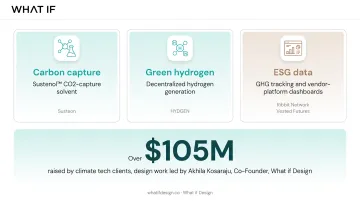
- Carbon capture: What if Design built brand strategy and a website for Susteon, communicating its Sustenol™ CO2-capture solvent
- Green hydrogen: For HYDGEN, the team delivered branding, UX strategy, and website development explaining decentralized hydrogen generation
- ESG data: Work for Ribbit Network and Vested Futures covered GHG tracking and vendor-platform dashboards
That pattern is intentional: Akhila Kosaraju, What if Design's co-founder, has contributed to design work behind over $105M raised by climate tech clients, brands and sites built to close funding and partnerships, not just look polished.
4. In-house vs agency: which is better for climate tech startups?
There's no universal winner here. The right call depends on four things:
- Runway and burn rate: how much cash you can commit to fixed payroll
- Company stage: pre-seed and Series A companies rarely have steady, year-round design demand
- Frequency of design need: daily iteration versus periodic milestones
- What you actually need: specialized science communication, or ongoing production support
Choose in-house if:
- Design work is predictable, high-volume, and needed daily
- Your runway comfortably supports a full-time salary long-term
- You want product context that compounds across months of continuous shipping
Choose an agency if:
- You need senior strategic expertise for a raise, launch, or brand overhaul
- You can't justify long-term headcount yet
- The work needs multi-disciplinary depth one generalist hire can't cover alone
Many climate tech founders take a hybrid path: agency support for foundational brand and product work, then an in-house hire once design volume is continuous enough to justify a dedicated seat. That shift often lands in later growth rounds, when product surface area multiplies, though timing still varies by company.
Match the model to your stage and fundraising timeline, not to whichever option looks cheaper on paper.
5. Real-world case study: choosing a design partner over in-house hiring
HYDGEN, a decentralized green hydrogen company, had a real credibility problem. Their existing website was dense and text-heavy, packed with technical detail about AEM and PEM electrolyzers. It lacked the visual hierarchy and storytelling industrial decision-makers, investors, and partners needed to grasp the technology and its market value quickly.
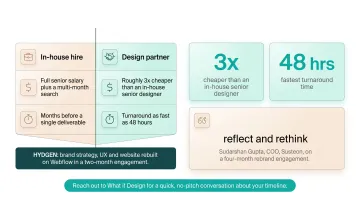
Hiring in-house wasn't realistic. Skilled climate tech design talent is scarce, and the timeline didn't allow for a multi-month search. We came in well under the cost of an in-house senior designer, with the first deliverables inside the opening week. No salaried hire could match that mix of cost and speed.
Over a two-month engagement, What if Design rebuilt HYDGEN's brand strategy, UX, and website on Webflow. HYDGEN finally had a site that explained its hydrogen technology and product line to the audiences that mattered.
Susteon, a carbon capture company, saw a related upside from working with a design partner instead of hiring in-house. COO Sudarshan Gupta said the four-month rebrand pushed the team to "reflect and rethink" its corporate strategy, a byproduct hiring alone rarely delivers.
If you're racing toward a funding milestone without months to spare for a hiring search, an experienced climate tech design partner can close that gap. Reach out to What if Design for a quick, no-pitch conversation about your timeline.
Clarity here is what turns a defensive conversation into a confident one. Get a free strategic audit.
6. Frequently asked questions
6.1 Is it cheaper to hire an in-house designer or work with a design agency?
It depends on volume. A senior in-house designer can exceed $200,000 a year before benefits and tools; agency projects typically run $10,000, $50,000 per scope. Agencies cost less unless you need continuous, high-volume design.
6.2 How long does it take to build an in-house design team compared to hiring an agency?
Recruiting a senior designer, especially in a niche like climate tech, can take a long, unpredictable search. We can begin work within days of a first conversation, with initial deliverables often arriving in under a week.
6.3 Can a design agency understand our specific climate tech or deep tech product as well as an in-house hire?
Specialized agencies invest real time learning the science and market before designing, using research methods like stakeholder interviews and insight sprints. What if Design's team has worked across carbon capture, green hydrogen, and ESG data specifically for this reason.
6.4 At what company stage should we switch from an agency to an in-house design team?
Switch when design demand is continuous and high-volume, not project-based. That often lands after early growth rounds, when product surface area expands and you need design every week, not every quarter.
6.5 Do design agencies only handle one-off projects, or can they support ongoing work?
Both. Agencies handle fixed-scope work like a brand identity or website, plus month-to-month retainers for pitch decks, sales collateral, and marketing support as needs arise.
6.6 What should climate tech startups look for in a design partner?
Look for sector expertise, a documented process for learning technical subject matter before designing, and a track record tied to funding or partnership outcomes. Ask to see examples in your specific sub-vertical, whether that's hydrogen, carbon capture, or grid technology.
Ready to take the next step?
If you're weighing a design partner for climate, deep tech, or hard-to-explain products, Book a strategy call with our founders at What if Design, a no-pressure 25-minute conversation about what you're building and where design can help. You can also View our work to see how we've helped teams like yours, or Get a free strategic Audit of your current brand, website, or product experience.