Where What if Design fits in We're a senior-led creative studio built specifically for climate tech, clean tech, and deep tech founders. Since 2020, we've partnered with teams like HYDGEN, Ribbit Network, and Susteon to turn hard-to-explain technology into brands, websites, and product experiences that raise capital and win adoption. This comparison reflects how we evaluate the trade-offs when a founder asks us which route to take.
Fast-growing climate tech and deep-tech startups hit the same fork in the road eventually: hire one full-service design agency, or stitch together a roster of freelance specialists for brand, website, and product work.
Many founders default to freelancers because the sticker price looks smaller. But when brand, website, and product all need to tell one coherent story, ahead of a raise or a launch, fragmented vendors can cost more in rework, delays, and confused investors than they ever saved.
This decision shapes brand consistency, speed to market, fundraising readiness, and your total design spend. This article breaks down both models side by side, then helps you decide which one fits your company's stage.
TL;DR: key takeaways
- One agency centralizes accountability and brand consistency; specialists bring deep expertise but need more coordination
- Coordination overhead is the hidden cost of juggling several vendors
- Neither model wins outright. The right choice depends on scope, growth stage, and how linked your design needs are
- Early and mid-stage companies with interdependent brand, website, and product needs usually do best with one creative partner
1. One agency vs. multiple specialists: quick comparison
Here's how the two models compare on the factors founders feel day to day:
| Factor | One Agency | Multiple Specialists |
|---|---|---|
| Cost | Single retainer or project fee for brand, website, and product | Separate fees per specialist, plus your time managing them |
| Team Composition | Small integrated team with full project context | Independent experts deep in their niche, no shared context |
| Consistency | Unified visual language across every touchpoint | Fragmented style risk when each specialist works alone |
| Speed | Faster turnaround; one team owns the full workflow | Slower when work depends on handoffs between vendors |
| Management Overhead | One point of contact, one contract | Multiple contracts, timelines, and quality checks |
On paper, freelancers look cheaper. Clutch's 2026 branding pricing data shows most branding-only agency projects run $10,000 to $49,999, before website or UX work as separate line items. Freelance marketplaces show lower entry prices per task, but that number rarely reflects what happens after the contract is signed.
Designer Fund's guide to working with freelancers flags costs that never show up on an invoice:
- Writing a fresh brief for every new vendor
- Assigning someone internally to consolidate feedback
- Re-explaining your brand each time a specialist starts fresh
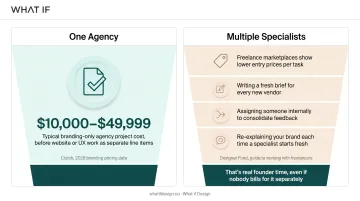
That's real founder time, even if nobody bills for it separately.
2. What is the one-agency model?
The one-agency model means hiring a single creative partner, usually a small, senior team, that owns your brand, website, and product design under one engagement. Instead of separately briefing a logo designer, a web developer, and a UX consultant, one team learns your full story once and carries it across every deliverable.
That matters most for technical, science-heavy companies. If your product involves electrolyzers, direct air capture, or grid interconnection hardware, explaining what you actually do takes real effort. Repeating that explanation to three different vendors wastes time you don't have.
Core benefits include:
- Strategic alignment across brand, website, and product from day one
- Less time spent re-briefing new vendors on context they don't have
- Senior-level expertise without the cost of building an in-house team
- Fewer rework cycles, since one team already knows your constraints
Agencies built for this model, What if Design among them, pair architect-trained systems thinking with hands-on UX and brand execution. That mix matters most when the brief itself is hard: the founder can explain the science, but not yet turn it into a coherent visual story.
2.1 Where the one-agency model fits
This model works best for pre-seed through Series B climate tech, deep tech, and frontier tech companies preparing for a raise, a product launch, or a full brand refresh.
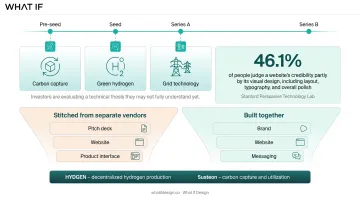
Consider a company raising capital in carbon capture, green hydrogen, or grid technology. Investors are evaluating a technical thesis they may not fully understand yet. If the pitch deck, website, and product interface each tell a slightly different version of the story, that inconsistency reads as risk.
Stanford's Persuasive Technology Lab found that 46.1% of people judge a website's credibility partly by its visual design, including layout, typography, and overall polish. For a climate tech company asking investors or utility partners to trust an unfamiliar technology, that visual coherence carries real weight.
What if Design's work with HYDGEN, a decentralized hydrogen production company, and Susteon, a carbon capture and utilization venture, followed this pattern. Brand, website, and messaging were built together rather than stitched from separate vendors.
How we evaluated the options
Every recommendation here comes from actual client work, brand systems shipped, websites launched, and product experiences delivered under fundraising deadlines. We compared the options against five criteria that matter most for technical founders:
- Total cost of ownership across the first 12 months (not just the sticker price)
- Speed to a usable output given a typical Series A runway
- Quality of the technical translation, can they explain your science without oversimplifying it?
- Rework risk, how often teams re-hire because the first choice couldn't scale
- Ability to move with the roadmap without a re-onboarding tax every quarter
💡 Working through this decision right now? If you're a climate-tech or deep-tech founder weighing this trade-off, Book a strategy call with our team, 25 minutes, no pitch, and we'll pressure-test your specific situation.
Where we cite numbers or trade-offs below, they come from projects we've delivered or watched founders navigate first-hand.
3. What is the multiple-specialists model?
The multiple-specialists model means assembling a roster of independent freelancers or boutique studios, each hired separately for one job: a logo here, a website there, a pitch deck somewhere else. For a single, well-defined need, this feels efficient. Why pay a full agency retainer for one deliverable?
See how we have approached this in practice: 10 Best SaaS UX Design agencies for product growth in 2026.
Core benefits include:
- Lower cost per individual task
- Freedom to hand-pick a specialist who does one thing exceptionally well
- Flexibility to scale up or down without a standing contract
There are two flavors here: individual contractors found on platforms like Upwork, and boutique studios that specialize narrowly: one that only does logo design, another that only builds no-code websites. Both can produce excellent isolated work.
3.1 Where the multiple-specialists model fits
This model works best for a single, standalone deliverable that doesn't need to connect to a broader brand or product system. A company with an already-established brand identity that just needs one new illustration set, or a one-page landing site for an event, doesn't need a full-service partner for that.
The risk shows up when the deliverables aren't actually standalone. Brand, website, and product design are interdependent by nature: your color palette informs your UI, your messaging informs your web copy, your typography shows up everywhere. When three different vendors handle those pieces without shared context, inconsistency is the default outcome.
4. One agency vs. multiple specialists: which is better?
Neither model is inherently better. The right choice comes down to four questions:
- Interdependency: Does your brand feed into your website, which feeds into your product experience, or is this one isolated task?
- Timeline pressure: Are you racing toward a raise or launch where delays compound?
- Internal bandwidth: Does anyone on your team have time to manage three or four vendors and chase revisions?
- Budget structure: Would you rather pay one predictable retainer, or track several smaller invoices?
Choose one agency if your brand, website, and product need to function as a single system, especially ahead of a funding round or launch. You want one team that already knows your full story and can move across every touchpoint without re-briefing.
Choose multiple specialists if you have one isolated task and strong internal design direction. When your brand system is solid and you only need a one-off asset, a narrow specialist is enough. No strategist relearning your business for a single deliverable.
Most founders slip when the model they pick doesn't match how connected their design needs actually are.
5. Real-world example: A climate tech venture studio's design consolidation
LabStart, a climate tech venture studio that helps translate lab-based science into market-ready companies, brought What if Design a site COO Megan Holcomb called a "static, version 101 website." It didn't reflect where the organization was headed or the caliber of the science it supported.
Rather than hiring a separate web developer and a separate brand designer to patch the site piecemeal, LabStart brought in one team to rebuild its brand identity and website together as a single system.
The result, in Holcomb's words, was a brand that felt "professional, creative, and human." She also noted that the What if Design team worked as an extension of LabStart's own mission, embodying its values rather than simply executing a brief handed to them.
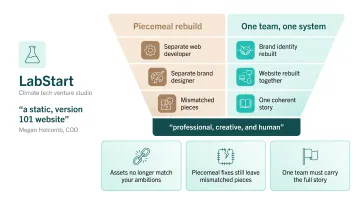
The takeaway: consolidation pays off when:
- Current design assets no longer match your ambitions
- A piecemeal rebuild (new logo here, new site there) still leaves pieces that don't fit
- One team must carry the full story, especially for a venture studio with multiple technical portfolio companies
In LabStart's case, that shared understanding mattered more than any single deliverable.
If your brand, website, and product are pulling in different directions, or you're bracing for a raise that demands one coherent story, talk to What if Design about bringing it under one roof.
Which option is right for your stage
The right answer depends less on the two options themselves and more on where you are as a company.
Pre-seed / seed (0–$3M raised): Speed and story matter more than polish. A focused boutique-agency sprint usually beats an in-house hire, because the founder still needs to control the narrative. We've seen this pattern with early climate-tech teams, a 4-to-6-week engagement to get brand, website, and pitch coherent is more valuable than a full-time designer.
Series A ($5–20M raised): This is where a senior-led agency partner pays for itself. You need a brand system that will survive three product pivots, a website that converts enterprise buyers, and pitch materials that hold up in board meetings. In-house is still premature unless you're planning to ship design-heavy product weekly.
Series B and beyond ($20M+ raised): Hire in-house design leadership and keep an agency partner for concentrated bursts (rebrands, launches, category shifts). The two aren't substitutes at this stage, they solve different problems.
Growth-stage climate tech specifically: The stakes shift once you're commercializing. Your brand needs to hold up to procurement diligence, regulatory scrutiny, and investor updates simultaneously. A specialist studio that already speaks the science, like our team, reduces the translation tax that generalists impose on every deliverable.
6. Conclusion
The right choice between one agency and multiple specialists depends on how interconnected your design needs are, and on the stage your company is at.
A pre-seed startup with one standalone deliverable might do just fine with a freelance illustrator or a no-code website builder. A Series A climate tech company gearing up for a raise, where brand, website, and product all need to say the same thing, usually can't afford the coordination tax that comes with juggling four vendors.
Whichever path you choose, keep the practical outcomes in view: faster fundraising conversations, a brand that reads the same way everywhere a prospect or investor encounters it, and less of your own time spent managing vendors instead of building the company. Judge the model by those outcomes, not by which structure looks cleaner on paper.
When the story is clear, the next conversation starts from confidence rather than explanation. Get a free strategic audit.
7. Frequently asked questions
7.1 Is it cheaper to hire multiple freelance specialists than one full-service agency?
Individual freelancers often look cheaper per task, but coordination time, rework from miscommunication, and inconsistent output can offset those upfront savings. Once you factor in the hours spent briefing separate vendors, the gap narrows fast.
7.2 What are the risks of using multiple specialists instead of one agency?
The main risks are fragmented branding, slower timelines from handoffs between vendors, and the burden of managing several contracts and quality checks internally. Each specialist optimizes for their own piece, not the whole system.
7.3 How do I know if my company needs a full-service agency or individual specialists?
Look at interdependency first. If your brand, website, and product all need to work together as one story, a single agency usually fits better. If you need one standalone deliverable, a specialist can work well.
7.4 Can a single agency really cover brand, website, and product design well?
We are a small, senior-led team built to carry one narrative across brand, website, and product, rather than treating each as a separate project. That's different from generalist freelancers working in isolation.
7.5 What is the biggest hidden cost of managing multiple specialists?
Coordination overhead: the time you or your team spend aligning separate vendors, resolving inconsistencies between their work, and re-briefing each one on context the others already have.
7.6 When should a startup move from freelancers to a full-service design agency?
That shift usually happens ahead of a funding round or product launch, or once brand, website, and product all need a redesign as one cohesive system rather than isolated updates.
Ready to take the next step?
If you're weighing a design partner for climate, deep tech, or hard-to-explain products, Book a strategy call with our founders at What if Design, a no-pressure 25-minute conversation about what you're building and where design can help. You can also View our work to see how we've helped teams like yours, or Get a free strategic Audit of your current brand, website, or product experience.