That moment, not the technology itself, is often what kills the deal.
Most teams still treat UX as design polish, something you add once the "real" work is done. But bad UX is a financial risk. It shows up in abandoned checkouts, stalled sign-ups, and support tickets that eat engineering time. For technical, science-heavy products like climate tech, deep tech, and enterprise software, the cost is even steeper, because the brief itself is hard to write. Nobody has a template for explaining carbon capture chemistry to a Series A investor in under two minutes.
This article breaks down exactly where that cost hides, and what the data says about fixing it.
TL;DR: key takeaways
- Bad UX drains revenue directly through abandoned carts, checkouts, and sign-up flows
- In climate tech, deep tech, and enterprise software, bad UX costs funding and adoption, not just conversions
- Research-backed UX investment shows measurable, repeatable ROI
- Fixing bad UX after launch or a failed raise costs far more than preventing it early
1. The real costs of bad UX: where it hits your business
The most visible cost of bad UX is lost revenue, but it rarely stops there. Poor usability compounds across acquisition, retention, and support in ways most teams never fully trace back to design.
1.1 Conversions disappear before users even reach checkout
Baymard Institute's meta-analysis of 50 separate studies puts the average cart abandonment rate at 70.22%. Separately, 17% of US online shoppers said they abandoned an order because checkout felt too long or too complicated. That's friction, not disinterest, walking money out the door.
Beyond conversions, bad UX reshapes customer behavior in a few predictable ways:
- Existing customers churn. Across 12 countries, roughly 25 to roughly 33% of consumers say they'll leave a brand they loved after one bad experience, per PwC's global CX research.
- Support costs climb. Nielsen Norman Group found that roughly 64% of customer journeys required at least one user-initiated support contact, with missing information causing 38% of those contacts. Every one of those tickets pulls someone off product work.
- Customers switch to competitors. McKinsey reports that 54% of B2B buyers likely to switch suppliers cite poor digital experience as a reason. Your friction becomes their opening.
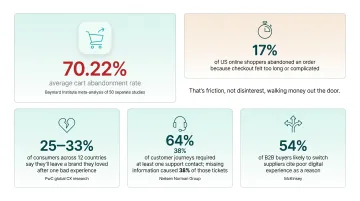
The pattern is consistent: confusion doesn't just cost the sale in front of you. It compounds into higher acquisition costs, slower support teams, and lost trust that spreads through reviews and word of mouth long after the original interaction ended.
2. The hidden cost of bad UX for climate tech, deep tech, and frontier tech companies
For most consumer apps, bad UX means a bounce. For climate tech and deep tech founders, it means something worse: an investor who closes the pitch deck before understanding what the technology actually does.
2.1 When investors can't see the value
DocSend's analysis of 320 pitch decks, reported by TechCrunch, found investors spent 24% less time reviewing decks in 2022 than the year before. Failed decks lost investor attention after just 2 minutes and 13 seconds. When your core value is a novel electrochemical process or a grid-interconnection breakthrough, that's not nearly enough time to land the "why this matters" message unless it's designed to communicate fast.
Carbon capture, green hydrogen, and battery chemistry don't translate themselves. They need to be visually simplified for non-technical stakeholders, without losing what makes the science credible.
Susteon hit the same wall. Their site couldn't explain carbon capture and hydrogen tech to investors, partners, or other non-specialist audiences.
After a four-month brand and website redesign that put messaging and vision first, they saw a 30% increase in applicants for open roles, proof that clearer technical storytelling widens who understands and engages with the work.
2.2 Enterprise adoption depends on workflow fit, not feature count
Gartner predicts that by 2027, more than roughly 70% of recently implemented ERP initiatives won't fully meet their original business goals, and up to 25% will fail outright, largely because interfaces don't match how people actually work day to day. The same risk shows up across technical products:
💡 Working through this decision right now? If you're a climate-tech or deep-tech founder weighing this trade-off, Book a strategy call with our team, 25 minutes, no pitch, and we'll pressure-test your specific situation.
- Fleet and logistics platforms
- ESG reporting tools
- Battery management systems
See how we have approached this in practice: Why UX failures cost climate and deep-tech startups credibility.
A dashboard that looks clean in a demo but ignores real operational habits gets ignored on the floor.
What if Design's work with the Ministry of Health of Saudi Arabia shows the fix. Replacing a fragmented, multi-system network with one Asset Performance Management platform meant designing around how facility staff triage tasks, not how an org chart is drawn.
The interface grouped Dashboard, Assets, Inventories, and Tickets around real workflows, with visual indicators for scheduled, assigned, and completed work so teams could prioritize at a glance.
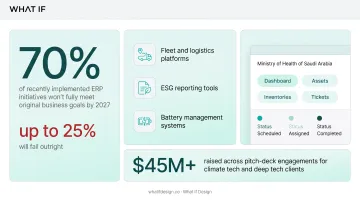
Engineering-heavy founding teams often skip this step because the brief is hard to write for deeply technical products. Closing that gap takes learning the science and market before designing, work that has contributed to over $45M raised across pitch-deck engagements for climate tech and deep tech clients backed by the US DOE and ARPA-E.
Poor onboarding multiplies the same cost. Lean teams without dedicated support absorb every confused user into engineering time that should go to shipping, not explaining the product.
3. Is UX investment really worth it? What the ROI What we see in practice is
Design ROI isn't a soft metric anymore. It's measurable, and the numbers are larger than most founders expect.
Forrester's Total Economic Impact study of a UX research platform found 415% ROI with payback in under six months. A separate Forrester model on mature design-thinking practices found 71 to roughly 107% organizational ROI, with three-quarters of modeled projects at least doubling their investment.
The revenue opportunity is substantial industry-wide, too:
- Baymard maps improved checkout design across $738 billion in combined US/EU ecommerce sales to $260 billion in potentially recoverable lost orders
- The average large ecommerce site could gain an estimated 35.roughly 26% in conversion rate through better checkout design alone
- Bain & Company In our work we consistently see that increasing customer retention by just roughly 5% can boost profits by as much as roughly 95%
Early validation also cuts rework. Mozilla's iterative testing program, which included tree testing and paper prototypes before launch, cut new support forum questions by roughly 70%, from about 7,000 to 2,000 per month. Catching those issues before launch costs far less than supporting confused users after the fact.
Unresolved usability gaps carry a quantifiable price tag, and that cost rarely shrinks with time.
4. Common root causes of bad UX
Most bad UX doesn't happen because a team lacks talent. It happens because of a few recurring decisions made early and rarely revisited.
- Design gets treated as decoration. When UX enters the process after engineering and strategy are locked, it can only patch surfaces, not fix structural confusion.
- Usability testing gets skipped before launch. Problems that could've been caught in a week of user interviews instead surface post-launch, where fixes require rebuilding rather than adjusting.
- Technical founders assume the tech will speak for itself. "If it works, users will figure it out" is one of the costliest assumptions in deep tech. Investors and buyers rarely reverse-engineer value from a confusing interface.
5. How to prevent the cost of bad UX
Preventing bad UX costs a fraction of fixing it later, and the interventions are straightforward.
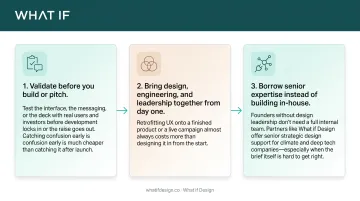
- Validate before you build or pitch. Test the interface, the messaging, or the deck with real users and investors before development locks in or the raise goes out. Catching confusion early is much cheaper than catching it after launch. 2.
Bring design, engineering, and leadership together from day one. Retrofitting UX onto a finished product or a live campaign almost always costs more than designing it in from the start. 3. Borrow senior expertise instead of building it in-house. Founders without design leadership don't need a full internal team. We offer senior strategic design support for climate and deep tech companies, especially when the brief itself is hard to get right.
When the story is clear, the next conversation starts from confidence rather than explanation. Get a free strategic audit.
6. Frequently asked questions
6.1 What does "bad UX" mean?
Bad UX is any design that creates friction, confusion, or outright failure for users trying to complete a task. Common examples include unclear navigation, slow load times, and confusing checkout flows.
6.2 Is UI/UX really worth it?
Yes. In our work we consistently see UX investment delivers measurable returns, including 415% ROI in Forrester's TEI study and significant conversion lift from improved checkout design. The payback is even higher for technical or high-stakes products.
6.3 Will AI replace UI/UX?
AI can assist with tasks like prototyping and summarizing research, but it can't replace strategic design thinking. Nielsen Norman Group found AI tools still miss visual context and behavioral nuance that human researchers catch.
6.4 How do you calculate the cost of bad UX for your business?
Add up lost conversions, support ticket costs, development rework, and churn caused by user frustration. That total is a realistic starting estimate of what poor UX is already costing you.
6.5 What's the difference between the cost of bad UX in consumer apps versus enterprise software?
Consumer users simply leave for a competitor. Enterprise and technical users are often stuck using the product, so the cost shows up as lost productivity, errors, and internal frustration instead of lost customers.
6.6 How quickly can improving UX show a return on investment?
Many teams see measurable results, fewer support tickets or higher conversion, within 1 to 3 months. Returns come faster when UX is validated through testing before launch, not patched afterward.
Ready to take the next step?
If you're weighing a design partner for climate, deep tech, or hard-to-explain products, Book a strategy call with our founders at What if Design, a no-pressure 25-minute conversation about what you're building and where design can help. You can also View our work to see how we've helped teams like yours, or Get a free strategic Audit of your current brand, website, or product experience.