That confusion rarely comes from bad science. It comes from UX that never translated the science into something a non-technical evaluator can trust in under five minutes. It comes from UX that never translated the science into something a non-technical evaluator can trust in under five minutes. When that trust fails, diligence stalls, pilots slip, and fundraising conversations lose momentum.
Founders building climate tech, deep tech, or other hard-to-explain products often lead with "Is UX worth investing in?" The question that actually moves budget is more specific: how do you calculate, and defend, the return UX design delivers for your business model?
That answer looks different when your buyer is a technical due-diligence team, a government program officer, or an engineer reviewing a grid-software dashboard instead of a shopper clicking "buy now."
This article breaks down a step-by-step ROI framework, the metrics worth tracking, and how the math shifts once your product is genuinely hard to explain.
TL;DR: key takeaways
- UX ROI is a directional estimate, not a precise forecast, so treat it like scenario planning
- Popular "$1 returns $100" multipliers come from e-commerce and don't map onto climate tech or enterprise sales
- For technical products, ROI often shows up as faster due diligence and funding secured, not just checkout conversion
- Five-step framework works for any business model: baseline, category, estimate, calculate, monitor
- Start with a focused UX/brand audit before committing to a full redesign
1. What is the ROI of UX design (and why it's different for technical products)?
UX ROI follows the same formula as any other investment:
ROI = (Gains − Cost) / Cost
The tricky part isn't the math. It's that most UX gains can't be measured with the precision of a manufacturing cost report. Treat the output as a directional estimate, a number that tells you whether an investment is likely worth it, not a forecast you'd hand an auditor.
For budget context, Nielsen Norman Group's analysis of 863 design projects found usability work typically cost 8% to 13% of total project budget, with roughly 10% as a reasonable planning benchmark.
That study is over two decades old, but it remains one of the only sourced figures on how much of a product budget usability work tends to consume.
1.1 Why the popular multipliers don't apply here
You've probably seen the claim that every $1 spent on UX returns $10, $100, or more. Those figures trace back to a handful of specific, decades-old cases, including one unnamed company that spent $68,000 on usability and reported $6.8 million in year-one benefit, according to UXPA's sourcing review.
They're rules of thumb, not typical outcomes, built on consumer software and e-commerce contexts.
That distinction matters even more for climate and deep tech. If you're selling carbon capture systems, hydrogen electrolyzers, or grid software, your "conversion" isn't a checkout button. It's:
- Investor confidence during a term sheet review
- Faster technical due diligence
- A successful demo for a non-technical board member
- Funding secured and partnership velocity
Those outcomes, not checkout conversions, are the real currency for DOE- and ARPA-E-backed teams.
1.2 Why the stakes are higher for complex, technical products
When the underlying product is genuinely hard to explain, bad UX doesn't just annoy users. It compounds confusion for everyone evaluating the work.
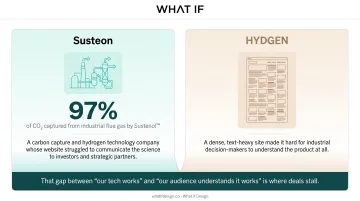
Susteon, a carbon capture and hydrogen technology company, ran into exactly this. Its website struggled to communicate complex technologies like Sustenol™, which captures over roughly 97% of CO₂ from industrial flue gas, to investors and strategic partners.
HYDGEN faced a similar problem: a dense, text-heavy site made it hard for industrial decision-makers to understand the product at all.
Neither company had a science problem. They had a translation problem. In technical fields, that gap between "our tech works" and "our audience understands it works" is where deals stall.
2. The ROI of UX framework: A step-by-step approach
3. The UX ROI framework: A step-by-step approach
Use this five-step process to build a defensible UX ROI case for your specific business model.
3.1 Identify the problem and set a baseline
Pick one pain point tied to a measurable business outcome. Vague goals like "improve the UX" don't produce a number anyone can defend. Good starting points:
- Onboarding steps causing drop-off
- A confusing dashboard generating repeat support tickets
- A low demo-to-close rate on sales calls
Measure the current baseline before you touch anything. If you don't know where you started, you can't prove where you ended up.
3.2 Choose what kind of return you're solving for
Not every UX investment should be measured the same way. Pick the category that matches your actual goal:
- Cost savings: reduced support tickets, less development rework
- Revenue and deal-closing: higher win rates, larger average deal size
- Opportunity cost: what you avoid losing by not fixing the issue
- Team velocity and morale: faster shipping, less internal friction
- Innovation capacity: freed-up bandwidth for higher-value work
Mixing categories muddies the case. Choose one primary lens per calculation.
3.3 Estimate gains and costs
Your formula depends on the category from Step 2. For cost savings, a simple structure works:
Monthly cost = tickets per month × hours per ticket × hourly loaded cost
💡 Working through this decision right now? If you're a climate-tech or deep-tech founder weighing this trade-off, Book a strategy call with our team, 25 minutes, no pitch, and we'll pressure-test your specific situation.
Adapt the inputs to your situation. If confusing UI generates 200 support tickets a month, each taking 20 minutes to resolve at a $40/hour loaded cost, that's roughly $2,667 a month in avoidable support spend, about $32,000 a year.
For revenue, pull from existing pipeline data: current win rate, average deal size, and the modeled shift you expect after the redesign. You don't need a perfect number. You need a reasonable one.
3.4 Calculate ROI and run scenarios
Plug your figures into the formula, then build three versions:
- Best case: optimistic but still plausible gains
- Realistic case: the number you plan against
- Worst case: deliberately conservative assumptions
Lead with the worst case when you present. That builds credibility with a skeptical CFO or board member. A UX case that only works in a best-case scenario isn't a strong case.
3.5 Monitor, iterate, and refine
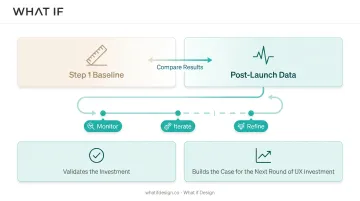
Once the redesign ships, compare results against your Step 1 baseline. Real post-launch data does two things: it tells you whether the investment worked, and it becomes the evidence you use to justify the next round of UX investment.
See how we have approached this in practice: Mobile UX design.
4. Key metrics that prove UX ROI
Five metric groups turn UX work into numbers leadership already uses in planning and fundraising.
4.1 Revenue and conversion
Track these before and after your UX changes:
- Funnel drop-off
- Demo-to-close rate
- Average deal size
These are numbers a sales leader already trusts, which makes them easier to defend internally.
4.2 Cost avoidance
Support ticket volume and development rework are leading indicators of wasted spend. Measure:
- Support ticket volume
- Development rework
- Time-to-resolution
When Mozilla rebuilt its support site's information architecture using card sorting, tree testing, and prototype testing, monthly new support questions dropped from about 7,000 to roughly 2,000. Over the same period, 24-hour response rates rose from the 40 to roughly 60% range to 80 to roughly 90%.
That's one company's documented result, not a guaranteed outcome. It shows the mechanism, though: clearer UX reduces the volume of confused users generating tickets.
4.3 Retention and engagement
Value past the first conversion shows up in:
- Churn
- Feature adoption
- Task completion
A user who finishes onboarding isn't the same as a user who sticks around for six months.
4.4 Fundraising and partnership velocity
This is the metric most standard UX ROI models skip, and it's often the one that matters most for climate tech and deep tech founders. Track:
- Time-to-close on technical due diligence
- Investor sentiment shifts after product demos
- Partnership or funding deals closed following a redesign
4.5 Sentiment and trust
NPS, satisfaction surveys, and qualitative feedback matter most when evaluators include non-technical stakeholders: a board member, a government program officer, or a corporate partnership lead. They often judge your product on clarity as much as capability.
5. Common myths that undermine UX ROI calculations
5.1 Myth: ROI must be expressed in dollars
For mission-driven or grant-funded organizations, revenue isn't always the right currency. Reach, funding secured, or partnership velocity can be the more honest measure of impact, especially for DOE- and ARPA-E-backed teams where the mission itself is the mandate.
5.2 Myth: the calculation must be perfectly accurate
A simple, directionally correct estimate is usually enough to win leadership buy-in. Chasing decimal-point precision on a number that's inherently an estimate wastes time you could spend fixing the actual problem.
5.3 Myth: more detail always strengthens the case
Over-engineering an ROI model doesn't make it more persuasive. It makes it slower to finish and harder to explain. Do only as much analysis as your specific audience needs to say yes.
6. Maximizing UX ROI as a climate tech or deep tech startup
Climate tech and deep tech founders face a challenge most UX frameworks never account for: sometimes the brief itself is hard to write. When your product involves carbon capture chemistry, grid interconnection standards, or hydrogen electrolysis, design decisions and business communication decisions become the same decision.
This is why the choice of design partner matters more here than in most industries.
6.1 Learn the science before you design
A design partner who understands your underlying technology and market before opening a design tool will make fewer costly mistakes. Susteon's rebrand started with a stakeholder strategy workshop to understand different technical and business perspectives before any logo or messaging work began.
The result: complex systems like carbon capture, hydrogen production, and sustainable aviation fuel became visuals and messaging non-specialists could actually follow. Sudarshan Gupta, COO of Susteon, Sudarshan Gupta, said the process "forced us to reflect and rethink our corporate strategy" and "accurately translated our vision to creatively visualize our deeply scientific work."
The rebuilt site also drove a 30% increase in job applicants. That kind of ROI rarely appears in a checkout funnel. It shows up in hiring, partnerships, and the other outcomes climate tech companies actually track.
6.2 The fundraising connection
What if Design has worked with teams backed by the U.S. Department of Energy and ARPA-E, along with climate VCs across carbon capture, grid interconnection, and green hydrogen. The firm reports these engagements have contributed to over $105 million raised across its client portfolio.
The mechanism is straightforward: when investors understand what you've built in the first three minutes of a demo, technical due diligence moves faster and confidence builds sooner.
6.3 Start with an audit, not a full redesign
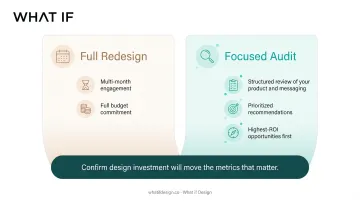
Before committing budget to a complete overhaul, start smaller. A focused UX or brand audit is a structured review of your product and messaging with prioritized recommendations. It surfaces your highest-ROI opportunities first, and gives you a lower-risk way to confirm design investment will move the metrics that matter before you commit to a multi-month engagement.
When the story is clear, the next conversation starts from confidence rather than explanation. Get a free strategic audit.
7. Frequently asked questions
7.1 Is a roughly 30% ROI high for UX design?
It depends entirely on the calculation method and category. A 30% return can be strong for a conservative, cost-avoidance-only estimate, while revenue- or fundraising-linked calculations often report much higher multiples.
7.2 Is UX design worth the investment in 2026?
Yes. As AI accelerates how fast anyone can ship features and interfaces, design judgment and clarity become the differentiator between products people trust and products that look interchangeable.
7.3 What is a good ROI benchmark for a UX redesign project?
There's no universal number. Treat ROI as a tailored, directional estimate based on what matters most to your audience: revenue, cost savings, or fundraising outcomes.
7.4 How do you calculate the ROI of a UX redesign?
Follow five steps: set a baseline, choose your return category, and estimate gains and costs. Calculate ROI under best- and worst-case scenarios, then monitor post-launch results to refine future investment cases.
7.5 What is the 1-10-100 rule in UX design?
It's a cost-escalation heuristic: a usability issue costs roughly $1 to fix during design, $10 during development, and $100 after release. It's a rule of thumb, not a controlled study, but the direction holds.
7.6 How long does it take to see ROI from UX investment?
Small usability fixes can show gains within weeks. Strategic or brand-level UX investment, the kind that affects fundraising or partnerships, usually takes several months to a few quarters to fully materialize.
Ready to take the next step?
If you're weighing a design partner for climate, deep tech, or hard-to-explain products, Book a strategy call with our founders at What if Design, a no-pressure 25-minute conversation about what you're building and where design can help. You can also View our work to see how we've helped teams like yours, or Get a free strategic Audit of your current brand, website, or product experience.