Where What if Design fits in We're a senior-led creative studio built specifically for climate tech, clean tech, and deep tech founders. Since 2020, we've partnered with teams like HYDGEN, Ribbit Network, and Susteon to turn hard-to-explain technology into brands, websites, and product experiences that raise capital and win adoption. This comparison reflects how we evaluate the trade-offs when a founder asks us which route to take.
Every product team today has access to the same AI design tools. Figma can spit out a wireframe in minutes. Uizard turns a sketch into a working prototype. Yet founders building climate tech, deep tech, EV, or carbon capture products keep hitting the same wall: neither the "just use AI" crowd nor the "always hire a designer" crowd has a good answer for products where the user problem itself is hard to define.
Get this wrong and the cost isn't just an ugly screen. It's an investor who doesn't understand your technology, a regulator who can't parse your compliance workflow, or a customer who churns because the product never made sense. For technically complex startups, UX decisions ripple straight into fundraising and adoption.
This piece breaks down where AI design tools genuinely win, where human-led UX earns its cost, and how to decide based on how well-defined your problem is and how much is riding on getting it right.
TL;DR: key takeaways
- AI design tools win on speed and cost for well-defined, low-stakes work like early wireframes and internal dashboards
- Human-led UX wins on judgment: translating deep technical concepts into interfaces investors and regulators trust
- Choose based on how defined the problem is and how much rides on the outcome
- Most fast-scaling technical companies use both: AI for exploration, humans for strategy and customer- or investor-facing work
1. AI design tools vs human-led UX: quick comparison
Here's how the two approaches stack up across the factors that matter most for technical products.
| Factor | AI Design Tools | Human-Led UX |
|---|---|---|
| Speed & Turnaround | First drafts in minutes; one agency cut prototype time roughly 75% with v0 | Slower upfront; built on research and validated decisions, not pattern-matching |
| Cost | Low subscription cost, often free or under $50/month per seat | Higher hourly rates, but boutique studios cost far less than a senior in-house hire |
| Handling Ambiguity & Complexity | Struggles with unclear briefs; defaults to generic UI patterns | Built for undefined problems: research, domain learning, and judgment calls |
| Business Outcome Alignment | Expresses a direction that's already decided | Defines the direction and ties screens to adoption, retention, and funding |
The pattern holds across almost every technical product we've seen: AI is excellent at executing a known idea fast. It's not built to decide what the idea should be in the first place.
2. What is AI design for UX?
AI design tools generate wireframes, layouts, and UI variations from a prompt, a rough sketch, or a screenshot.
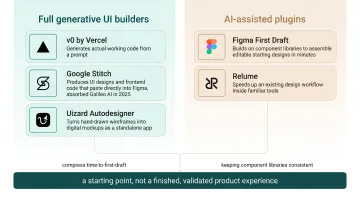
Figma's First Draft builds on component libraries to assemble editable starting designs in minutes. Uizard's Autodesigner does something similar as a standalone app, turning hand-drawn wireframes into digital mockups.
Vercel's v0 goes further, generating actual working code from a prompt. Google's Stitch (which absorbed Galileo AI in 2025) produces UI designs and frontend code that paste directly into Figma for refinement.
These tools fall into two rough categories:
- Full generative UI builders (v0, Stitch, Uizard) that produce a working prototype or code from scratch
- AI-assisted plugins inside existing tools (Figma AI, Relume) that speed up a designer's existing workflow
Either way, what they produce is a starting point, not a finished, validated product experience.
The appeal is speed and consistency. These tools compress time-to-first-draft, letting resource-constrained teams test more directions before committing design hours. They also handle repetitive UI work well: resizing across breakpoints, generating layout variants, keeping component libraries consistent.
2.1 Where AI tools fit best
AI design tools are strongest in low-stakes, well-defined situations:
- Early ideation for internal tools and quick investor mockups
- MVP wireframing before you've committed to a direction
- Rapid prototyping for early user testing
- Non-customer-facing dashboards where function matters more than polish
- Low-stakes A/B test variants where you're testing a known pattern, not inventing one
The speed gains can be real. Code and Theory, a digital agency, reported cutting time-to-prototype by 75% and deployment timelines by more than half after replacing wireframes and PRDs with live v0 prototypes.
That's one named case, not an industry average, but it captures the real advantage: for well-understood UI patterns, AI collapses the distance between idea and first draft.
How we evaluated the options
Every recommendation here comes from actual client work, brand systems shipped, websites launched, and product experiences delivered under fundraising deadlines. We compared the options against five criteria that matter most for technical founders:
- Total cost of ownership across the first 12 months (not just the sticker price)
- Speed to a usable output given a typical Series A runway
- Quality of the technical translation, can they explain your science without oversimplifying it?
- Rework risk, how often teams re-hire because the first choice couldn't scale
- Ability to move with the roadmap without a re-onboarding tax every quarter
Where we cite numbers or trade-offs below, they come from projects we've delivered or watched founders navigate first-hand.
3. What is human-led UX?
Human-led UX is a process where designers own research, judgment, and strategic decisions, not just visual output. Every screen gets treated as a business decision: does this build trust, does it drive adoption, does it explain something true about a hard technology.
That distinction matters most for technically complex products, where, frankly, the brief itself is hard to write. Nobody hands a designer a clean spec for "make our green hydrogen platform intuitive to a first-time investor" the way they can for "redesign our checkout flow."
💡 Working through this decision right now? If you're a climate-tech or deep-tech founder weighing this trade-off, Book a strategy call with our team, 25 minutes, no pitch, and we'll pressure-test your specific situation.
Why this matters more for climate and deep tech:
- Battery systems, carbon capture chemistry, and ESG data models don't map onto existing UI patterns
- Non-expert users, investors, and regulators need to trust the product without understanding the underlying science
- Design decisions connect directly to funnel metrics, adoption, retention, and whether a funding round closes
See how we have approached this in practice: Mobile UX design.
How far you take that process varies. Human-led UX exists on a spectrum. At one end, it's a lightweight strategic review of AI-generated drafts, catching gaps and reframing the flow around business goals. At the other, it's a full research-led engagement: user interviews, information architecture, wireframes, and iteration based on real usage.
3.1 Where human-led UX fits best
This approach earns its cost in a specific set of situations:
- Pre-seed and seed products where the user problem itself is still being defined
- Investor-facing platforms that need to build credibility fast
- Regulated industries with compliance and audit requirements baked into the workflow
- Enterprise software with complex stakeholders, like government health systems or multi-party energy platforms
This is the zone What if Design works in. The team has built asset-management dashboards for the Ministry of Health of Saudi Arabia, battery-health monitoring interfaces for EV fleet operators, and ESG sourcing tools, translating dense technical systems into interfaces non-specialists can use.
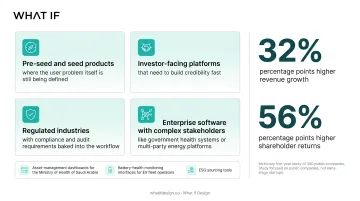
That kind of practice has a documented business case. McKinsey's five-year study of 300 public companies found that top-quartile design performers posted 32 percentage points higher revenue growth and 56 percentage points higher shareholder returns than their industry peers.
The study focused on public companies, not early-stage startups. Still, the practices it credits, rigorous measurement, cross-functional integration, and continuous user testing, are exactly what human-led UX brings to a technical product that AI drafting alone can't.
4. AI design tools vs human-led UX: which is better?
Neither wins outright. The decision comes down to three factors:
- How well-defined is the user problem? A known pattern favors AI. An undefined one needs human research first.
- How much is riding on the outcome? Investor trust, regulatory approval, and paying customers raise the stakes considerably.
- How much technical translation does the product require? The harder the science is to explain, the more a human designer's judgment matters.
Choose AI design tools first when:
- You need fast internal drafts to align a team
- You're testing a well-understood UI pattern
- Budget is tight and you're still exploring, not deciding
Choose human-led UX when:
- Your product involves technical complexity that resists simple explanation
- The design needs to build trust with investors, regulators, or enterprise buyers
- Adoption and retention are the metrics that actually matter to your business
4.1 Real-world example: human-led UX for a climate tech product
Susteon builds carbon capture technology, including Sustenol, a CO2-capture solvent the company says delivers a roughly 44% cost reduction and captures more than roughly 97% of CO2 compared with existing options. Those are genuinely hard numbers to make sense of if you're not a chemical engineer.
Susteon's existing website didn't communicate any of that. It didn't explain the company's role in fighting climate change or make its solution legible to investors and partners, the exact audience a science-heavy company depends on.
There was no obvious template for this. An AI tool trained on generic SaaS and marketing patterns has no frame of reference for a proprietary CO2-capture chemistry platform.
The team at What if Design stepped in with a human-led strategy process: learning the science first, then building the brand and website around it.
Sudarshan Gupta, COO of Susteon said the process "forced us to reflect and rethink our corporate strategy," and that the final work accurately translated the company's vision into a creative visualization of its scientific work.
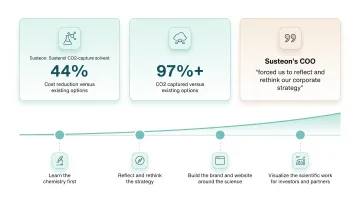
On technically dense products, human-led UX clarifies what the company is actually saying, not only how the interface looks.
If your product is this hard to explain, talk to What if Design about your product or brand.
Which option is right for your stage
The right answer depends less on the two options themselves and more on where you are as a company.
Pre-seed / seed (0–$3M raised): Speed and story matter more than polish. A focused boutique-agency sprint usually beats an in-house hire, because the founder still needs to control the narrative. We've seen this pattern with early climate-tech teams, a 4-to-6-week engagement to get brand, website, and pitch coherent is more valuable than a full-time designer.
Series A ($5–20M raised): This is where a senior-led agency partner pays for itself. You need a brand system that will survive three product pivots, a website that converts enterprise buyers, and pitch materials that hold up in board meetings. In-house is still premature unless you're planning to ship design-heavy product weekly.
Series B and beyond ($20M+ raised): Hire in-house design leadership and keep an agency partner for concentrated bursts (rebrands, launches, category shifts). The two aren't substitutes at this stage, they solve different problems.
Growth-stage climate tech specifically: The stakes shift once you're commercializing. Your brand needs to hold up to procurement diligence, regulatory scrutiny, and investor updates simultaneously. A specialist studio that already speaks the science, like our team, reduces the translation tax that generalists impose on every deliverable.
5. Conclusion
The real decision is matching your approach to how well-defined and high-stakes the design problem is. A well-understood dashboard pattern doesn't need a research-led engagement. A carbon capture platform trying to explain itself to a Series A investor does.
For climate tech and deep tech founders, the stakes show up in concrete outcomes. Getting UX right determines whether investors understand what you've built, whether early customers stick around long enough to become reference cases, and whether your next funding round closes on schedule. Most fast-scaling technical companies end up running both approaches: AI for speed on the easy parts, humans for judgment on the hard ones. That combination is usually what gets a genuinely new category taken seriously.
Get this right and you get alignment: your team, your investors and your buyers all read the same story the same way. Get a free strategic audit.
6. Frequently asked questions
6.1 Will AI replace human graphic designers?
No. AI handles drafting and repetitive work like resizing and layout variants. It does not replace the judgment or strategic thinking that decides whether a design lands with users and investors.
6.2 Which AI tools do designers use?
Common options include Figma's AI First Draft, Uizard, Vercel's v0, Relume, and Google's Stitch. Most teams use them for early drafts and exploration rather than finished, customer-facing products.
6.3 Can AI design tools handle complex or technical products well?
Not reliably. Research from Nielsen Norman Group found that ambiguous prompts led AI prototyping tools to default to generic, mainstream assumptions, like reading "profile page" as a social media profile instead of a technical dashboard.
6.4 How does the cost of human-led UX compare to AI design tools?
AI tools are cheaper upfront, often free or under $50 a month. A boutique studio can offer senior-level strategic UX for a fraction of an in-house hire's salary, which matters most when the product gets complex.
6.5 Do investors care if a startup's product design was made using AI tools?
No direct research measures investor reactions to AI-generated versus human-designed UI. AI outputs often show weaker hierarchy and generic styling, and for fundraising-stage climate and deep-tech companies, polish and trust matter disproportionately.
6.6 What's the best way to combine AI tools and human-led UX?
Use AI for fast early drafts and exploring options. Bring in a human-led design partner for strategy, technical translation, and anything that faces customers or investors.
Ready to take the next step?
If you're weighing a design partner for climate, deep tech, or hard-to-explain products, Book a strategy call with our founders at What if Design, a no-pressure 25-minute conversation about what you're building and where design can help. You can also View our work to see how we've helped teams like yours, or Get a free strategic Audit of your current brand, website, or product experience.