Yet the same founders often struggle to get investors and first customers to understand and trust what they've built.
"Climate tech design agency" gets thrown around as a buzzword in accelerator programs and LinkedIn posts. Its real value shows up somewhere less abstract: funding rounds that close, pilot partnerships that get signed, and adoption curves that hold after launch.
This article looks at why a specialized climate tech design partner matters in practice, not as a nice-to-have but as a decision that affects how fast you raise, who trusts you, and whether the product gets used.
TL;DR: key takeaways
- Generalist agencies often need months just to understand the science before they can design anything useful
- Domain fluency in carbon capture, grid tech, or ESG data shortens revisions and investor-ready timelines
- Specialized design signals credibility to investors, regulators, and buyers wary of greenwashing
- Get senior-level strategic thinking without the payroll cost of a full in-house design team
- Climate tech portfolio depth, not general B2B experience, is the real differentiator when picking a partner
1. What is a climate tech design agency
A climate tech design agency translates complex science, hardware, and data systems into brand identities, websites, and products that investors, partners, and users can understand.
In practice, this shows up in three places:
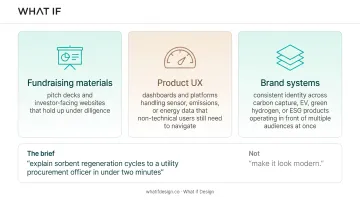
- Fundraising materials: pitch decks and investor-facing websites that hold up under diligence
- Product UX: dashboards and platforms handling sensor, emissions, or energy data that non-technical users still need to navigate
- Brand systems: consistent identity across carbon capture, EV, green hydrogen, or ESG products operating in front of multiple audiences at once
The goal is closing funding rounds, winning pilot partnerships, and getting technically complex products adopted by people who don't have an engineering degree, not visual polish for its own sake.
We exist specifically because generalist agencies often lack the vocabulary and patience to learn deep science before they start designing. For a carbon capture startup, the brief is closer to "explain sorbent regeneration cycles to a utility procurement officer in under two minutes" than "make it look modern."
2. Key advantages of choosing a climate tech design agency
These advantages tie directly to metrics founders already track: fundraising velocity, stakeholder trust, adoption rates, and cost efficiency. None of it is design theory for its own sake.
2.1 Domain fluency speeds up translation of complex science
A specialized agency already knows the terminology across carbon capture, grid interconnection, and ESG data. That means skipping the weeks generalist agencies spend just learning what a founder means by "interconnection queue" or "Scope 3 emissions."
This shows up in concrete ways:
- Faster first drafts, because the team isn't starting from zero
- Fewer revision cycles, since messaging is technically accurate from the outset
- Less time spent re-explaining basic science instead of refining the story
Susteon's four-month rebrand and website engagement with What if Design is a useful example. The project covered carbon capture, hydrogen production, and sustainable aviation fuel (dense technical territory).
Sudarshan Gupta, COO of Susteon, Sudarshan Gupta, said the team "accurately translated our vision to creatively visualize our deeply scientific work." The redesigned site went on to generate a 30% increase in job applicants, while still communicating hard numbers like 97%+ CO2 capture rates and a roughly 44% cost reduction versus existing solutions.
When it matters most: mid-fundraising, ahead of a demo day, or any moment when explaining the "why" behind the technology is half the battle. Shorter ramp-up time directly translates to hitting an investor-ready deadline instead of missing it.
2.2 Specialized design builds trust with investors, regulators, and technical buyers
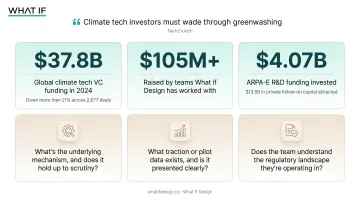
Climate tech investors are unusually skeptical, and for good reason. TechCrunch has noted that climate-tech investors "must wade through greenwashing", marketing that claims sustainability credentials a product doesn't actually have. Design that looks polished but says nothing specific reads as a red flag, not a strength.
An experienced climate tech agency knows how to structure materials to answer the diligence questions investors and technical buyers actually ask:
- What's the underlying mechanism, and does it hold up to scrutiny?
- What traction or pilot data exists, and is it presented clearly?
- Does the team understand the regulatory landscape they're operating in?
Capital has also gotten harder to win. Global climate tech VC funding fell to $37.8 billion across 2,677 deals in 2024, down more than 21% in value from 2023. In a tighter market, credibility signals matter more, not less.
This is where design's role in fundraising becomes tangible. What if Design has contributed to teams that collectively raised over $105M, working with founders backed by the US Department of Energy, ARPA-E, and leading climate VCs.
If your site hasn't kept pace with where the business actually is, we can show you what that's costing you. Get a free strategic audit.
That context matters. ARPA-E alone has funneled $4.07B in R&D funding into the sector, attracting more than $13.5B in private follow-on capital. Founders navigating that pipeline need materials that hold up to the same scrutiny DOE program officers apply.
When it matters most: active fundraising, grant applications, or entering partnerships with utilities and regulators who scrutinize legitimacy closely.
2.3 Senior-level strategic design without the cost of in-house hiring
Early and growth-stage climate tech companies rarely have the budget for a full in-house design team, but they still need senior strategic thinking, not junior execution.
A senior full-time product or UX designer typically costs upwards of $100,000 annually in the US, before benefits or overhead. Most small teams that do hire in-house end up with just one or two designers, usually stretched thin across brand, product, and marketing simultaneously.
Climate tech design agencies solve this differently:
- Founder-level design strategists and UX leads engaged on demand
- No salary, benefits, or lengthy hiring cycle to manage
- Scope that scales up during a fundraising sprint and back down afterward
We give you senior capacity at startup cost, delivered through models like a month-to-month Design Supercharger rather than a fixed headcount commitment.
When it matters most: seed-to-Series A companies, or any team whose design needs fluctuate with grant cycles, fundraising sprints, or product launches rather than staying constant year-round.
3. What happens when you skip a specialized climate tech design partner
Generalist agencies often produce work that looks clean but doesn't hold up under real scrutiny. Polished slides don't answer the technical questions a climate VC or DOE reviewer actually has.
The common failure points:
- Generic messaging that could describe any B2B SaaS company, not one working on grid interconnection or carbon removal
- Slower timelines while teams re-brief agencies that don't understand the science or regulatory context
- Mismatched brand, website, and product systems that create friction from the first investor call through onboarding
Each of these costs time, and in climate tech, time is often the difference between closing a round on schedule and missing a runway deadline.
4. How to choose the right climate tech design partner
Not every agency claiming climate expertise actually has it. A few questions separate the real ones from the rebranded generalists.
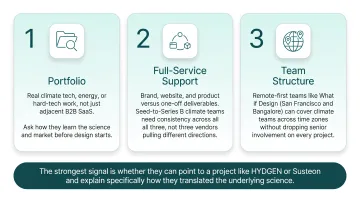
- Check the portfolio for real climate tech, energy, or hard-tech work, not just adjacent B2B SaaS. Ask how they learn the science and market before design starts.
- Evaluate full-service support across brand, website, and product versus one-off deliverables. Seed-to-Series B climate teams need consistency across all three, not three vendors pulling different directions.
- Consider how the team is structured. We work remote-first across San Francisco and Bangalore, so we can cover climate teams in different time zones without dropping senior involvement on any project.
The strongest signal is whether they can point to a project like HYDGEN or Susteon and explain specifically how they translated the underlying science.
5. Conclusion
The value of a climate tech design agency comes down to three things:
- Domain fluency that speeds up communication
- Credibility that builds trust with investors and technical buyers
- Senior-level strategic thinking without in-house overhead
These advantages compound. A stronger first impression with investors leads to faster fundraising, which frees up resources to invest further in design maturity as the company scales.
For climate tech companies, design isn't a one-time branding exercise wrapped up before a launch. It's an ongoing strategic practice that has to keep pace with a sector where scrutiny, complexity, and stakes keep rising.
If you're building in that environment and need a partner who already speaks the science, we help climate tech teams turn complex work into brand, product, and web experiences that win funding and adoption.
When the story is clear, the next conversation starts from confidence rather than explanation. Get a free strategic audit.
6. Frequently asked questions
6.1 What is a climate designer?
A climate designer is a design professional who applies systems thinking, storytelling, and UX skills specifically to climate-focused products, brands, and platforms. They translate technical and scientific complexity into materials that non-experts can understand and trust.
6.2 What does a climate tech design agency actually do?
They handle brand strategy, website design, product UX, and pitch deck design, all tailored to the specific credibility and technical-communication needs of climate tech companies. The focus is on outcomes like funding, partnerships, and adoption rather than visual polish alone.
6.3 How is designing for climate tech different from general B2B design?
Climate tech design has to balance scientific accuracy, regulatory nuance, and trust across very different stakeholders (investors, regulators, and end users) often within the same set of materials. General B2B design rarely has to satisfy that many audiences at once.
6.4 When should a climate tech startup hire a design agency instead of building in-house?
Agencies make the most sense when speed, fundraising cycles, or fluctuating design needs make a full-time hire impractical. Many seed-to-Series A teams simply don't have consistent enough workload to justify a $100,000+ annual salary.
6.5 How much does it typically cost to work with a climate tech design agency?
Costs vary by scope: a brand-only engagement runs smaller and faster than a full product design build. Most specialized agencies still cost less over time than an equivalent in-house senior hire, once salary and benefits are factored in.
6.6 Can a generalist design agency work for a climate tech company, or is a specialist necessary?
Generalists can handle simple, low-stakes projects reasonably well. For fundraising, regulatory scrutiny, or complex technical products, a specialist cuts ramp-up time. They've already navigated credibility challenges most generalists haven't seen.
Related reading: 7 inspiring cleantech websites and UX design strategies for B2B technology success.
Ready to take the next step?
If you're weighing a design partner for climate, deep tech, or hard-to-explain products, Book a strategy call with our founders at What if Design, a no-pressure 25-minute conversation about what you're building and where design can help. You can also View our work to see how we've helped teams like yours, or Get a free strategic Audit of your current brand, website, or product experience.