Where What if Design fits in We're a senior-led creative studio built specifically for climate tech, clean tech, and deep tech founders. Since 2020, we've partnered with teams like HYDGEN, Ribbit Network, and Susteon to turn hard-to-explain technology into brands, websites, and product experiences that raise capital and win adoption. This comparison reflects how we evaluate the trade-offs when a founder asks us which route to take.
Every climate tech founder hits this fork in the road eventually: hire a generalist creative agency, or bring in a specialist that already lives inside the energy transition. It feels like a branding decision. It's actually a fundraising decision.
Climate-tech venture and growth investment reached $40.5 billion in 2025, up 8% year-over-year, even as deal count fell 18% to its lowest point since 2020, according to CTVC's 2025 investment report. Fewer deals, bigger checks, more scrutiny per pitch.
That shift raises the stakes on how you present your technology. A mismatched agency can slow diligence, confuse technical investors, or oversimplify science that took years to develop. The right partner speeds diligence and keeps technical depth intact for investors who know the domain.
This article breaks down when a generalist makes sense, when a specialist earns its premium, and how to decide.
TL;DR: key takeaways
- Generalist agencies bring broader creative range, lower entry pricing, and faster kickoff for standard branding work.
- Specialists shorten discovery with fluency in green hydrogen, grid interconnection, and related technical concepts.
- Speed-to-brief and investor credibility matter more than raw talent quality alone.
- Choose based on technical complexity, timeline, budget, and fundraising stage.
1. Generalist agency vs. renewable energy specialist: quick comparison
Here's how the two approaches stack up across the factors that matter most to climate tech founders.
1.1 Cost & pricing structure
- Generalist agency: Lower entry pricing from broader market competition, but onboarding and technical education often create hidden costs.
- Specialist agency: Higher rate on paper, offset by fewer revision cycles because less time goes to explaining the underlying science.
1.2 Industry & technical fluency
- Generalist agency: Limited built-in knowledge of concepts like green hydrogen, carbon capture, grid interconnection, or ESG disclosure frameworks.
- Specialist agency: Already fluent in the terminology and science, which shortens discovery and briefing considerably.
1.3 Speed & agility
- Generalist agency: Needs a longer ramp-up period to understand a novel technology before design work can even start.
- Specialist agency: Moves into strategy and design faster, drawing on existing category context and reference points.
1.4 Scope of services
- Generalist agency: Often siloed into branding-only or web-only work, requiring founders to coordinate multiple vendors.
- Specialist agency: Often delivers end-to-end brand, website, and product design under one roof, cutting coordination overhead during a raise.
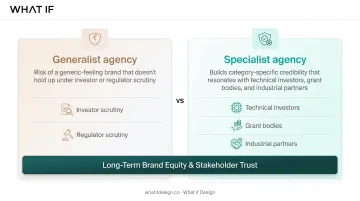
1.5 Long-term brand equity & stakeholder trust
- Generalist agency: Risk of a generic-feeling brand that doesn't hold up under investor or regulator scrutiny.
- Specialist agency: Builds category-specific credibility that technical investors, grant bodies, and industrial partners recognise.
2. What is a generalist design agency?
A generalist agency serves clients across many unrelated industries without deep concentration in one vertical. One month it's a skincare brand, the next a fintech app, then a hospitality client.
Founders still consider generalists for good reasons:
- Broader creative perspective across categories
- Larger talent pools to draw from
- More competitive base pricing on logos, decks, and websites
The trade-off shows up when the product itself is hard to explain. A generalist team walking into carbon capture, green hydrogen, or grid-scale storage for the first time has to learn the science before they can design anything usable. That learning curve translates into extra briefing sessions and more correction rounds than a founder typically budgets for.
2.1 Use cases of generalist agencies
Generalists tend to shine where differentiation is emotional or lifestyle-driven rather than deeply technical:
- Consumer packaged goods and retail branding
- Hospitality and food & beverage identity work
- General B2B SaaS with straightforward value propositions
- Early-stage consumer products where design taste matters more than domain expertise
No study pins an exact hour count on that ramp-up. In practice, teams new to terms like PPA or electrolyzer stack ask more clarifying questions before a single mockup ships, and founders pay for that time even when it never appears as a line item.
How we evaluated the options
Every recommendation here comes from actual client work, brand systems shipped, websites launched, and product experiences delivered under fundraising deadlines. We compared the options against five criteria that matter most for technical founders:
- Total cost of ownership across the first 12 months (not just the sticker price)
- Speed to a usable output given a typical Series A runway
- Quality of the technical translation, can they explain your science without oversimplifying it?
- Rework risk, how often teams re-hire because the first choice couldn't scale
- Ability to move with the roadmap without a re-onboarding tax every quarter
Where we cite numbers or trade-offs below, they come from projects we've delivered or watched founders navigate first-hand.
3. What is a renewable energy branding specialist?
A renewable energy branding specialist centers their practice on the sector's science, funding cycles, and stakeholder audiences. That focus matters when you're raising capital or explaining a technology without an obvious consumer analog.
The practical benefit is speed. A specialist already understands terms like ARPA-E, DOE grants, PPAs, or grid interconnection, so your first strategy call can skip the vocabulary lesson and get straight to positioning.
That fluency builds credibility with technical investors and partners who can tell within minutes whether an agency actually understands what they're looking at.
Specialists also vary in scope. Some offer brand identity work alone. Others, including What if Design, bundle brand strategy, website design, and product UX under one engagement, so founders aren't managing three separate vendors during a fundraising sprint.
If your site hasn't kept pace with where the business actually is, we can show you what that's costing you. Get a free strategic audit.
3.1 Use cases of renewable energy specialists
Specialists tend to show up at specific inflection points in a founder's journey:
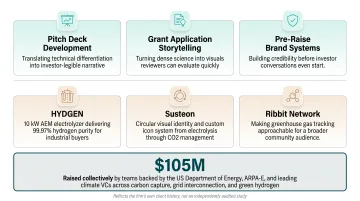
- Pitch deck development ahead of a fundraising round, translating technical differentiation into investor-legible narrative.
- Grant application storytelling, turning dense science into visuals that reviewers can evaluate quickly.
- Pre-raise brand systems, building credibility before investor conversations even start.
What if Design's climate tech portfolio shows this in practice:
- HYDGEN (decentralized green hydrogen): Turned a dense, text-heavy site into a clearer experience highlighting a 10 kW AEM electrolyzer and 99.roughly 97% hydrogen purity for industrial buyers.
- Susteon (carbon capture and hydrogen): Brand strategy, circular visual identity, and a custom icon system from electrolysis through CO2 management.
- Ribbit Network (open-source climate observability): A digital presence that made greenhouse gas tracking approachable for a broader community audience.
According to What if Design, its strategists have supported teams backed by the US Department of Energy, ARPA-E, and leading climate VCs across carbon capture, grid interconnection, and green hydrogen, contributing to over $105M raised collectively. That figure reflects the firm's own client history rather than an independently audited study, but it points to a pattern: technical fluency compounds across engagements in this sector in a way generalist experience doesn't.
4. Generalist vs. specialist: which one should you choose?
Four factors should drive this decision:
- Technical complexity of what you're building
- Timeline urgency, especially relative to a funding deadline
- Budget structure and what you can realistically allocate
- Multi-service integration (brand + web + product) versus a single deliverable
Choose a generalist agency if your immediate need is simple, consumer-facing collateral unrelated to deep technical differentiation. Budget limits that rule out a specialist premium also point this way. A one-off social media campaign or an internal deck doesn't need a climate specialist.
Choose a renewable energy specialist if you're preparing to raise funding, need to explain hard science to non-technical stakeholders, or want one partner handling brand, website, and product cohesively. That beats stitching together three vendors mid-raise.
Neither option is universally better. The question is whether your growth stage carries technical and strategic stakes high enough to justify the specialist premium. A pre-seed team validating a concept has different needs than a Series A company walking into DOE grant review.
5. Real-world case study: specialist branding in climate tech
Susteon is a climate tech company working on carbon capture, hydrogen production, and CO2 management technologies. Like many deep tech startups, it faced a familiar problem: its website didn't communicate what the company actually did, or why it mattered, to investors and partners outside its technical circle.
The company's work was genuinely complex. Explaining decarbonization pathways to a non-specialist audience is hard even with unlimited time. Without a brand system built to translate that complexity, potential investors and partners were left guessing at Susteon's role and value.
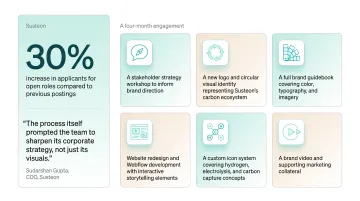
To close that gap, What if Design ran a four-month engagement that included:
- A stakeholder strategy workshop to inform brand direction
- A new logo and circular visual identity representing Susteon's regenerative carbon ecosystem
- A full brand guidebook covering color, typography, and imagery
- Website redesign and Webflow development with interactive storytelling elements
- A custom icon system covering hydrogen, electrolysis, and carbon capture concepts
- A brand video and supporting marketing collateral
The redesigned website produced a 30% increase in applicants for open roles compared to previous postings. Susteon COO Sudarshan Gupta noted the process itself prompted the team to sharpen its corporate strategy, not just its visuals.
The real lesson is narrower: specialist fluency in the science builds trust with technical stakeholders faster than generic branding. When the team already understands carbon pathways and hydrogen systems, the brand stops guessing and starts translating.
If your climate tech company is heading into a raise, grant application, or partnership pitch and your brand isn't doing the science justice, we work with teams like Susteon to turn complex technology into a brand investors and partners can actually evaluate.
Get this right and you get alignment: your team, your investors and your buyers all read the same story the same way. Get a free strategic audit.
Which option is right for your stage
The right answer depends less on the two options themselves and more on where you are as a company.
Pre-seed / seed (0–$3M raised): Speed and story matter more than polish. A focused boutique-agency sprint usually beats an in-house hire, because the founder still needs to control the narrative. We've seen this pattern with early climate-tech teams, a 4-to-6-week engagement to get brand, website, and pitch coherent is more valuable than a full-time designer.
Series A ($5–20M raised): This is where a senior-led agency partner pays for itself. You need a brand system that will survive three product pivots, a website that converts enterprise buyers, and pitch materials that hold up in board meetings. In-house is still premature unless you're planning to ship design-heavy product weekly.
Series B and beyond ($20M+ raised): Hire in-house design leadership and keep an agency partner for concentrated bursts (rebrands, launches, category shifts). The two aren't substitutes at this stage, they solve different problems.
Growth-stage climate tech specifically: The stakes shift once you're commercializing. Your brand needs to hold up to procurement diligence, regulatory scrutiny, and investor updates simultaneously. A specialist studio that already speaks the science, like our team, reduces the translation tax that generalists impose on every deliverable.
6. Frequently asked questions
6.1 What is the difference between a generalist agency and a specialized renewable energy branding agency?
Generalists serve varied industries with broad creative capability but limited sector-specific knowledge. Specialists concentrate on climate tech's science, funding cycles, and stakeholder audiences, which shortens onboarding and strengthens investor credibility.
6.2 Is a renewable energy branding specialist more expensive than a generalist agency?
Base rates can run higher, but reduced revision cycles and faster onboarding often offset that premium. You're paying less for education time and more for immediate strategic fit.
6.3 How quickly can a specialist start delivering versus a generalist?
Specialists usually begin productive strategy work within days because they already know sector terminology, stakeholders, and funding norms. Generalists often need weeks of education before that work can start in earnest.
6.4 How do I know if my climate tech company needs a specialist branding agency?
Watch for signals like an upcoming funding round, technology that's hard to explain to non-technical audiences, or repeated investor confusion about your product. Any of these point toward a specialist.
6.5 Can a generalist agency effectively brand a highly technical energy product?
It's possible, but it typically requires more time, more back-and-forth, and carries a higher risk of oversimplification or technical inaccuracy.
6.6 What should I look for when hiring a renewable energy branding partner?
Prioritize partners who show:
- Demonstrated technical fluency in climate and energy
- A portfolio of real climate tech clients
- Integrated brand-to-product services, not piecemeal deliverables
Related reading: Eight strategies to boost your renewable energy marketing strategy and LEED certification and renewable energy standards.
Ready to take the next step?
If you're weighing a design partner for climate, deep tech, or hard-to-explain products, Book a strategy call with our founders at What if Design, a no-pressure 25-minute conversation about what you're building and where design can help. You can also View our work to see how we've helped teams like yours, or Get a free strategic Audit of your current brand, website, or product experience.