This decision affects more than your marketing budget. It affects your runway, how quickly you can get in front of investors, and whether your next hire is a designer or a strategist. Get the scope wrong, and you'll pay twice: once for a strategy document that sits in a Google Drive folder, and again for an agency to translate it into something usable.
Scope confusion is a real cost driver here. AIGA's pricing guidance for design firms notes that fixed-fee proposals only work when the scope is spelled out in detail, with anything extra treated as a separately billed change order. Vague scoping is exactly what turns a $15,000 project into a $40,000 one.
TL;DR: key takeaways
- Brand strategy firms suit scoped positioning and messaging work priced by deliverable, not retainer hours
- Full-service agencies fit when strategy, brand, website, and product design need one accountable team
- Match the model to stage: pre-seed teams usually need clarity first; funded startups often need everything moving together
- Climate and deep tech gain most from a hybrid path that removes the strategy-to-execution handoff
1. Brand strategy firm vs full agency: quick comparison
| Factor | Brand Strategy Firm | Full-Service Agency |
|---|---|---|
| Cost | Flat fee or hourly, about $100, $149/hour per Clutch | Project fees often $10,000, $50,000+ by scope, plus ongoing retainers |
| Scope of Services | Positioning, narrative, messaging architecture, sometimes a pitch narrative | Strategy plus website, product UX/UI, campaigns, and ongoing creative production |
| Team Structure | Solo strategists or small positioning studios, senior-heavy | Mixed teams: strategists, designers, developers, account managers |
| Best Fit For | Pre-fundraise founders needing a defensible story fast | Companies that need brand, website, and product shipping together |
Neither option is objectively better. They solve different problems at different moments in a company's life.
2. What is a brand strategy firm?
A brand strategy firm specializes in the "who we are and why it matters" work: positioning, messaging architecture, and narrative. It stops short of execution. No website, no logo files ready for production, no ongoing campaigns. Just the strategic foundation.
That narrow focus is the point. Before a technical company has a website or pitch deck to build, someone needs to answer harder questions first: What's the actual claim we're making? Who's the buyer? What's the one thing a VC needs to believe in the first ninety seconds?
Core benefits of this model:
- Clear message before a single design file exists
- Faster investor-ready narrative, without competing with visual production timelines
- Shared foundation designers or in-house marketers can build on later, without reopening what the company stands for
Not every brand strategy firm looks the same. Some are solo consultants who hand over a positioning deck and step away. Others are boutique studios that stay involved loosely through early execution.
The typical engagement is short and fixed-scope, measured in weeks rather than months, and priced as a flat fee rather than an ongoing retainer.
2.1 Use cases of a brand strategy firm
This model fits best for:
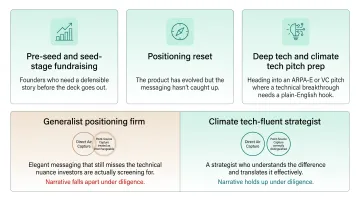
- Pre-seed or seed-stage companies preparing for a fundraising round who need a defensible story before the deck goes out
- Companies doing a positioning reset, where the product has evolved but the messaging hasn't caught up
- Deep tech and climate tech founders heading into an ARPA-E or VC pitch, where a technical breakthrough needs a plain-English hook
The catch for climate tech specifically: a generalist positioning firm can produce elegant messaging that still misses the technical nuance investors are actually screening for. A strategist who doesn't understand the difference between direct air capture and point-source capture will write a narrative that sounds confident and falls apart under diligence.
3. What is a full-service agency?
A full-service agency combines brand strategy with execution (website, product design, campaigns, and ongoing content) under one team. Instead of handing off a strategy deck to a separate execution vendor, the same team that defined your positioning builds the thing that expresses it.
Core benefits:
- Single point of accountability, so nobody blames "the other vendor" when something doesn't land
- No handoff gap between strategy and execution, which is where most brand work quietly dies
- Faster time-to-market, since strategy and design run in parallel rather than sequentially
Full-service agencies split into two very different flavors. Large traditional agencies come with account layers, multiple approval rounds, and overhead that shows up in the invoice. Lean, boutique full-service studios, senior-led and often remote-first, cover the same full stack with fewer people touching your project.
Engagements typically run longer: ongoing retainers or multi-phase projects that move from brand to website to product over several months rather than weeks. Clutch market data puts most UI/UX-specific projects between $10,000 and $50,000, before brand strategy or a full website build on top.
3.1 Use cases of a full-service agency
This model fits best for:
- Companies shipping brand, website, and product together without coordinating three vendors on three timelines
- Funded climate tech and hard-tech startups translating complex science into a pitch deck, website, and product UI at once
- Teams without an internal design lead who need one accountable partner rather than a patchwork of freelancers
The math on outsourcing versus building in-house rarely favors the in-house route at this stage. Deloitte's 2024 outsourcing survey of over 500 executives found companies turning to outside partners for speed and specialized skill.
For an early-stage startup, a senior brand strategist and senior product designer full-time means two salaries, benefits, and management overhead before either ships anything.
If your site hasn't kept pace with where the business actually is, we can show you what that's costing you. Get a free strategic audit.
4. Brand strategy firm vs full agency: which one is right for you?
Four factors decide this, and none of them is "which one sounds more impressive on a call."
- Budget: A flat-fee positioning project costs less upfront than a multi-month retainer, full stop.
- Company stage: Pre-seed companies often need clarity before they need a website. Funded companies usually need both moving at once.
- Timeline urgency: If your pitch deck is due in three weeks, you don't have time for a strategy-then-handoff sequence.
- The actual next deliverable: Is it a single strategic document, or continuous creative output over the next two quarters?
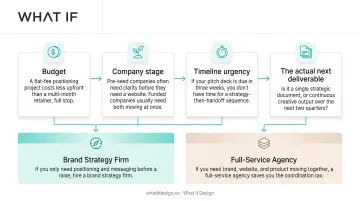
If you only need positioning and messaging before a raise, hire a brand strategy firm. If you need brand, website, and product moving together, a full-service agency saves you the coordination tax.
4.1 Why climate tech is the exception
Here's where the standard advice breaks down for climate and deep tech. The brief itself is hard to write. A generalist strategist can't write a positioning brief for a green hydrogen electrolyzer without first understanding what makes it different from three competitors doing something that sounds identical. Hand that brief to a separate execution agency, and you've now paid twice for the same learning curve.
That double learning curve is the gap What if Design was built to close. Founded by Akhila Kosaraju and Tejas Mahajan, the studio works only with climate tech, deep tech, and sustainability companies. The team learns the underlying science before any design decision, instead of treating the work like a generalist branding exercise.
Their pitch deck work has helped clients raise $105 million+ to date, with teams backed by ARPA-E, the U.S. Department of Energy, Accel, Y Combinator, and Sequoia.
Cost efficiency matters here too. A senior-led boutique partner gives you strategist-plus-designer depth without a large agency's account layers or the cost of in-house hires.
What if Design's retainer runs roughly $4,999 to $6,999 per month depending on tier, up to three times cheaper than hiring senior designers in-house, with turnaround as fast as 48 hours on individual requests.
Neither model wins universally. The right fit depends on your stage and what your next deliverable actually needs to be.
5. Real-world example: brand strategy firm vs full agency in climate tech
Susteon, a carbon capture and hydrogen production company, shows why splitting brand strategy and execution across two vendors gets messy for technical companies.
Susteon's challenge wasn't a lack of substance. It was translation. Complex carbon-capture, hydrogen-production, and CO₂-management technology is hard to explain to investors and partners through a generic website template.
A positioning firm could write elegant copy about "climate innovation." Without understanding the chemistry and market mechanics, that copy risks sounding like every other climate startup's homepage.
Susteon chose What if Design as a single hybrid partner instead of splitting work between a positioning firm and a separate execution shop. The engagement ran four months and covered:
- Brand strategy and brand design
- Full website redesign and build
- Communications design, logo, and brand guidebook
- Brand video and marketing collateral
The results:
- Clean, technically accurate site using visual storytelling and interactive elements
- 30% more applicants for open roles versus previous hiring cycles
- Internal strategy reset, COO Sudarshan Gupta said the work pushed Susteon to rethink corporate strategy, not just visuals
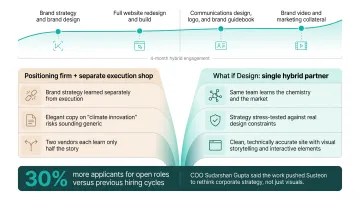
When one team owns both the thinking and the making, strategy gets sharper. It is stress-tested against real design constraints the whole way through.
The takeaway: If your technology needs someone to understand it before they can position it, a hybrid full-service partner beats two vendors who each learn half the story. If positioning is already crisp and you only need design, splitting the work can still make sense.
If you're facing a positioning-to-execution gap, What if Design's team is worth a conversation.
A site that reflects the company you have actually become is the cheapest credibility you can buy, and it puts you back in control of the first impression. Get a free strategic audit.
6. Frequently asked questions
6.1 What is the difference between a brand and an agency?
A brand is the perception and reputation a company holds in people's minds. An agency is the external partner: a strategy firm, design studio, or full-service shop, hired to help build and express that brand.
6.2 What are the 7 key elements of brand strategy?
HubSpot's brand strategy framework names seven core elements: authentic purpose, coherent presence, emotional connection, agility, employee advocacy, customer loyalty, and cultural awareness.
6.3 Is it cheaper to hire a brand strategy firm than a full agency?
Brand strategy firms are typically cheaper upfront because of narrower scope, often billed hourly around $100, $149 based on Clutch benchmarks. A full-service agency can cost less overall once execution work is included in the total.
6.4 Can I start with a brand strategy firm and later move to a full agency?
Yes, this is common practice. It works well as long as the strategy documentation is thorough enough for a new execution team to pick up without starting the discovery process over.
6.5 Do climate tech and deep tech startups need a specialized agency?
Technical, hard-to-explain businesses benefit from partners who understand the underlying science before designing the brand. This reduces the costly back-and-forth that happens when a generalist team misinterprets the technology.
6.6 How do I decide between a brand strategy firm and a full-service agency?
Weigh your company stage, the urgency of your timeline, and whether you need a single strategic deliverable or continuous creative output. Pre-raise founders often need clarity first; funded companies often need everything shipping together.
Related reading: 10 Best SaaS UX Design Agencies For Product Growth In 2026 and Discover the top UI/UX design agencies in Bangalore.
Ready to take the next step?
If you're weighing a design partner for climate, deep tech, or hard-to-explain products, Book a strategy call with our founders at What if Design, a no-pressure 25-minute conversation about what you're building and where design can help. You can also View our work to see how we've helped teams like yours, or Get a free strategic Audit of your current brand, website, or product experience.