None of that matters if a CFO or investor closes your pitch deck feeling like they just read another sustainability brochure.
Climate tech founders lose funding rounds and enterprise deals over this exact gap: brilliant science, unconvincing brand. A wrong agency hire doesn't just waste a proposal fee. It burns months of runway and pushes back your raise. It can also misrepresent complex technology to the people deciding whether to write a check.
The skepticism is real. 94% of investors believe corporate sustainability reporting contains at least some unsupported claims, up from 87% a year earlier, according to PwC's 2023 Global Investor Survey. Your brand is either closing that trust gap or widening it.
This guide breaks down exactly what to evaluate before signing with a climate tech branding agency.
TL;DR: key takeaways
- Climate tech branding must build technical credibility first, aesthetics second
- Vet for domain fluency, relevant case studies, full-service scope, and proven outcomes, not portfolio awards
- Generic "eco" visuals and vague scoping are the two biggest reasons to walk away
- Senior-led specialists like What if Design deliver climate tech expertise without in-house hiring overhead
1. What is a climate tech branding agency?
A climate tech branding agency is a creative partner that translates science-heavy technology (carbon capture solvents, hydrogen electrolyzers, battery chemistry, ESG data platforms) into brand identity, messaging, and digital experiences that investors, regulators, and enterprise buyers trust.
That's a different job than general branding. A generic agency can make a logo look good. A climate tech agency has to get the chemistry right, understand funding cycles from seed to Series B, and know which certifications and technical partnerships actually move a buyer's confidence.
1.1 Core services a climate tech branding agency should offer
Before evaluating any agency, know what "full service" should include:
- Brand strategy and identity: naming, visual systems, and messaging architecture built to survive investor due diligence, not just look good in a pitch deck
- Website and digital experience design: structured to translate technical differentiation into a buyer journey, so an engineer and a CFO reading the same site both find what they need
- Product and UX design support: for companies whose "brand" also lives inside a dashboard, monitoring platform, or SaaS tool, not just a marketing site
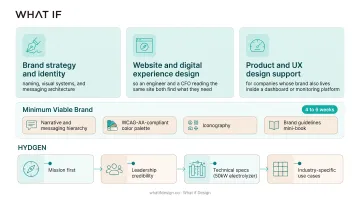
What if Design's Minimum Viable Brand package shows what brand strategy looks like in practice: a narrative and messaging hierarchy, WCAG-AA-compliant color palette, iconography, and a brand guidelines mini-book, typically within 4 to 6 weeks.
On the website side, its work for green hydrogen company HYDGEN restructured a text-heavy site into a clear path: mission first, then leadership credibility, then technical specs like a 50kW electrolyzer, then industry-specific use cases.
1.2 Why generic branding agencies fall short for climate tech
Generic agencies default to what's familiar: leaf green palettes, stock solar panels, tree-planting imagery. Sophisticated buyers like CFOs and sustainability directors see through it fast. It signals surface-level understanding, not technical credibility.
The deeper risk is oversimplification. An agency that doesn't understand the underlying science can flatten real differentiation into generic claims, and that erodes investor and partner confidence quickly.
It also misses how buyers decide. B2B buyers increasingly evaluate the sustainability of the product itself, not just a supplier's mission statement.
Bain's 2025 B2B sustainability research found nearly 70% of B2B customers plan to accelerate purchases from sustainable suppliers over the next three years. Yet only half felt the sustainability benefits pitched to them were adequately supported.
Climate tech buyers scrutinize credentials and certifications as closely as product specs. An agency needs to know how to design trust signals such as DOE backing, third-party verification, and technical partnerships, not just place a logo next to a tagline.
2. Key factors to vet before hiring a climate tech branding agency
Every agency will tell you they "get" sustainability. Few can prove they understand the science, the funding stakes, and the buyer psychology involved. These six factors separate agencies that treat climate as a niche market from ones who genuinely understand what's on the line.
2.1 Climate & deep-tech domain fluency
An agency that learns the underlying science before designing: carbon capture chemistry, grid interconnection, or green hydrogen methods, produces pitch materials that hold up under investor questioning.
Get this wrong and you'll spend weeks in revision cycles re-explaining the same technical nuance. Get it right, and your materials build credibility on the first draft.
What to check: ask what climate or deep-tech projects the agency has actually shipped, not just pitched for.
For example, What if Design has worked on carbon capture through Susteon, a solvent the company reports captures over 97% of CO2 from industrial flue gas at a 44% cost reduction versus existing options, and on decentralized hydrogen through HYDGEN's AEM and PEM electrolyzer platforms.
2.2 Proof in portfolio: relevant climate tech case studies
Logos from carbon capture, EV, or ESG data clients tell you more than a stack of generic B2B SaaS work ever will. An agency that's already designed for a hydrogen electrolyzer company understands your buyer's skepticism and your sales cycle before the first call.
Look for named, verifiable client work, not vague "climate-adjacent" claims. What if Design's portfolio includes:
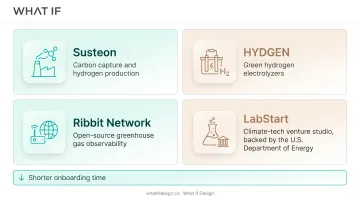
- Susteon: carbon capture and hydrogen production
- HYDGEN: green hydrogen electrolyzers
- Ribbit Network: open-source greenhouse gas observability
- LabStart: a climate-tech venture studio with U.S. Department of Energy backing
2.3 Full-service capability across brand, website, and product
Fragmented vendors: one team for brand, another for the website, a third for product UX, create inconsistent messaging and slower go-to-market timelines. Every handoff is a chance for your narrative to drift.
A founder juggling three vendors also loses time coordinating instead of fundraising.
What to check: ask whether one team owns brand, website, and product design under a single strategic thread.
Susteon's four-month engagement with What if Design covered brand strategy, visual identity, website development, and communications design as one continuous project, not three separate handoffs.
If your site hasn't kept pace with where the business actually is, we can show you what that's costing you. Get a free strategic audit.
2.4 Business-outcome track record, not just awards
Design awards look nice on an agency's homepage. They don't tell you whether the work closed a funding round, landed a partnership, or moved an adoption metric. Ask for outcomes tied to business results instead.
The evidence for design's business impact is real. A Design Council and Innovate UK program applied user-focused design to 47 net-zero businesses and helped them collectively secure £5.7 million in private investment.
Of that group, 42% secured follow-on funding, and two-thirds directly credited the design program, according to Design Week's coverage of the initiative.
What to check: ask for specifics, not aggregate claims.
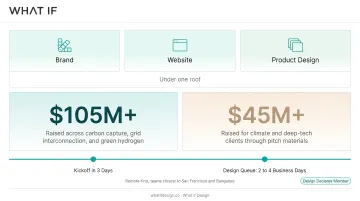
What if Design has contributed to $45M+ raised through pitch decks for climate and deep-tech clients, plus brand and website work behind $105M+ raised across teams backed by the U.S. Department of Energy, ARPA-E, and leading climate VCs.
2.5 Access to senior strategists, not junior account managers
When you're making a high-stakes messaging decision two weeks before a term sheet closes, you need someone who can make a call, not someone checking with a strategist three levels up.
Founder-level or senior-strategist access matters most when timelines compress. Fast answers reduce miscommunication and prevent a rushed board deck from going out with unreviewed claims.
What to check: ask directly who will be on your calls. At a two-person, founder-led studios like ours, that access is structural rather than a premium add-on. The same people setting brand strategy are the ones in your working sessions.
2.6 Process for translating complex science into investor-grade trust signals
Certifications, technical partnerships, and third-party validation build buyer confidence, but only if they're designed to be seen, not buried in a footnote.
What to check: ask how the agency structures discovery before designing anything.
What if Design typically runs a stakeholder strategy workshop on goals, audiences, and competitive positioning, then distills it into a creative brief that shapes messaging and visual direction. For Susteon, that process turned dense carbon capture chemistry into infographics and concise content investors and partners could actually follow.
3. Red flags & smart questions to ask during the vetting process
Some warning signs surface before you even sign a contract. Watch for these during initial calls:
Red flags:
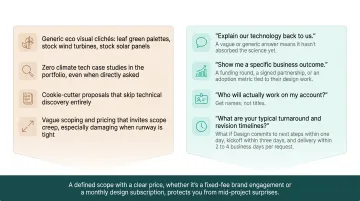
- Generic "eco" visual clichés: leaf green palettes, stock wind turbines, stock solar panels
- Zero climate tech case studies in the portfolio, even when directly asked
- Cookie-cutter proposals that skip technical discovery entirely
- Vague scoping and pricing that invites scope creep, especially damaging when runway is tight
Ask these questions before signing anything:
"Explain our technology back to us." After an initial discovery call, ask the agency to describe what your company does in its own words. A vague or generic answer means it hasn't absorbed the science yet. 2. "Show me a specific business outcome." Don't accept "we've worked with climate companies." Ask for one concrete example: a funding round, a signed partnership, an adoption metric tied to their design work.
"Who will actually work on my account?" Get names, not titles. A senior strategist on the pitch call and a junior account manager on delivery is a mismatch worth catching early. 4. "What are your typical turnaround and revision timelines?" Get this in writing. What if Design, for example, commits to next steps within one day of signup, kickoff within three days, and delivery within 2 to 4 business days per request.
Clear timelines are only half the protection. A defined scope with a clear price, whether it's a fixed-fee brand engagement or a monthly design subscription, protects you from mid-project surprises.
4. How we can help
we are a full-service creative partner built specifically for climate tech, energy, and deep-tech founders who need brand, website, and product design under one roof, rather than three separate vendors to coordinate.
Co-founders Akhila Kosaraju and Tejas Mahajan bring a background that's unusual for a design studio. Akhila designed LEED-certified buildings and $100M+ urban interventions before co-founding the studio. Tejas leads product and UX for software companies, designing for adoption, retention and the metrics that drive growth, across battery management systems, fleet platforms and ESG tools.
That mix of an architect's systems thinking and startup-scale operations experience shows up in how they turn dense science into brand narratives investors can actually evaluate.
The track record backs it up:
- Akhila's work with teams backed by the U.S. Department of Energy, ARPA-E, and leading climate VCs has contributed to over $105M raised across carbon capture, grid interconnection, and green hydrogen
- The studio has designed pitch materials behind $45M+ raised for climate and deep-tech clients
The model is remote-first, with teams closest to San Francisco and Bangalore. Clients get senior-level strategy and design without the overhead of building an in-house team. Kickoff happens within three days of signing, and requests typically move through the design queue in 2 to 4 business days.
we are also a signatory to Design Declares, a public commitment to ethical, sustainable design practices and to using creative work as a force for environmental accountability.
For a founder who needs a partner that understands carbon capture chemistry or electrolyzer specs well enough to design around them, domain-specific portfolio work, senior access, and full-service delivery under one roof are what make the engagement work.
5. Conclusion
When vetting a climate tech branding agency, prioritize domain fluency, a proven process, and a track record that matches your funding stage and technical complexity, not awards or name recognition alone.
Climate tech branding carries higher stakes than typical B2B design work. Every visual choice and messaging decision either builds or erodes the trust of investors, regulators, and enterprise buyers who are already skeptical of sustainability claims by default.
Fit also isn't a one-time decision. The agency that nails your seed-stage story may not be the right partner once you need enterprise-grade credibility for a Series B or a major utility partnership. Reassess as your stage, buyers, and proof requirements change.
A site that reflects the company you have actually become is the cheapest credibility you can buy, and it puts you back in control of the first impression. Get a free strategic audit.
6. Frequently asked questions
6.1 What's the difference between a general branding agency and a climate tech branding agency?
A climate tech agency combines design skill with real fluency in the underlying science, funding cycles, and credibility signals like certifications and technical partnerships. General agencies typically default to visual polish without that technical grounding.
6.2 How much does it cost to hire a climate tech branding agency?
Costs vary by scope: brand-only work costs less than a full brand, website, and product engagement. Boutique, senior-led studios often run $2,999 per month on subscription models, which is typically more cost-efficient than building an in-house team.
6.3 How long does a climate tech branding or rebranding project typically take?
A brand identity project usually takes 4 to 6 weeks, while a full website build runs 4 to 12 weeks and product UX work runs 4 to 8 weeks. Agile agencies can compress timelines around fundraising deadlines.
6.4 Should an early-stage climate tech startup hire an agency or build an in-house design team?
Early-stage startups get more from senior-level agency expertise than from in-house hiring overhead. Reserve in-house teams for later growth stages, once design needs are constant enough to justify full-time salaries.
6.5 What questions should I ask a climate tech branding agency before signing a contract?
Before you sign, ask them to:
- Explain your technology back to you after discovery
- Tie a past project to a specific business outcome
- Confirm exactly who will work on your account
6.6 What are common red flags when evaluating a climate tech branding agency?
Watch for:
- Generic "eco" visual clichés
- No relevant case studies
- Vague scoping or pricing that invites scope creep
Related reading: Climate tech brand messaging and 7 inspiring cleantech websites.
Ready to take the next step?
If you're weighing a design partner for climate, deep tech, or hard-to-explain products, Book a strategy call with our founders at What if Design, a no-pressure 25-minute conversation about what you're building and where design can help. You can also View our work to see how we've helped teams like yours, or Get a free strategic Audit of your current brand, website, or product experience.