A poor agency hire wastes budget, delays fundraising or launch timelines, and leaves you with a brand that looks fine today but can't scale once you raise a Series A or ship a second product line.
The tricky part is that most red flags surface early, during the pitch and discovery process, before you've signed anything. This guide walks through the specific warning signs to catch during vetting, plus what a trustworthy branding partner actually looks like.
TL;DR: key takeaways
- Watch for skipped strategy work, cookie-cutter portfolios, opaque pricing, bait-and-switch teams, and unclear file ownership
- Treat brand as a business tool for fundraising, adoption, and growth, not just visuals
- Get team structure, process, and asset ownership in writing before signing anything
- Vet agencies like a key hire: references, proof of process, and verifiable results
1. What does a branding agency actually do?
A branding agency shapes how a company is perceived externally, through its name, visual identity, messaging, and the systems that keep those consistent across every touchpoint.
Core deliverables typically include:
- Brand strategy: positioning, audience insight, and messaging direction
- Naming: company, product, or portfolio names when the project calls for it
- Visual identity: logo, color palette, typography, iconography
- Brand guidelines: rules for applying the identity consistently
- Messaging framework: core messages, proof points, and tone of voice
Some full-service agencies extend further into website and product design. For fast-moving tech companies going from brand to launch, this matters. It removes the handoff gaps that happen when three different vendors interpret the same strategy three different ways. If an agency can’t define this scope clearly up front, that’s often an early hiring red flag.
2. Red flags to watch for when hiring a branding agency
These signs typically surface during the pitch and discovery process, well before a contract lands on the table. Each one predicts a specific downstream cost, whether that's wasted budget, missed deadlines, or a brand that stalls the moment you need it to scale.
2.1 They skip strategy and jump straight to logos
If an agency wants to show you mood boards in the first meeting, that's a problem. Without discovery on your business model, market, and audience, the "identity" they produce is decoration, not a business asset.
The Design Council's Double Diamond framework places Discover and Define phases before any development or delivery work begins, for good reason: you can't design for a problem you haven't defined yet.
What to look for instead: Agencies that ask about your funding stage, audience, and business goals before presenting a single visual concept.
2.2 Their portfolio looks like one template reskinned
Scroll through their case studies. If every client's brand uses the same color-gradient-and-sans-serif formula regardless of industry or audience, the agency is applying a template, not solving a specific positioning problem.
The probe: Ask them to explain the strategic reasoning behind two different portfolio projects. A real strategist can tell you why a carbon-capture brand needed a different visual language than a hospital dashboard. A vague answer like "we wanted it to feel modern" reveals there wasn't much process behind it.
2.3 They can't explain the "why" behind design decisions
Real strategists can defend every color, word, and shape with a business rationale. If the answer to "why this font?" is "it just looked right," that reasoning won't hold up under investor or customer scrutiny later.
The test: During the pitch, ask why they chose a specific font, color, or shape for a past project. Listen for whether the answer ties back to audience psychology or market positioning, not just personal taste.
2.4 Senior team pitches, junior freelancers execute
The strategist who impressed you on the sales call often disappears the moment the contract is signed. What actually shows up to execute is a rotating cast of junior freelancers, leading to inconsistent quality and missed deadlines.
What to ask: Exactly who will work on your account day-to-day, by name. Request to meet them before you sign anything, not after.
2.5 Vague pricing and scope creep
An unclear deliverable list is how "one extra revision round" turns into a costly overrun three weeks before launch.
💡 Working through this decision right now? If you're a climate-tech or deep-tech founder weighing this trade-off, Book a strategy call with our team, 25 minutes, no pitch, and we'll pressure-test your specific situation.
What to look for: A fixed-scope proposal listing exact deliverables, revision limits, and timeline milestones in writing. That same proposal, once signed, should become the binding contract, not a loose starting point for negotiation.
See how we have approached this in practice: 10 Best SaaS UX Design agencies for product growth in 2026.
2.6 No ownership of source files or final assets
Some agencies withhold editable source files or lock brand assets inside their own tools, making it expensive to switch partners later, sometimes forcing a full rebrand from scratch.
What to look for: Written confirmation that you own all final files and source assets upon completion of payment, not a PDF export, but the underlying working files.
2.7 No experience translating complex or technical products into a brand
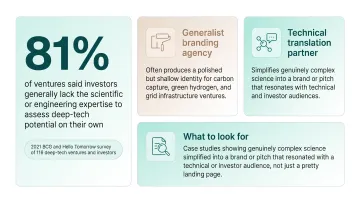
For companies working in carbon capture, green hydrogen, or grid infrastructure, a generalist branding agency often produces polished but shallow identities that don't hold up with technical buyers or investors.
This gap is well documented. In a 2021 BCG and Hello Tomorrow survey of 116 deep-tech ventures and investors, 81% of ventures said investors generally lack the scientific or engineering expertise to assess deep-tech potential on their own. That's exactly the gap brand and pitch narratives need to close.
What to look for: Case studies showing the agency has simplified genuinely complex science into a brand or pitch a technical or investor audience actually trusted, not just a pretty landing page.
3. What a trustworthy branding partner looks like instead
The best branding partners turn each red flag above into a clear practice you can verify before you hire.
- Lead with discovery: pointed questions about your business, market, and audience come before any visuals
- Show real portfolio diversity, genuinely different outputs across clients, not one house style in new colors
- Put terms in writing before you sign, including team structure, project scope, pricing, and file ownership
Agencies that do these three things consistently remove most hiring risk before work starts.
4. How we approach branding differently
we are a senior-only, remote-first creative partner built for climate tech, deep tech, and other technically complex organizations. Teams work out of San Francisco and Bangalore.
A few ways that shape how we work:
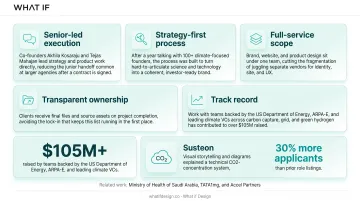
- Senior-led execution. Co-founders Akhila Kosaraju and Tejas Mahajan lead strategy and product work directly, reducing the junior handoff common at larger agencies after a contract is signed.
- Strategy-first process. After a year talking with 100+ climate-focused founders, the process was built to turn hard-to-articulate science and technology into a coherent, investor-ready brand.
- Full-service scope. Brand, website, and product design sit under one team, cutting the fragmentation of juggling separate vendors for identity, site, and UX.
- Transparent ownership. Clients receive final files and source assets on project completion, avoiding the lock-in that keeps this list running in the first place.
- Track record. Work with teams backed by the US Department of Energy, ARPA-E, and leading climate VCs across carbon capture, grid, and green hydrogen has contributed to over $105M raised.
That shows up in outcomes. For Susteon, a carbon-capture company, visual storytelling and diagrams explained a technical CO2-concentration system, and the redesigned site drew 30% more applicants than prior role listings. Related work includes the Ministry of Health of Saudi Arabia, TATA1mg, and Accel Partners.
5. Conclusion
Hire for fit, not flash. The right branding agency matches your stage and technical complexity in process, team structure, and ownership terms.
Vetting a branding agency deserves the same diligence as a key hire. Check references. Get scope and ownership terms in writing. Watch for the red flags above before you sign anything.
The right partner builds systems and guidelines that scale as you add channels, launch products, and enter new markets, not a one-off deliverable you outgrow in a year.
When the story is clear, the next conversation starts from confidence rather than explanation. Get a free strategic audit.
6. Frequently asked questions
6.1 What are some red flags in a company?
When vetting a branding agency, watch for lack of transparency, inconsistent communication, unclear ownership or pricing terms, and no verifiable track record. Those same signals apply to any vendor you trust with core business work.
6.2 What is the rule of 7 in branding?
It's a marketing heuristic that a prospect needs about seven exposures to a brand before taking action. The origin is poorly documented, so treat it as a rule of thumb. What matters is whether the agency builds a brand system that stays consistent across repeated touchpoints.
6.3 How much does hiring a branding agency typically cost?
Costs vary widely by scope and agency size. Clutch's 2025 pricing data shows most reviewed branding projects fall between $10,000 and $49,999. A fixed-scope, itemized proposal is safer than an open-ended one regardless of budget.
6.4 How long does a branding project usually take?
A strategy-and-identity-only engagement often runs 4-6 weeks. Add guidelines, a website, and product design, and the full scope can stretch to several months.
6.5 What questions should I ask before hiring a branding agency?
Ask exactly who works on your account day-to-day, who owns the final files, and what the process and timeline look like in writing. Vague answers to any of these are a warning sign.
6.6 Can one agency handle both branding and website or product design?
Yes. Full-service agencies can cut the handoff friction and miscommunication that happen when multiple vendors interpret the same brand differently, especially useful for technical startups moving quickly.
Ready to take the next step?
If you're weighing a design partner for climate, deep tech, or hard-to-explain products, Book a strategy call with our founders at What if Design, a no-pressure 25-minute conversation about what you're building and where design can help. You can also View our work to see how we've helped teams like yours, or Get a free strategic Audit of your current brand, website, or product experience.