Where What if Design fits in We're a senior-led creative studio built specifically for climate tech, clean tech, and deep tech founders. Since 2020, we've partnered with teams like HYDGEN, Ribbit Network, and Susteon to turn hard-to-explain technology into brands, websites, and product experiences that raise capital and win adoption. This comparison reflects how we evaluate the trade-offs when a founder asks us which route to take.
For most companies, a website is the first product customers, investors, and partners actually experience. Get the choice of agency wrong, and you're not just out the invoice amount. You're looking at a missed launch, a rebuild in 12 months, or a site that looks polished but never explains what you actually do.
Many founders struggle with the same pattern: a beautiful proposal, a slow discovery process, and a final product that doesn't move the metrics that matter. Missed deadlines, budget overruns, and sites that fail to communicate complex offerings are common complaints, especially for companies selling something technical or unfamiliar.
This guide breaks down exactly how to evaluate and select a web design agency in 2026, factor by factor.
TL;DR: key takeaways
- Mismatched expectations sink more projects than weak visuals, lock scope and process before you judge the portfolio
- Choose for project complexity and budget, not agency headcount
- Weight portfolio relevance and post-launch support above the lowest bid
- Treat vague proposals and missing case studies as deal-breakers early
- Technically complex products usually need a specialist, not a generalist shop
1. Types of web design agencies (and which one fits your project)
A web design agency plans, designs, and builds websites that represent a brand and drive measurable business outcomes, not just visual identity. The market spans a wide spectrum:
- Freelancers: independent designers/developers, often lower cost, limited bandwidth
- Boutique studios: small, senior-led teams offering hands-on strategy
- Mid-size agencies: broader teams with dedicated project management
- Full-service firms: design plus SEO, paid media, and content under one roof
- Niche specialists: deep expertise in a specific industry or technology
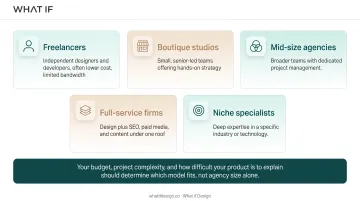
Your budget, project complexity, and how difficult your product is to explain should determine which model fits, not agency size alone.
1.1 Boutique vs. full-service: the real trade-off
Boutique studios put you in direct contact with the strategists and designers actually doing the work. There's no account manager relaying messages between you and a junior team three layers down. That direct access usually means faster iteration and a team that genuinely understands your product.
Full-service firms make sense when you need integrated services such as SEO, paid media, and content production managed under a single contract. They tend to come with higher budgets and more layers of process, which suits larger companies that need everything centralized.
Neither model is inherently better. The right one depends on whether you need speed and depth from a small team, or breadth across multiple disciplines.
1.2 When a specialist agency makes sense
Companies in climate tech, deep tech, or regulated industries face a specific risk: a generalist agency will design something that looks great and explains nothing.
If your product involves carbon capture chemistry, grid interconnection standards, or a novel hydrogen electrolysis process, a designer who doesn't understand the science will default to generic tech-startup visuals.
A specialist agency learns the domain first, then designs. The result is a site that explains why your electrolyzer, carbon pathway, or grid solution works, and why that matters to the person reading it.
2. What to consider when choosing a web design agency
These factors connect an agency's capabilities to measurable outcomes, like leads, funding conversations, or demo requests, rather than just visual appeal. Not every factor carries equal weight. A brand site prioritizes clarity and story; an e-commerce site prioritizes conversion and technical performance.
2.1 Relevant portfolio and industry experience
Screenshots lie. Live sites don't. Always ask to click through actual production sites, not case study slides, and pay attention to load speed, navigation, and how quickly you understand what the company does.
Look specifically for:
- Work in your industry or with similarly complex offerings
- Evidence the agency translated technical concepts into plain language
- Sites that still look current a year or two after launch
This directly affects time-to-understand your offering and how credible you look to technical buyers or investors.
A site for a decentralized hydrogen company, for instance, needs to communicate proprietary electrolyzer technology without drowning visitors in jargon. The HYDGEN website does this by framing complex hydrogen production specs around a clear commercial story.
2.2 Strategic approach vs. pure visual design
Ask an agency about their process before you ask about their portfolio. The ones worth hiring will ask you about business goals, target audience, and funding or sales stage before they ever open Figma.
This isn't a formality. An agency building a brand identity, for example, should run a discovery workshop to understand stakeholders, mission, and audience resonance before producing a single logo concept. Skipping that step is how you end up with a site that looks like a template with your logo swapped in.
This influences KPIs like qualified lead generation, demo requests, and investor engagement. Sites built on strategy convert. Sites built on aesthetics alone tend to just sit there.
2.3 Technical capability and platform fit
Confirm the agency's CMS and platform expertise before signing anything, whether that's Webflow, WordPress, or a headless setup. Ask how they handle performance optimization and accessibility, because retrofitting these later costs far more than building them in from day one.
Two technical benchmarks worth knowing:
- Core Web Vitals: LCP under 2.5s, INP under 200ms, CLS under 0.1 at the 75th percentile (web.dev thresholds)
- WCAG 2.2 accessibility: perceivability, operability, understandability, and robustness across every responsive view
If your site hasn't kept pace with where the business actually is, we can show you what that's costing you. Get a free strategic audit.
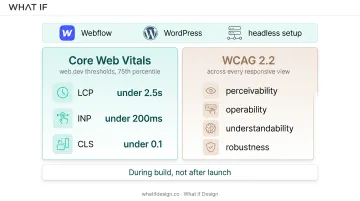
Confirm they optimize for these standards during build, not after launch.
2.4 Communication style and process transparency
Ask for named team members, not just a sales contact. Ask how often you'll hear from them and what a milestone review actually looks like. Vague answers here predict vague delivery later.
Practical questions to ask:
- Who is my day-to-day contact, and what's their role?
- How often are check-ins scheduled: weekly, biweekly, ad hoc?
- How do you flag delays before they become deadline misses?
- What does a milestone review process look like, and who signs off?
Poor communication isn't just an inconvenience. PMI research found that 56% of project dollars are at risk due to ineffective communication, across project types generally, not web design alone.
A clear cadence with named team members and defined review points reduces scope creep and missed deadlines.
2.5 Pricing transparency and budget fit
A detailed cost breakdown matters more than the number at the bottom of the proposal. You want to see design, development, content, SEO, and hosting itemized separately, so you know exactly what you're paying for and where cuts might happen if budget tightens.
Rough pricing patterns across the market:
- Freelancers typically sit at the lower end, suited to simple sites or smaller budgets
- Boutique studios price mid-range, reflecting senior-level, hands-on work
- Full-service firms command higher fees, covering broader service integration
Platform data from Clutch shows web design projects ranging from roughly $2,000 for simple builds into six figures for complex, multi-phase work. Shortlisted agencies commonly bill $100 to $149 per hour.
Share your actual budget with prospective agencies early. You get realistic, comparable proposals instead of inflated first quotes.
2.6 Post-launch support and long-term partnership
A launched site isn't a finished site. Ask what happens in month two, month six, and year one. Ongoing maintenance, iteration based on real user behavior, and reporting determine whether your site keeps performing as your business grows.
Look for agencies offering:
- Clear handoff documentation and reusable assets, so you're not locked into one vendor
- Retainer or month-to-month options for ongoing updates
- UX audits or conversion-focused iteration after launch, not just a "good luck" email
This affects uptime, sustained site speed, and your ability to update content without needing a developer for every small change.
How we evaluated the options
Every recommendation here comes from actual client work, brand systems shipped, websites launched, and product experiences delivered under fundraising deadlines. We compared the options against five criteria that matter most for technical founders:
- Total cost of ownership across the first 12 months (not just the sticker price)
- Speed to a usable output given a typical Series A runway
- Quality of the technical translation, can they explain your science without oversimplifying it?
- Rework risk, how often teams re-hire because the first choice couldn't scale
- Ability to move with the roadmap without a re-onboarding tax every quarter
Where we cite numbers or trade-offs below, they come from projects we've delivered or watched founders navigate first-hand.
3. Red flags to watch out for
These warning signs show up before you sign, if you know where to look.
- Vague proposals: no defined scope, timeline, or itemized costs (process, deliverables, milestones, and exclusions should be explicit).
- No case studies or measurable results: an agency that can't show outcomes probably hasn't tracked them.
- Portfolios where every site looks identical: a sign of rigid templates, not real strategy.
- Unrealistically low quotes: corners get cut on accessibility, performance, or QA, and those gaps get expensive later.
- Slow or evasive communication during sales: if straight answers are hard before you pay, they won't get easier after the contract.
4. How we help technical and purpose-driven companies communicate complex work
For founders building something genuinely hard to explain (climate tech, deep tech, sustainability ventures), the biggest agency-selection risk is hiring a generalist who starts designing before understanding the science or the business model. What if Design exists for that gap.
Founded in 2020 by Akhila Kosaraju and Tejas Mahajan, the studio pivoted entirely toward climate and deep tech after speaking with over 100 founders in the space. What sets their work apart:
- Senior, co-founder-led delivery: Akhila and Tejas lead directly, with no junior handoffs diluting strategic decisions
- Full-service scope: brand, website, and product design under one roof, so messaging stays consistent from pitch deck to live site
- Domain-first process: the team learns the science and market before UI, as on the Ribbit Network site for open-source greenhouse gas monitoring
- Track record with technically demanding clients: including DOE and ARPA-E-backed teams, climate VCs, and enterprise work for the Ministry of Health Saudi Arabia
- Remote-first team: based across San Francisco and Bangalore, built for agile timelines without in-house hiring overhead
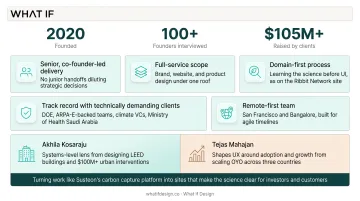
Akhila's background designing LEED buildings and $100M+ urban interventions brings a systems-level lens to complex technical products. Tejas leads product and UX for software companies, shaping design around adoption, retention and the metrics that drive growth. Together, they've turned work like Susteon's carbon capture platform into sites that make the science clear for investors and customers.
Which option is right for your stage
The right answer depends less on the two options themselves and more on where you are as a company.
Pre-seed / seed (0–$3M raised): Speed and story matter more than polish. A focused boutique-agency sprint usually beats an in-house hire, because the founder still needs to control the narrative. We've seen this pattern with early climate-tech teams, a 4-to-6-week engagement to get brand, website, and pitch coherent is more valuable than a full-time designer.
Series A ($5–20M raised): This is where a senior-led agency partner pays for itself. You need a brand system that will survive three product pivots, a website that converts enterprise buyers, and pitch materials that hold up in board meetings. In-house is still premature unless you're planning to ship design-heavy product weekly.
Series B and beyond ($20M+ raised): Hire in-house design leadership and keep an agency partner for concentrated bursts (rebrands, launches, category shifts). The two aren't substitutes at this stage, they solve different problems.
Growth-stage climate tech specifically: The stakes shift once you're commercializing. Your brand needs to hold up to procurement diligence, regulatory scrutiny, and investor updates simultaneously. A specialist studio that already speaks the science, like our team, reduces the translation tax that generalists impose on every deliverable.
5. Conclusion
The right agency is the one whose process, technical depth, and pricing genuinely align with your project's priorities, not the one with the most reviews or the loudest reputation.
Treat selection as a structured decision: define your goals, weigh the factors above against your project type, and verify claims with real references before you sign.
Once you've chosen a partner, keep evaluating the relationship. What worked at launch may not fit as your business and its needs evolve.
Get this right and you get alignment: your team, your investors and your buyers all read the same story the same way. Get a free strategic audit.
6. Frequently asked questions
7.1 How do I choose the right web design agency?
Start by defining your goals clearly, then evaluate portfolio relevance, process transparency, technical capability, and post-launch support. The best fit aligns with your project's complexity and budget, not just its reputation.
7.2 How much do web design agencies charge for website design?
Costs vary widely by agency type and project complexity, ranging from a few thousand dollars for simple sites to well over $100,000 for complex, multi-phase builds. Share your budget upfront with agencies to get realistic, comparable proposals.
7.3 What is the 3-second rule in web design?
There's no authoritative standard defining a strict three-second rule. Research from the Nielsen Norman Group found users often decide to stay or leave within the first 10 seconds. Fast load times and immediate message clarity still matter most.
7.4 What questions should I ask a web design agency before hiring them?
Ask about their process and milestones, who specifically will work on your project, how they handle scope changes, and what post-launch support looks like. Vague answers to any of these are a warning sign.
7.5 Should I choose a local or remote web design agency?
Remote-first agencies often bring specialized expertise and cost efficiency, especially for technical or niche industries. Local agencies suit teams that prioritize in-person collaboration and same-timezone availability.
7.6 How long does a typical web design project take?
Timelines range from a few weeks for simple sites to several months for complex, technical, or product-driven builds. Scope, CMS integration, and content complexity all affect the final timeline.
Related reading: How web portal UX design gives you the edge to win deals after demos and 10 Best SaaS UX Design Agencies For Product Growth In 2026.
Ready to take the next step?
If you're weighing a design partner for climate, deep tech, or hard-to-explain products, Book a strategy call with our founders at What if Design, a no-pressure 25-minute conversation about what you're building and where design can help. You can also View our work to see how we've helped teams like yours, or Get a free strategic Audit of your current brand, website, or product experience.