A SaaS website should help prospective customers understand what the software does, who it serves and why it may be a suitable choice. Clear messaging, relevant evidence, accessible navigation and purposeful conversion paths support that evaluation. Their impact should be measured using site-specific data rather than assumed improvements in acquisition costs or subscription conversion.
This guide compares five SaaS web design agencies in 2026: What if Design, Eleken, Ramotion, Huemor and Arounda. The shortlist includes marketing-website specialists and product UX partners because SaaS companies often need both capabilities at different stages. We explain their respective strengths, the types of projects they suit and what deep-tech founders should evaluate before selecting a partner.
TL;DR: key takeaways
- Match the agency to the assignment: A SaaS marketing website, product dashboard and full brand redesign require different capabilities.
- Compare five agencies: What if Design, Eleken, Ramotion, Huemor and Arounda each have different areas of emphasis.
- Evaluate real work: Review relevant case studies, service scope, technical capabilities and evidence of outcomes rather than relying on rankings alone.
- Clarify the engagement model: Confirm deliverables, website development, CMS ownership, ongoing support and whether the work is project-based or subscription-based.
- Consider technical complexity: Climate-tech, deep-tech and specialized B2B software companies may need a partner who can translate technical capabilities into understandable buyer-facing communication.
1. Why SaaS web design needs a specialized approach in 2026
SaaS buyers may evaluate several software options before contacting sales. They need to understand product capabilities, integrations, implementation requirements, pricing models and available proof. A well-structured marketing website should help different stakeholders find relevant information without requiring every question to be answered in a sales call.
The central design challenge is not the size of the SaaS market. It is helping a potential customer understand how a particular product fits their requirements. For B2B software, that often means organizing technical information, demonstrating product workflows, communicating differentiation and making the next step clear.
1.1 Your website is now an unpaid sales rep
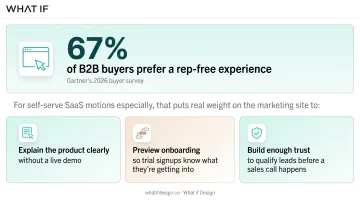
Many B2B buyers prefer to research independently before engaging a sales representative. Gartner's March 2026 survey reported that 67% of B2B buyers prefer a rep-free experience. This does not mean human sales conversations are unnecessary; it means the website should support meaningful research and evaluation before those conversations begin. For SaaS companies, useful website information includes:
- Clear explanations of product capabilities, use cases and relevant integrations
- Product screenshots, workflows or demos that help visitors understand what to expect
- Pricing information or a clear process for requesting a quote, supported by relevant proof and a suitable next step
1.2 Marketing website vs. product design - know the difference
Marketing website design and software product UX are related but distinct disciplines. Some agencies offer both, while others specialize in one. Before evaluating a portfolio, clarify whether you need to improve how prospects understand the product before signup or how customers use it afterward.
| Type | Focus | Example Elements |
|---|---|---|
| Marketing website design | Pre-login, conversion-focused | Hero messaging, pricing page, CTAs, demo requests |
| Product/UX design | Post-login, adoption and retention | Onboarding flows, dashboards, feature discovery |
The shortlist below identifies which agencies focus primarily on marketing websites, brand and website integration, or ongoing SaaS product UX. These are not interchangeable services. An agency that performs well on product onboarding may not be the best choice for a standalone marketing website redesign.
2. Top SaaS web design agencies in 2026
This is a curated shortlist, not an independently scored industry ranking. The agencies were selected because their published portfolios or service descriptions demonstrate relevant work in SaaS websites, branding or digital product design. The comparison distinguishes these capabilities rather than presenting every agency as a direct substitute.
| Agency | Primary strength | Best suited for | Engagement approach |
|---|---|---|---|
| What if Design | Brand, website and product communication for technically complex companies | Climate-tech, deep-tech and specialized B2B SaaS startups | Project scope or ongoing support, confirmed through proposal |
| Eleken | Dedicated SaaS product UX/UI design | SaaS teams needing continuous product interface and onboarding work | Designer subscription |
| Ramotion | Brand identity, marketing websites and product design | SaaS companies aligning brand and digital experience | Project-specific scope and quote |
| Huemor | Marketing website redesign, messaging and conversion-focused UX | B2B SaaS teams improving their marketing website | Website redesign projects and related support |
| Arounda | Digital product UX/UI and web design | Startups building or improving software products and digital experiences | Confirm scope and arrangement directly |
2.1 What if Design
What if Design is a brand, website and product design partner focused on climate-tech, deep-tech and technically complex businesses. Its work includes digital products such as Batteryze's battery-health platform and Vested Futures' sustainability-focused platform, alongside websites and brand systems for technical companies. This experience is relevant to SaaS founders whose products require careful explanation across investor, buyer and user audiences.
What distinguishes the approach: The studio combines technical discovery, positioning and visual communication. For a climate-data platform, battery management software, or other specialized SaaS platforms, this can involve making complex workflows understandable, structuring buyer-facing explanations and ensuring the marketing website and product experience communicate a consistent proposition.
Relevant portfolio work includes UX design for Batteryze's battery-health platform and product strategy and UX design for Vested Futures. These projects demonstrate experience with complex software workflows, but they should not be presented as proof that design alone caused funding or sales outcomes.
| Best For | Climate tech, deep tech, and technical SaaS founders whose product is difficult to explain to non-technical buyers |
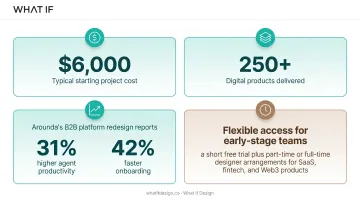
| Pricing | Custom scope and proposal; confirm website development, product UX and ongoing support requirements |
| Key Strength | Technical discovery, brand positioning and experience design for complex climate-tech and B2B software |
2.2 Eleken
Eleken focuses on SaaS product UX/UI design through a subscription model. Its offering centers on providing a dedicated designer who works within the client's product team and design workflow. This can suit SaaS businesses that need ongoing interface, dashboard, onboarding or feature-design work rather than a standalone marketing website redesign.
The subscription structure may suit teams with a continuing stream of product-design requirements. However, buyers should confirm designer availability, collaboration expectations, research responsibilities and development handoff. If the primary need is a new marketing website, ask whether that work is covered by the proposed scope instead of assuming product UX expertise includes website design and development.
| Best For | Ongoing SaaS product UI/UX improvement |
| Pricing | Monthly subscription for a part-time or full-time dedicated designer |
| Key Strength | Dedicated SaaS product UX/UI design integrated into an existing team workflow |
2.3 Ramotion
Ramotion works across brand identity, website design and digital product design. Its published SaaS portfolio includes work connecting a company's brand with its marketing website and broader digital experience. This makes Ramotion relevant to teams whose website, visual identity and product design need to feel like parts of the same company.
Ramotion's published work spans SaaS branding, web design and product interfaces. Before requesting a proposal, clarify whether the engagement includes positioning, visual identity, website UX, development and ongoing design-system support. These services may be scoped separately, so buyers should compare deliverables rather than relying on broad agency price ranges.
Ramotion is worth considering when the central requirement is aligning brand identity, marketing website design and digital product experience. Confirm the specific responsibilities and outputs through its proposal.
| Best For | SaaS companies seeking connected brand, marketing website and product design |
| Pricing | Custom; typically suited to mid-market and enterprise budgets |
| Key Strength | Design systems work and a portfolio spanning brand, web, and product |
2.4 Huemor
Huemor focuses on website redesign, digital experience and conversion-oriented website strategy. Its published work includes B2B and SaaS marketing websites where messaging, case-study visibility and clear demo paths are important. It is more directly relevant to a SaaS marketing-site redesign than an engagement focused only on internal product dashboards.
In its published AutoVitals case study, Huemor reports that the client's demo-page conversion rate rose from approximately 1.5% to just over 6% after a website redesign. This is a company-reported result for one engagement, not a typical outcome that another SaaS company should assume. Request a project-specific quote and confirm the scope of strategy, copywriting, development, migration and post-launch support.
| Best For | Growth-stage SaaS teams running paid acquisition that need measurable performance gains |
| Pricing | Project-based redesigns, plus ongoing support and SEO retainers |
| Key Strength | Marketing website redesigns with published, client-specific conversion examples |
2.5 Arounda
Arounda works across product UX/UI design, digital product development and website design for sectors that include SaaS, fintech and Web3. Its portfolio makes it relevant to startups needing a product interface, MVP experience or coordinated product and web design. Confirm which deliverables are included, because website implementation and product UX may require different scopes.
Arounda's published portfolio includes software interface projects and website redesign work. Buyers should assess the relevance of those examples to their own requirements, particularly whether the desired outcome is a marketing website, a usable software product or both. Request evidence of the agency's work on comparable assignments rather than assuming that published product results will generalize.
| Best For | Early-stage startups needing MVP or product design support |
| Pricing | Confirm current scope, project arrangement and pricing directly |
| Key Strength | Product UX/UI, website design and digital experience work across software sectors |
3. How we chose these SaaS web design agencies
The shortlist uses four practical evaluation criteria. These are editorial selection factors, not numerical scores or independently audited performance rankings:
- SaaS-specific portfolio depth
- CRO focus
- Engagement model transparency
- Post-launch scalability
Evaluate portfolios according to the work you need. For a marketing website, inspect the structure of product pages, how technical information is explained, the clarity of conversion paths and the evidence supporting the design decisions. For product UX, examine onboarding, dashboard workflows, usability research and design-to-development handoff. Published results can be useful, but they should be attributed to the relevant client and project.
SaaS teams should distinguish marketing website conversion from product activation and free-to-paid conversion. A demo-request rate measures a different stage of the customer journey from the percentage of free software accounts that become paying customers. Product-led growth benchmarks, such as those discussed in our SaaS benchmarks guide, can provide context for a product growth strategy, but they should not be used as universal performance targets for a website design agency.
A combined engagement covering positioning, copy, design and development can help maintain consistency between the message and the website experience. However, broader service scope does not automatically produce better conversion results. Evaluate whether the agency has the capabilities needed for the actual project and how responsibilities will be managed between internal and external teams.
4. How to choose the right agency for your SaaS stage
Four checks separate a strong-fit agency from an expensive mismatch.
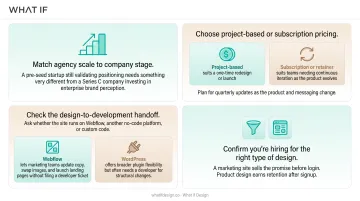
Match the scope to your company's stage. A pre-seed company may need core positioning, a credible launch website and a manageable content system. A growth-stage SaaS company may need deeper product communication, conversion research, more complex page architecture or a broader design system. Choose the capabilities required now while considering how the website will evolve.
Choose project-based or subscription pricing.
- Project-based pricing suits a one-time redesign or launch
- Subscription/retainer models suit teams needing continuous iteration as the product evolves
Avoid treating the website as a one-time deliverable. Plan for quarterly updates as the product and messaging change.
Check the design-to-development handoff. Ask which CMS or development platform the agency recommends and why. Confirm who will own the final website, how your team can edit content, whether accessibility and technical SEO are included, and how reusable components will be documented. The right choice depends on the complexity of the website and your team's operational requirements.
Webflow, WordPress and custom implementations can each support SaaS marketing websites. Compare them on editorial control, functionality, integrations, security, maintenance and the skills available within your team rather than assuming one platform is always easier to manage.
Confirm the project scope before selecting an agency. A SaaS marketing website and a product interface serve different user journeys, even when they share the same visual identity. Before shortlisting partners, ask:
- Can the agency show relevant marketing website or SaaS product examples?
- Who is responsible for positioning, messaging and copywriting?
- Does the scope include design only, or also development and CMS setup?
- How will technical claims, product screenshots and integration information be verified?
- What research, accessibility checks and testing are included?
- Which business and usability metrics will be used to assess the finished work?
- Who will maintain the website or design system after launch?
5. Conclusion
The right SaaS web design agency depends on what you are trying to improve. Some teams need a clearer marketing website and buyer journey. Others need ongoing product UX, a new brand system or a partner who can connect those disciplines. Compare agencies on relevant experience, defined deliverables, evidence and collaboration fit rather than treating an editorial ranking as a universal recommendation.
Before signing, request examples of comparable work and ask what the agency was responsible for delivering. A marketing-site case study may demonstrate improved information architecture, clearer product communication or a documented change in demo requests. A product UX case study may demonstrate better workflows or usability findings. The evidence should match the type of project being purchased.
Climate-tech and deep-tech software companies have an additional communication challenge: their products may require technical explanation before a buyer can evaluate the commercial proposition. What if Design works with these teams on positioning, websites and product experiences that make complex information easier to understand. Its Batteryze and Vested Futures projects provide examples of this work.
The next step is to define the problem your website or product experience needs to solve, then identify an agency with evidence and a process suited to that assignment. Use the comparison above to narrow the shortlist and prepare a focused project brief.
6. Frequently asked questions
6.1 What is SaaS in web design?
SaaS web design is the design of marketing websites for software-as-a-service companies. It commonly includes product explanations, feature and integration pages, pricing information, customer proof and paths to a trial or sales conversation. SaaS product UX is related but focuses on the experience people have while using the software.
6.2 What makes a SaaS web design agency different from a general web design agency?
A SaaS web design agency may bring relevant experience with software buying journeys, product messaging, pricing pages, technical integrations and conversion paths. A generalist agency can also be suitable if it demonstrates comparable capabilities. The important distinction is the relevance of the agency's work and process to your specific project.
6.3 How much does SaaS website design cost in 2026?
SaaS website design pricing depends on the scope, the depth of strategy and copywriting, page complexity, development platform, integrations and post-launch requirements. A focused landing-page project will usually involve different work from a complete marketing website and brand redesign. Request an itemized quote rather than treating unrelated agencies' published prices as directly comparable.
6.4 Should I choose a subscription-based or project-based SaaS design agency?
Project-based pricing suits a one-time redesign or launch. Subscription models suit teams needing continuous design support as the product and messaging evolve.
6.5 What platform is best for a SaaS website: Webflow or WordPress?
Both Webflow and WordPress can support SaaS marketing websites. Webflow may suit teams seeking a visual design and CMS workflow, while WordPress can suit teams with established content processes or particular plugin requirements. Compare editorial usability, integrations, accessibility, performance, security and maintenance before choosing. Custom development may be appropriate for more specialized needs.
6.6 How do I evaluate a SaaS design agency's portfolio before hiring?
Check pricing page structure, CTA placement, and documented conversion outcomes rather than just hero-section visuals. Ask for case studies tied to trial activation or demo requests, not just before-and-after screenshots.
Related reading: Explore our SaaS UX design agency comparison for product-design specialists and our SaaS UI/UX design guide for B2B software experiences.
Ready to take the next step?
If you're building a climate-tech, deep-tech or technically complex SaaS company and need clearer positioning, a stronger marketing website or a better product experience, What if Design can help as a design partner to define the right scope. Book a strategy call to discuss your goals, or explore our portfolio to see relevant work.