Gartner's 2026 buyer survey found that B2B buyers now pull from an average of seven information sources before making a purchase decision, and 70% say they'd prefer a fully digital, self-service buying experience over talking to a sales rep at all. Your website is doing sales work whether you designed it to or not.
Hire the wrong agency and the damage compounds. Budget gets burned on a redesign that still confuses investors. Sales cycles stretch because technical buyers can't find proof points. For deep tech and climate tech founders, this is worse: a generic web shop that doesn't understand your science will produce a site that undersells your technology to the people funding it.
This guide covers what a B2B web design agency actually does, six factors worth evaluating before you sign a contract, red flags to walk away from, and how a specialized partner changes the outcome.
TL;DR: key takeaways
- Pick a B2B web design agency built for long sales cycles, multiple decision-makers, and lead gen, not one-click checkout
- Score agencies on six factors: niche experience, strategic process, portfolio proof, team access, tech stack, pricing transparency
- Walk away from generic portfolios, no discovery phase, and vague pricing or timelines
- The right partner acts as a strategic extension of your team, not a vendor executing a brief
- Technical and deep-tech companies (climate tech included) should require scientific and market fluency from any agency
1. What is a B2B web design agency?
A B2B web design agency designs and builds websites for companies selling to other businesses rather than individual consumers. That distinction shapes everything: longer sales cycles, multiple stakeholders per deal, and a website built to generate qualified leads rather than close impulse purchases.
Forrester's 2026 research puts real numbers behind that complexity: a typical business buying decision now involves 13 internal stakeholders and nine external influencers. That's not a website you can design around a single "customer persona."
You'll encounter a few different types of partners:
- Full-service B2B agencies: strategy, brand, and web under one roof (the focus of this guide)
- Production-only web shops: execute a brief but don't shape positioning
- Freelancers: lower cost, less strategic bandwidth
- In-house teams: full control, higher fixed cost
1.1 Core services you should expect
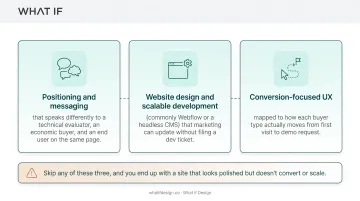
A proper B2B web design engagement covers three connected areas, well beyond a Figma file:
- Positioning and messaging that speaks differently to a technical evaluator, an economic buyer, and an end user on the same page
- Website design and scalable development (commonly Webflow or a headless CMS) that marketing can update without filing a dev ticket
- Conversion-focused UX, mapped to how each buyer type actually moves from first visit to demo request
Skip any of these three, and you end up with a site that looks polished but doesn't convert or scale.
1.2 Why the right choice matters
The right agency directly affects business outcomes, not just aesthetics:
- Faster sales cycles: buyers self-qualify through clear proof points instead of asking sales to explain basics
- Higher-quality inbound leads: messaging that filters for buyer intent before a form is submitted
- Stronger investor and partner trust: a site that communicates technical credibility, not just visual polish
Nielsen Norman Group research on B2B usability shows buyers often check a vendor's website early in their process. Weak credibility signals can disqualify you before a sales conversation ever happens.
For a company explaining carbon capture chemistry or grid interconnection to a non-technical investor, that first impression carries even more weight.
2. What to consider when choosing a B2B web design agency
These six factors connect an agency's actual approach to measurable outcomes, not just which portfolio you liked best.
2.1 Factor 1: industry and niche experience
Generic B2B experience isn't enough for scientific or deeply technical products. An agency needs enough vocabulary in your market to write copy that's credible to an engineer and clear to a non-technical investor.
2.2 Factor 2: strategic process (positioning before pixels)
Agencies that jump straight to visuals almost always produce sites with confused messaging. Look for a structured discovery phase with stakeholder interviews, audience research, and competitive analysis before anyone opens a design tool.
Nielsen Norman Group's discovery-phase research warns that skipping this step means designing around assumptions, which risks solving a problem that doesn't actually matter to your buyers.
2.3 Factor 3: portfolio and measurable outcomes
Screenshots don't tell you much. Ask for case studies with numbers attached:
- Funding raised following a rebrand or pitch redesign
- Conversion or applicant-volume lift after a website relaunch
- Traffic or engagement growth tied to a specific launch date
If your site hasn't kept pace with where the business actually is, we can show you what that's costing you. Get a free strategic audit.
2.4 Factor 4: access to senior talent and team structure
Small, specialized studios often put you directly in touch with a founder or senior strategist. Larger agencies frequently route day-to-day work through junior account managers, which slows decisions and dilutes strategic quality across revisions.
2.5 Factor 5: tech stack and platform scalability
Your platform choice, whether Webflow, a headless CMS, or a custom build, determines whether your marketing team can update content independently or waits on developers for every change.
Speed matters more than most teams assume. Google's analysis of over 11 million mobile landing pages found that when load time increased from one to ten seconds, bounce probability rose 123%. A slow, over-engineered site actively pushes buyers away before they see your product.
2.6 Factor 6: budget, pricing transparency, and post-launch partnership
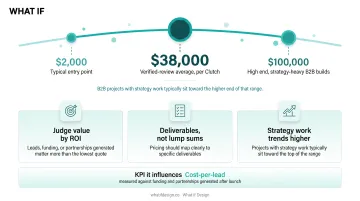
Judge value by ROI, meaning leads, funding, or partnerships generated, not by who quoted the lowest number. Pricing should map clearly to specific deliverables, not a vague lump sum.
Industry pricing data from Clutch shows web design projects commonly range from $2,000 to $100,000, with a verified-review average around $38,000. B2B-specific projects with strategy work typically sit toward the higher end of that range.
3. Red flags to watch for
Before signing anything, check for these warning signs:
- A generic portfolio with no B2B or industry case studies and no measurable outcomes
- No structured discovery phase: the agency jumps straight to visual mockups without asking who your buyers actually are
- Unclear scope and no proof: won't share a defined project scope, timelines, client references, or past performance data
If an agency can't answer "who was this for, what changed, and what happened next" with specifics, keep looking.
4. How we help technical B2B companies choose the right agency
Climate tech and deep tech founders face a harder version of this problem: the product itself is difficult to explain, let alone brief a designer on. That's the gap What if Design was built to close.
Co-founders Akhila Kosaraju and Tejas Mahajan bring two different lenses to the same challenge.
Akhila designed LEED buildings and urban interventions worth over $100 million before shifting to climate tech branding and websites. She applies that same systems-level thinking to companies in carbon capture, grid interconnection, and green hydrogen.
Tejas leads product UX with a focus on adoption and growth metrics. His work spans battery management platforms, fleet software, and ESG data tools.
That combination shows up in the track record:
- Pitch design work associated with over $45 million raised, for clients backed by the US Department of Energy and ARPA-E
- Enterprise software design for Saudi Arabia's Ministry of Health, replacing a fragmented multi-system network with one platform
- A roughly 30% increase in applicant volume for Susteon's career openings following a brand and website redesign
What if Design runs as a lean, founder-led, remote-first team based in San Francisco and Bangalore. Clients get senior strategic access without the overhead of hiring in-house.
Every engagement spans brand, website, and product design under one roof:
- Minimum Viable Brand (4 to 6 weeks): positioning, messaging, visual identity
- Website Design and Development (4 to 12 weeks): buyer-journey mapping, SEO-focused Webflow builds, conversion-focused copy
- Product UX and Prototyping (4 to 8 weeks), insight sprints and iterative testing for adoption
we are also a signatory to Design Declares, a movement for designer accountability and environmental responsibility. That alignment matters when climate and sustainability organizations choose who represents them publicly.
5. Conclusion
Choose the agency whose niche expertise, process, and team structure match how complex your sales motion actually is. Awards and popularity matter far less than that fit.
For technical or climate tech companies, agency-market fit matters just as much as agency-budget fit. A cheaper generalist that misrepresents your technology to investors costs more in the long run than a specialized partner who gets it right the first time.
And this isn't a one-time decision. Your product, market, and buyers will keep evolving, so plan for an ongoing relationship, not a single handoff.
Get this right and you get alignment: your team, your investors and your buyers all read the same story the same way. Get a free strategic audit.
6. Frequently asked questions
7.1 What is a B2B agency?
A B2B agency designs, markets, or builds for companies that sell to other businesses, rather than to individual consumers. It focuses on longer sales cycles and multiple decision-makers instead of single-purchase, emotion-driven buying.
7.2 What is B2B design?
B2B design is design built to support long, multi-stakeholder purchase decisions rather than quick consumer purchases. Clarity, credibility, and proof matter more here than emotional appeal or impulse triggers.
7.3 How much does a B2B web design agency typically cost?
Industry-wide, web design projects generally range from $2,000 to $100,000, with a verified average around $38,000, according to Clutch's pricing data. Strategy-heavy B2B engagements with positioning and messaging work typically land toward the higher end.
7.4 How long does a B2B website redesign usually take?
Most B2B website projects run 4 to 12 weeks from discovery through launch, depending on scope. For a comprehensive redesign, finishing in under 10 to 12 weeks is uncommon.
7.5 What's the difference between a general web design agency and a specialized B2B agency?
A specialized B2B agency understands your industry's vocabulary, maps buyer journeys for multiple stakeholders, and builds messaging for technical and non-technical audiences alike. A general agency typically optimizes for visual appeal over buyer-journey complexity.
7.6 Should I hire an agency, freelancer, or build an in-house team for B2B web design?
Agencies bring strategic depth and speed at a higher upfront cost. Freelancers cost less but often lack structured process. In-house teams offer control with ongoing salary overhead. Choose based on buyer-journey complexity and how much ongoing iteration you’ll need.
Related reading: Top B2B website design agencies delivering rapid Webflow sprints in 2026 and UX design strategies for B2B technology success.
Ready to take the next step?
If you're weighing a design partner for climate, deep tech, or hard-to-explain products, Book a strategy call with our founders at What if Design, a no-pressure 25-minute conversation about what you're building and where design can help. You can also View our work to see how we've helped teams like yours, or Get a free strategic Audit of your current brand, website, or product experience.