Series A design has to satisfy three audiences at once: enterprise buyers evaluating whether you're a real vendor, channel partners deciding whether to co-sell with you, and investors watching for signs of maturity ahead of your next round. Most founders raise their round, hire their first sales and engineering heads, and treat design as whatever's left over. The median Series A round landed at $7.9 million in early 2025, with typical rounds ranging from $5 million to $15 million, according to Carta's fundraising data. That's real capital, and design deserves a real line item.
This guide covers how much to budget, where the money should go, a simple allocation rule, and how to decide between hiring in-house, working with an agency, or partnering with a specialized design studio.
TL;DR: key takeaways
- Budget design as a deliberate line item tied to your raise, not funds squeezed from what's left over
- Split spend across brand, product/UX, website, and investor materials, plus a contingency buffer
- A 70/20/10 allocation protects core deliverables while leaving room to experiment
- Climate and deep tech need extra budget to turn complex science into visuals non-technical buyers and investors grasp
1. How much should Series A startups actually budget for design?
There's no universal percentage that applies cleanly to every Series A company, and be wary of anyone who hands you one. What actually drives the number is scope and audience complexity, not a fixed formula.
Factors that push design spend higher at this stage:
- Enterprise sales cycles that require polished decks, case studies, and RFP-ready collateral
- Board members and investors who scrutinize brand maturity as a proxy for operational discipline
- Climate, deep tech, or hardware products that need strategic translation before buyers or investors grasp what you do
Seed-stage design is usually founder-led: a logo made in a weekend, a one-page website, a deck that's mostly text. That's appropriate when you're validating product-market fit.
Series A is different. You're selling to procurement teams, courting partners who'll put their logo next to yours, and prepping for a Series B where investors compare your brand maturity against competitors who raised alongside you.
Treat the design budget as two separate pools:
- One-time capital investment: brand system, initial product UX architecture, core website build
- Ongoing operational spend: website updates, continued product design, campaign assets, refreshed investor materials
1.1 Quick benchmark: what Series A companies typically spend
Skip the percentage-of-raise guesswork. Market rates for the core workstreams look like this:
| Workstream | Freelancer / small studio | Agency |
|---|---|---|
| Brand strategy & positioning | $5K, $20K | $30K, $80K |
| Visual identity | $5K, $15K | $15K, $75K |
| Website | $2K, $20K | $30K, $200K |
These ranges draw from TechCrunch's reporting on startup branding costs. Current Clutch market data still puts most branding projects between $10,000 and $50,000.
Whichever range fits your scope, add a 10 to roughly 15% contingency. Product and construction budgets hold reserves for the same reason: scope shifts once real stakeholders react to real work.
2. Where the design budget should go: A category-by-category breakdown
Series A design budgets work best split across five categories rather than treated as one lump sum. Each one serves a different audience, and neglecting any single category creates a visible gap somewhere in your funnel.
| Category | Allocation |
|---|---|
| Brand Identity & Strategic Positioning | 10 to roughly 15% |
| Product & UX Design | 30 to roughly 35% |
| Website & Digital Presence | 15 to roughly 20% |
| Investor & Partner Materials | 10 to roughly 15% |
| Ongoing Design Ops & Contingency | roughly 10% |
2.1 Brand identity & strategic positioning (10 to roughly 15%)
This covers your logo, visual system, messaging framework, and narrative: the foundation everything else builds on. Many founders revisit brand identity post-Series A because the company's story has sharpened.
You know your ICP now. You know what differentiates you. That clarity deserves to show up visually.
2.2 Product & UX design (30 to roughly 35%)
This is typically the largest bucket: usability drives retention and expansion revenue directly. For technical products, this line needs extra room.
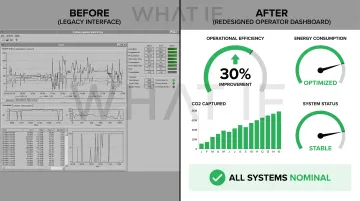
When What if Design worked with a carbon-capture client on real-time data monitoring for non-technical operators, the UX overhaul (audit, custom data visualizations, simplified dashboards) produced a roughly 30% increase in operational efficiency and cut the learning curve for new users. Template dashboards don't deliver that kind of outcome.
2.3 Website & digital presence (15 to roughly 20%)
Your seed-stage landing page won't hold up to enterprise scrutiny. Series A websites need to support SEO-driven content growth, technical documentation for engineers, and credibility signals for partners, not just a hero section and a sign-up form.
💡 Working through this decision right now? If you're a climate-tech or deep-tech founder weighing this trade-off, Book a strategy call with our team, 25 minutes, no pitch, and we'll pressure-test your specific situation.
Susteon's redesign, for example, needed to explain carbon capture and sustainable aviation fuel pathways clearly enough for both investors and job applicants. The rebuilt site drove 30% more applicants to open roles.
2.4 Investor & partner materials (10 to 15%)
Pitch decks, one-pagers, and partnership collateral aren't a one-time expense. You'll need updated versions for your Series B, for major partnership conversations, and for board updates. Budget for this as a recurring need, not a project you finish once.
2.5 Ongoing design ops & contingency (roughly 10%)
Reserve this for continuous iteration: A/B test variants, campaign assets between funding rounds, and the rebrand nobody planned for but everyone eventually needs.
See how we have approached this in practice: Mobile UX design.
3. Applying the 70/20/10 rule to your design budget
The 70/20/10 framework comes from innovation portfolio theory, popularized in Harvard Business Review's analysis of how companies allocate resources across core, adjacent, and transformational work. It maps cleanly onto a design budget:
- roughly 70%: Core deliverables: Your brand system, core product screens, and main website. Non-negotiable, proven work that everything else depends on.
- roughly 20%: Growth and enhancement: Campaigns, new feature design, conversion optimization on existing pages.
- roughly 10%: Experimentation: New formats, unexpected scope, testing ideas that might not pan out.
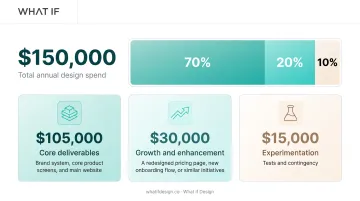
Say your total annual design spend is $150,000. A 70/20/10 split looks like this:
- $105,000 core: brand, product, and website work
- $30,000 growth: a redesigned pricing page, new onboarding flow, or similar initiatives
- $15,000 experiments: tests and contingency
This split works well for Series A teams because it protects essential deliverables from whatever is loudest that week, whether a board request or a last-minute sales deck. You still keep room to test what actually lands with customers and investors as you learn.
4. In-house hire vs agency vs freelancer vs specialized design partner
Each option carries a different cost and risk profile.
| Model | Cost | Trade-offs |
|---|---|---|
| In-house senior designer | ~$142K median salary, plus benefits (MeasuringU, 2024) | Ramp-up time, single point of failure, full-time cost even during quiet periods |
| Freelancer | $100: $150/hr | Variable quality, limited strategic depth, coordination overhead |
| Generalist agency | $10K: $50K per project, average $71,600+ (Clutch, 2025) | Broad capability but usually lacks sector-specific fluency |
| Specialized design partner | Retainer or project-based | Faster ramp-up in your specific domain, no "teaching design basics" phase |
An in-house hire makes sense once you have enough continuous design work to justify a full salary and the management bandwidth to support one person's growth. A generalist agency can execute competently but usually needs weeks of onboarding to understand your market before producing anything useful.
A specialized design partner works differently for technical sectors. If you're building in climate tech or deep tech, a partner who already understands the science, the investor landscape, and the buyer psychology can move immediately, without you first explaining what an electrolyzer stack does or why grid interconnection matters.
What if Design's team is built around this gap. Co-founder Akhila Kosaraju designed LEED buildings and $100M+ urban projects before shifting to climate tech branding; Co-founder Tejas Mahajan leads product and UX for software companies, designing for adoption, retention and the metrics that drive growth, across battery management systems, fleet platforms and ESG tools. The studio has worked with teams backed by the U.S. Department of Energy and ARPA-E, with pitch decks tied to $25M+ raised across climate and deep-tech clients.
Most Series A companies land on a hybrid model: a strategic partner for brand and product systems, paired with lightweight in-house support for day-to-day execution like landing page tweaks or sales one-offs.
5. Common design budget mistakes that derail Series A companies
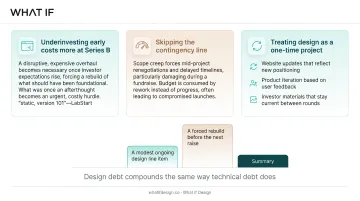
Underinvesting early and paying for it at Series B. Skimping on brand and product design after your Series A often means a disruptive, expensive overhaul later, once investor and customer expectations have risen. LabStart's team described their earlier site as "static, version 101." That gap is obvious the moment you're pitching a Series B investor who's already seen ten other decks that week.
Skipping the contingency line. Without a buffer, scope creep leads to mid-project renegotiations and delayed timelines, often right when you can least afford the delay: mid-fundraise or mid-sales cycle.
Treating design as a one-time project instead of a system. Companies without a continuous design budget consistently fall behind on:
- Website updates that reflect new positioning or product features
- Product iteration based on user feedback
- Investor materials that stay current between funding rounds
Design debt compounds the same way technical debt does. A modest ongoing line item almost always costs less than a forced rebuild before the next raise.
Get this right and you get alignment: your team, your investors and your buyers all read the same story the same way. Get a free strategic audit.
6. Frequently asked questions
6.1 How much funding is good for Series A?
Series A rounds typically range from $5 million to $15 million, with a median around $7.9 million as of early 2025, per Carta's fundraising data. A strong round size is the one that funds your runway, market push, and growth plan, not a fixed target.
6.2 How much is Series A funding in the UK?
UK figures aren't reported as a distinct "Series A" category, but the British Business Bank's venture-stage What we see in practice is an average deal size of roughly £5.64 million. The design budgeting principles in this guide apply proportionally regardless of currency or geography.
6.3 What is the 70/20/10 rule budget?
Put roughly 70% toward core, proven work; roughly 20% toward growth and enhancement; and roughly 10% toward experimentation. For design, that means most spend on brand, product, and website essentials, with smaller slices for campaigns and testing.
6.4 What percentage of Series A funding should go toward design?
There's no single verified benchmark, needs vary by sector and sales motion. Treat design as a defined line item in the raise; technical and deep-tech companies usually need a larger share for translation-heavy work like data visualization and technical storytelling.
6.5 Should a Series A startup hire an in-house designer or work with an agency?
Most early Series A teams benefit from a hybrid approach: a specialized partner for brand and product systems, plus light in-house support for day-to-day execution. Full-time hires fit better once the workload stays high enough to justify the seat.
6.6 How is design budgeting different for climate tech or deep tech startups?
These companies need extra budget for translating complex science and engineering into visuals that investors, customers, and partners can actually understand. Without that translation work, even a strong product can look confusing or unconvincing to a non-technical buyer.
Ready to take the next step?
If you're weighing a design partner for climate, deep tech, or hard-to-explain products, Book a strategy call with our founders at What if Design, a no-pressure 25-minute conversation about what you're building and where design can help. You can also View our work to see how we've helped teams like yours, or Get a free strategic Audit of your current brand, website, or product experience.