Industrial M&A activity is one of the biggest rebrand triggers manufacturers face right now, and it's been climbing hard. KPMG counted 1,078 industrial-manufacturing deals in Q1 2026 alone, with deal value up 124.7% quarter over quarter to $334.7 billion, driven largely by a handful of large acquisitions. Every merger, spin-off, or acquisition eventually creates a brand question that lands on someone's budget spreadsheet.
Generic rebrand cost guides don't hold up here, because a manufacturer's brand lives on physical assets - molds, cartons, safety markings - not just digital touchpoints. This guide breaks down pricing tiers, where the money actually goes, manufacturing-specific budget risks, and a framework for building a number you can defend to your CFO.
TL;DR: key takeaways
- Rebrand costs span a focused visual refresh to a seven-figure, multi-facility overhaul
- Packaging, tooling, signage, and compliance filings are the costs generic estimates miss most
- Phasing rollout around production and inventory cycles controls spend better than negotiation alone
- A documented budget framework prevents the two project-killers: underbudgeting and scope creep
1. How much does a manufacturing rebrand cost? (pricing overview)
Manufacturing rebrand costs don't follow a fixed price list. Scope, facility count, and product complexity all move the number, which is exactly why generic branding cost calculators tend to undershoot for industrial companies.
Three things typically go wrong before a project even starts:
- Underbudgeting physical asset replacement - packaging, tooling, and signage get treated as an afterthought instead of a major cost center
- Choosing "logo-only" when the business needs repositioning - a cosmetic refresh doesn't fix a market perception problem
- Getting blindsided by compliance costs - regulatory and legal review is often quoted separately, if it's quoted at all
1.1 Tier 1: brand refresh
A visual refresh - updated logo, color palette, and typography - for a single-facility manufacturer typically lands in the low-to-mid five figures. That assumes a proper identity system, brand guidelines, and priority templates.
This tier suits established manufacturers with a solid reputation whose visual identity has simply aged. If your positioning still works and customers still trust you, a refresh is usually enough.
1.2 Tier 2: brand reboot
A reboot adds new positioning and messaging on top of a redesigned identity. Scope usually covers strategy work, a new visual system, core website pages, and sales or product collateral.
Expect a clear step up from a refresh - strategy and messaging extend both timeline and budget. This tier fits manufacturers entering new markets, launching a new product line, or repositioning after a strategic pivot.
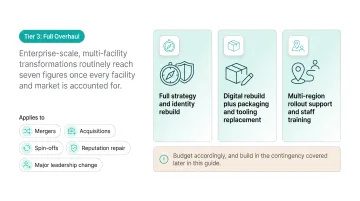
1.3 Tier 3: full overhaul
Enterprise-scale, multi-facility transformations routinely reach seven figures once every facility and market is accounted for. Typical scope includes:
- Full strategy and identity rebuild
- Digital rebuild plus packaging and tooling replacement
- Multi-region rollout support and staff training
This tier applies to mergers, acquisitions, spin-offs, and manufacturers facing reputation repair or major leadership change. Budget accordingly, and build in the contingency covered later in this guide.
2. Key factors that affect the cost of a manufacturing rebrand
Manufacturing rebrand pricing depends on physical footprint and regulatory exposure as much as it depends on design and strategy work.
2.1 Scope of transformation
The tier you choose is the single biggest lever you control. A refresh multiplies a small set of costs: design, templates, a few print runs. A full overhaul multiplies almost everything across every facility you run: strategy, tooling, packaging, digital, and training. Pick the tier that matches your actual business trigger, not the one that looks most impressive in a boardroom deck.
2.2 Number of facilities, product lines & SKUs
Every additional facility, distributor agreement, or SKU adds its own proofing round, translation pass, and rollout coordination. A manufacturer running 40 SKUs across three facilities isn't paying triple the cost of one SKU at one site. It's paying for the coordination overhead too.
- More SKUs mean more packaging variants, proofing cycles, and printer setup fees
- More facilities mean more signage, local compliance checks, and installation logistics
- More distributors mean more co-branded materials requiring separate sign-off
2.3 Physical & tangible assets
Packaging, signage, tooling and molds, uniforms, and vehicle branding are costs pure digital brands never touch. Tooling is the line item most budgets get wrong.
According to manufacturing rebrand consultancy BrandActive, custom molds and tooling can range from $500 to $150,000 per unit, while regulatory filings average roughly $10,000 per filing per country. Neither figure includes testing or recertification. Multiply that across every SKU and market, and physical assets often become the single largest line in a manufacturing rebrand budget.
💡 Working through this decision right now? If you're a climate-tech or deep-tech founder weighing this trade-off, Book a strategy call with our team, 25 minutes, no pitch, and we'll pressure-test your specific situation.
2.4 Regulatory, safety & compliance requirements
Export filings, safety markings, and industry certifications require legal review that most creative agencies never scope into a proposal. Each region can carry its own labeling rules, and one missed filing can hold up a product launch entirely. Treat regulatory review as its own workstream with its own timeline and budget line - not a rider tacked onto the design contract.
2.5 Technical complexity of the product or brief
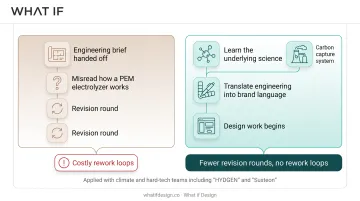
Manufacturers building hard-tech, clean energy, or complex industrial equipment face a different problem: the product itself is difficult to explain. A design team that doesn't understand how a PEM electrolyzer works, or how a carbon capture system actually functions, will burn through revision rounds trying to translate engineering into brand language. That's expensive rework, and it's avoidable.
Firms that specialize in this kind of technical translation can shortcut the problem. What if Design's work with climate tech and hard-tech manufacturers, including HYDGEN and Susteon, starts with learning the underlying science before any design work. That sequence cuts revision rounds and keeps founders and engineers out of costly rework loops.
See how we have approached this in practice: Best website design strategies for manufacturing companies in 2026.
3. Cost breakdown: where the manufacturing rebrand budget goes
Buying a new identity is one line in a much bigger ledger. Here's where the rest of a manufacturing rebrand budget typically goes:
| Budget Line | Cost Type | What It Covers |
|---|---|---|
| Brand strategy & research | One-time | Audits, stakeholder interviews, competitive mapping, positioning |
| Visual identity & messaging | One-time | Logo, guidelines, tone of voice, core copy |
| Physical asset production | One-time/periodic | Packaging, signage, tooling, uniforms |
| Digital rebuild | One-time | Website, ERP-linked systems, distributor portals, SEO migration |
| Legal, trademark & regulatory filings | One-time | Trademark search/registration, compliance filings by region |
| Internal training & change management | Recurring/periodic | Brand books, staff training, governance systems |
| Launch & marketing rollout | One-time | Campaign creative, PR, customer communication |
Two line items drive most of the budget variance:
Physical asset production is the highest-variability cost on this list. It scales with SKU count and facility footprint, not with how ambitious your creative brief is.
A single-plant manufacturer with a tight SKU range might barely notice this cost. A multi-facility manufacturer with dozens of SKUs sold through third-party distributors will find this line rivaling, or exceeding, everything else in the budget combined.
Digital rebuild costs also shift with complexity. A marketing site redesign is one thing; rebuilding distributor portals or ERP-linked ordering systems tied to your old brand name is a different scope entirely. Give that work its own line item rather than folding it into "website."
4. Manufacturing-specific budget considerations
4.1 Phased depletion vs. hard cutover
Replacing packaging and signage immediately can strand existing inventory, forcing you to scrap product that's still perfectly sellable. A phased depletion strategy, timed to your natural reprint and reorder cycles, avoids that waste.
The riskiest scenario is discovering unsold inventory at a third-party distributor mid-transition, after the planning window to deplete it naturally has already closed.
4.2 Centralize multi-site and multi-region rollouts
When Trane Technologies spun off from Ingersoll Rand, the team faced more than 8,600 branded assets across 60 countries, with a deadline of under 18 months. They didn't update everything at once.
Legal-risk and customer-visible assets moved first; lower-risk items were sequenced over the following months. That's the model for multi-facility manufacturers: one centralized budget, not a dozen business units each negotiating with their own vendors.
4.3 Use the rebrand to rationalize your asset portfolio
A rebrand is a natural checkpoint to cut what you don't need:
- Discontinue redundant SKUs that duplicate other products in your line
- Retire signage variants nobody's updated in years
- Consolidate collateral templates instead of recreating every legacy version
Done well, this rationalization can offset a real share of total rebrand cost.
5. How to build and allocate your rebrand budget
5.1 Steps to estimate the right budget
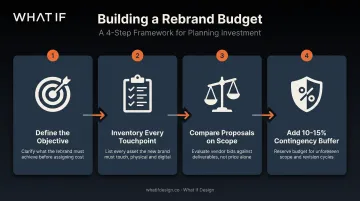
- Define the objective first. Repositioning, M&A integration, and market expansion each point toward a different tier and a different set of priority touchpoints.
- Inventory every touchpoint before requesting quotes. Digital, physical, and regulatory: all of it. You can't price what you haven't listed.
- Compare proposals on scope alignment, not price alone. For hard-tech and clean-tech manufacturers, one partner who can cover strategy, design, and web on a complex technical brief often costs less than coordinating three separate vendors.
- Add a 10-roughly 15% contingency buffer. Scope changes, extra SKUs, and unexpected compliance requirements show up more often than teams expect.
Once you have a total, allocate by phase: lock strategy and identity first, then fund digital and physical rollout in waves that match production and inventory cycles.
5.2 Common budgeting mistakes to avoid
- Focusing only on design fees while ignoring physical asset replacement and compliance costs
- Rushing the rollout timeline instead of phasing around production and inventory cycles
- Treating rebrand cost as a one-time expense rather than a long-term investment in brand equity and revenue growth
When the story is clear, the next conversation starts from confidence rather than explanation. Get a free strategic audit.
6. Frequently asked questions
6.1 What is the typical budget for rebranding a manufacturing company?
Costs range from a five-figure visual refresh to a seven-figure, multi-facility overhaul, depending on scope. Facility count, SKU volume, and physical assets push manufacturing costs well above typical brand estimates.
6.2 How can I rebrand without losing customers?
Phase the rollout, communicate changes clearly before they happen, and keep messaging consistent across every touchpoint during the transition. Sudden, unannounced changes to packaging or ordering systems are what actually confuse customers.
6.3 How long does a manufacturing company rebrand typically take?
Timelines run from several months for a single-facility refresh to two or three years for large, multi-country rollouts. Facility count and regulatory complexity are the main drivers of how long it takes.
6.4 Should we replace physical assets immediately or phase them in?
Phase them in, tied to your existing reprint and reorder cycles. A hard cutover strands sellable inventory and creates waste that a phased depletion strategy avoids entirely.
6.5 Do hard-tech or clean-tech manufacturers need a specialized rebranding partner?
Yes, in most cases. Products like electrolyzers or carbon capture systems are genuinely hard to brief, and a partner who understands the underlying science avoids costly rounds of rework.
6.6 What's the difference between a brand refresh and a full rebrand for a manufacturer?
A refresh updates visual identity - logo, color, typography - for a business whose positioning still works. A full rebrand rebuilds strategy, identity, and physical assets, and it's triggered by events like mergers, spin-offs, or repositioning.
Ready to take the next step?
If you're weighing a design partner for climate, deep tech, or hard-to-explain products, Book a strategy call with our founders at What if Design, a no-pressure 25-minute conversation about what you're building and where design can help. You can also View our work to see how we've helped teams like yours, or Get a free strategic Audit of your current brand, website, or product experience.