Brand repositioning is a deliberate shift in how the market perceives your company, without discarding the core identity you've already built. It's for founders, CMOs, and brand leaders at growth-stage or technical companies whose messaging no longer matches their technology, market, or ambition.
Here's the problem: most teams confuse repositioning with a rebrand or a quick visual refresh. Get that wrong, and you risk alienating loyal customers while still failing to win the new ones you're chasing.
This guide covers what repositioning actually is, the signals that tell you it's time, a step-by-step process, what separates success from failure, and when repositioning is the wrong call entirely.
TL;DR: key takeaways
- Repositioning changes perception and messaging while keeping your core identity intact, unlike a full rebrand
- Common triggers: stalled growth, a shifted audience, new technology, or fading differentiation
- Follow a clear arc: audit, research, redefinition, rollout, then measurement
- Internal alignment and consistent execution matter more than a clever new tagline
- Most failures come from changing too much at once, or rolling out inconsistently
1. What is brand repositioning (and how is it different from rebranding)?
Brand repositioning adjusts your message, target audience, or value proposition while your core name, identity, and brand equity stay put. Nothing about your company's foundation changes, only how the market understands it.
The goal is to shift your brand's "spot" in the customer's mind so it matches new market realities. You keep what already works and correct the story around it.
Three related moves get mixed up often:
- Repositioning: changes the message and market associations; name and visual identity stay the same
- Brand refresh: cosmetic updates to fonts, colors, and other visuals, with no change to strategy or message
- Rebranding: a full identity overhaul that can touch the name, logo, and even the business model
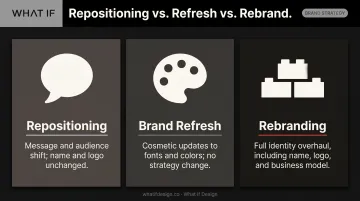
Branding Strategy Insider draws a clear boundary here. Knowing which category your project falls into before you start determines your entire scope, budget, and timeline.
2. When should you reposition your brand?
Repositioning tends to surface when one of these signals shows up:
- Sales or market share have stalled or declined despite steady product investment
- You're struggling to attract new customers or investors who fit your ideal profile
- A shift in your industry or technology has made your old differentiator irrelevant
- Competitors have closed the gap you once relied on
Repositioning isn't always a reaction to bad news. It can also be proactive. Intel's "Intel Inside" campaign is the clearest example of getting ahead of a shift rather than responding to one.
As PCs reached everyday buyers who'd never heard of Intel, the company moved from an invisible component supplier to a household name. By the end of 1992, more than 500 OEMs had joined the program and 70% of eligible OEM advertising carried the Intel logo. Nothing about Intel's business changed. The perception around it did.
2.1 The B2B and deep-tech version of this problem
For technical companies, the most common trigger looks different. It's not a market crash. It's that the product, science, or business model has moved faster than the brand's story.
We saw this firsthand with Susteon, a carbon-capture and hydrogen technology company. Their existing website couldn't communicate what their technology actually did to investors or partners. The work was too technical, and the story hadn't kept pace with it. The real gap was translation, not quality.
3. The step-by-step brand repositioning process
Brand repositioning runs through six steps: audit, audience research, positioning, identity and messaging, rollout, then ongoing measurement. Full engagements from research through website updates typically take 3 to 6 months. Messaging-only work can move faster.
3.1 Audit your current brand Health and perception
Document where the brand actually stands today, internally and in the market:
- Interview stakeholders across sales, product, and leadership
- Survey customers and investors on current perception
- Benchmark direct and adjacent competitors
- Review sales and marketing data for gaps between message and results
3.2 Research your target audience and market landscape
Perceptual mapping and interviews with customers or investors surface unmet needs your current positioning misses.
Dove’s research found only 2% of women considered themselves beautiful. That insight reframed the brand around body confidence instead of idealized beauty standards.
LEGO used audience research the same way. It learned that creative, open-ended play mattered more to kids and parents than the licensed sets the company had leaned on, and rebuilt around that truth.
💡 Working through this decision right now? If you're a climate-tech or deep-tech founder weighing this trade-off, Book a strategy call with our team, 25 minutes, no pitch, and we'll pressure-test your specific situation.
3.3 Define your New positioning statement
Articulate four things clearly:
- Target segment: who you're now speaking to, and how that overlaps with or replaces your current audience
- Value proposition: what you deliver that matters to them
- Competitive frame: who you're positioned against
- Reason to believe: the proof that backs your claim
See how we have approached this in practice: ESG storytelling.
Your core identity stays intact through this step. You're refining the story, not writing a new one.
3.4 Realign brand identity, messaging, and visual design
Your voice, story, and visual system need to reflect the new position everywhere: website, pitch materials, and product. For technical or scientific companies, this step is where projects often stall. The brief itself means translating complex science into a story a non-expert can trust.
That translation problem showed up clearly with LabStart, a research incubator that had run for over three years on a static “version 101” website. The science was strong; funders and fellows still couldn’t parse it. In a four-month engagement, What if Design rebuilt the brand identity, guidebook, website, and supporting materials around a clearer mission.
With Susteon, visual storytelling, diagrams, and simplified climate-impact messaging explained a system linking CO₂ capture, renewable energy, and sustainable aviation fuel. The company’s COO said the process “forced us to reflect and rethink our corporate strategy.”
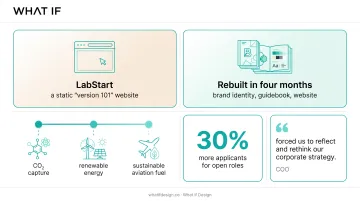
The redesigned site also drove 30% more applicants for open roles. Clearer positioning shows up outside marketing metrics too.
3.5 Roll out consistently across every touchpoint
Consistency across sales collateral, website, social, and internal training determines whether the new position sticks. Mixed signals make the brand look confused, not evolved.
This is not only a communications problem. Kantar attributes up to 75% of brand building to experiential touchpoints, not campaigns. In its banking analysis, brands where promise and experience aligned scored 61 on preference versus 32 where they diverged. Rollout has to cover what customers experience, not only what they read.
3.6 Monitor brand Health and iterate
Repositioning does not end at launch. Track whether the new position is landing and catch drift early, before it turns into a second, costlier fix.
Monitor a short set of signals on a fixed cadence:
- Brand perception and message recall among target segments
- Pipeline quality, win rates, and sales feedback on clarity
- Site engagement on key narrative pages and careers conversion
- Customer and investor feedback loops tied to the new story
4. Key factors that determine repositioning success
Success or failure hinges on a few variables, not the creative work itself:
- Audience overlap: Whether the new audience replaces or overlaps your current one, and how much you risk alienating existing customers
- Internal alignment: Leadership, sales, and product all bought into the new vision, not leadership alone
- Budget and timeline realism: Perception change almost always takes longer than teams plan for
- Industry complexity: Technical, regulated, or scientific categories need deeper translation from product to story
- Competitive timing: A response to a real market shift, not a move made in isolation
Treat these as go/no-go checks before you invest in messaging, design, or a full rollout.
5. Common mistakes that derail brand repositioning
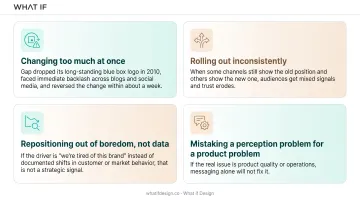
A solid repositioning plan still fails when execution slips. These four traps show up most often:
- Changing too much at once. Repositioning can tip into an unplanned rebrand and confuse loyal customers. Gap learned this in 2010: it dropped its long-standing blue box logo, faced immediate backlash across blogs and social media, and reversed the change within about a week.
- Rolling out inconsistently. When some channels still show the old position and others the new one, audiences get mixed signals and trust erodes before the new story can stick.
- Repositioning out of boredom, not data. If the driver is "we're tired of this brand" instead of documented shifts in customer or market behavior, pause. That is not a strategic signal.
- Mistaking a perception problem for a product problem. If the real issue is product quality or operations, messaging alone will not fix it. Repositioning only works when the underlying business can support the new claim.
6. Conclusion
Brand repositioning is a structured process: audit, research, redefinition, rollout, measurement, not a cosmetic update you can shortcut with a new tagline. Success depends far more on internal alignment and consistent execution than on clever copy.
For climate tech, deep-tech, and purpose-driven companies, the science itself is hard to communicate. That translation work is the hardest part of the whole process.
It's also where a specialized partner turns strategy into a market-ready brand faster. That's the specific gap What if Design works in, day to day, for founders whose technology has outpaced their story.
Get this right and you get alignment: your team, your investors and your buyers all read the same story the same way. Get a free strategic audit.
7. Frequently asked questions
7.1 What does it mean to reposition a brand?
It means changing how your market perceives you, your message, or your target audience, while keeping your brand's core name and identity intact. You're correcting perception, not rebuilding the company.
7.2 Can you give me an example of brand repositioning?
Old Spice repositioned toward younger buyers and the women who buy most household body wash, without dropping its name or "manly-smelling" heritage. Sales rose roughly 60% year over year within months of launch.
7.3 What are the four C's of brand positioning?
Clarity, credibility, consistency, and competitiveness. Jobber and Fahy's Foundations of Marketing uses this framework to build or refine a positioning statement once you've defined your target segment.
7.4 What's the difference between brand repositioning and rebranding?
Repositioning shifts your message and perception while your core identity stays the same. Rebranding overhauls that identity itself, and can include the name, logo, and business model.
7.5 How long does brand repositioning typically take?
Most engagements span several months across research, strategy, and rollout, and perception change tends to lag behind the launch itself. Treat any fixed timeline as a starting estimate, not a guarantee.
7.6 How much does brand repositioning cost?
Cost depends heavily on scope. Messaging-only work costs far less than a full identity and website realignment, and pricing scales further with company size and the number of channels involved.
Ready to take the next step?
If you're weighing a design partner for climate, deep tech, or hard-to-explain products, Book a strategy call with our founders at What if Design, a no-pressure 25-minute conversation about what you're building and where design can help. You can also View our work to see how we've helped teams like yours, or Get a free strategic Audit of your current brand, website, or product experience.