For climate tech, deep tech, and other technically complex companies, this moment carries more weight than it might elsewhere. Your brand is often the first thing investors, enterprise buyers, and partners encounter, long before anyone understands the science underneath it. If that first impression is muddled, you're losing ground before the technical conversation even starts.
This post gives founders a framework to quantify the case, get ahead of the objections, and walk into that room with a pitch built for how boards actually make decisions.
TL;DR: key takeaways
- Treat the rebrand as a business investment anchored in revenue, fundraising, and retention metrics
- Map every ask to board KPIs so approval hinges on outcomes, not visual deliverables
- Pre-empt the top three objections before the floor opens to raise approval odds
- Cite recognizable rebrand precedents to lower perceived risk in the room
1. Signs your company needs a rebrand (before you bring it to the board)
Before you draft a single slide, confirm the problem is real. Two categories of signals usually point to it.
Internal signals show up first:
- Pitch deck, website, and sales materials describe different versions of the company
- New hires can't explain what you do in a single sentence
- Fragmented visuals and inconsistent messaging slow already-long enterprise sales cycles
Investors notice this faster than founders think.
External signals are harder to ignore because they cost you deals:
- Losing partnership conversations to a competitor with clearer, simpler positioning
- Watching investors pass after struggling to explain your technology back to you
- Enterprise buyers taking longer to get internal sign-off because your materials don't address their specific concerns
This risk compounds for companies communicating complex science. Generic, one-size-fits-all materials create multi-stakeholder confusion that stalls deals.
Timing matters as much as the signal itself. Boards are most receptive to a rebrand ask around a specific trigger event:
- An upcoming funding round, when narrative clarity affects terms and conviction
- A pivot in technology or business model that outgrows the old story
- A merger that forces two identities into one market face
- Expansion into a new market with different buyers and objections
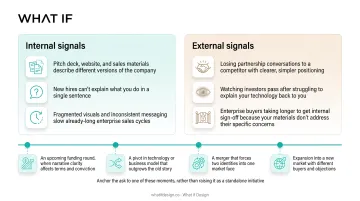
Anchoring your ask to one of these moments, rather than raising it as a standalone initiative, makes the conversation about business timing, not taste.
2. Building the business case: connect brand to metrics the board tracks
Boards don't approve "brand" as a line item. They approve outcomes. Your job is translating a qualitative brand problem into a quantified business risk the board already tracks: win rate, sales-cycle length, fundraising timeline, and retention.
2.1 Quantify what the current brand is costing you
Start with your own numbers before reaching for outside data. Audit three things:
- Stalled deals: how many sat in your pipeline past the expected close date, and what feedback came back?
- Investor pass notes: did any mention confusion about the technology, market, or category?
- Recruiting rejections: did candidates cite unclear positioning or mission when declining offers?
For external validation, a 2016 Demand Metric and Lucidpress survey found that 71% of respondents named market confusion as the greatest negative effect of inconsistent brand use, and organizations with consistency problems estimated a 23% average revenue opportunity from fixing it. Treat this as a directional benchmark, not a guaranteed return. The real evidence should come from your own pipeline.
2.2 Map the rebrand investment to outcomes the board actually cares about
For technical companies, funding rounds and partnerships are often lost on unclear communication, not the underlying science. We have seen this firsthand with climate tech founders backed by the US Department of Energy, ARPA-E, and leading climate VCs, work that helped translate complex science into brand and website assets tied to more than $105M raised across those engagements.
Put that risk next to the ask. Build a simple ROI comparison for the board:
| Rebrand cost | Cost of inaction |
|---|---|
| $50K: $250K for strategy, messaging, and visual identity | One lost enterprise contract, often worth more than the entire rebrand budget |
| 3 to 6 months of focused work | A funding round delayed by a full quarter |
| Team time for workshops and reviews | A senior hire lost to a competitor with clearer positioning |
Include both hard ROI (revenue protected, capital closed, shorter sales cycles) and soft ROI (leadership alignment, employee morale, investor confidence).
Boards respond to numbers, but they remember the emotional case too. A founder who can say "our team finally believes in how we tell our own story" often lands harder than another spreadsheet.
💡 Working through this decision right now? If you're a climate-tech or deep-tech founder weighing this trade-off, Book a strategy call with our team, 25 minutes, no pitch, and we'll pressure-test your specific situation.
3. Anticipating and answering board objections
Three objections come up almost every time: cost, timing, and the risk of confusing people who already trust your current brand. Address all three before anyone raises a hand.
See how we have approached this in practice: Rebranding strategies for mergers.
3.1 "We can't afford it right now"
Reframe cost as a phased investment rather than a single large ask. Propose a smaller pilot first, such as a messaging and pitch deck refresh, before committing to a full visual identity overhaul.
A Minimum Viable Brand engagement can be scoped to 4 to 6 weeks and cover messaging hierarchy, visual identity, and guidelines without the cost of a complete rebuild. That de-risks the initial approval and gives the board a checkpoint before the bigger spend.
3.2 "This will distract us from fundraising or product work"
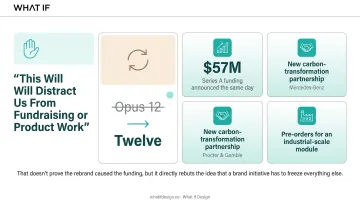
Rebranding and fundraising aren't mutually exclusive. When Twelve announced it was formerly known as Opus 12, it did so alongside a $57M Series A. The same announcement covered new carbon-transformation partnerships with Mercedes-Benz and Procter & Gamble, plus pre-orders for an industrial-scale module. That doesn't prove the rebrand caused the funding, but it directly rebuts the idea that a brand initiative has to freeze everything else.
3.3 "Will this confuse our existing customers or investors?"
A phased rollout protects existing equity while introducing new positioning:
- Soft launch: update internal materials and close relationships first
- Investor pre-briefing: walk existing investors through the change before it's public
- Grandfathered messaging: keep familiar language live during the transition period
Bring a one-page objection-and-rebuttal matrix into the meeting. Listing cost, timing, and confusion risk next to your prepared response signals you've already thought this through, which is often what tips a skeptical board.
4. Structuring your board presentation
Open with the data-backed problem statement from your business case, not the new logo. Boards trust the case before they trust the creative.
4.1 The core slides every rebrand deck needs
- Current-state brand audit and gap analysis: where messaging, visuals, and product experience diverge
- Proposed positioning summary: tied to a named business goal (fundraising, market expansion, or category creation)
- Timeline, budget, and phased milestones: a controlled process, not an open-ended commitment
Planning figures from Frontify's rebranding cost guide put a brand refresh around $50K, $100K over 3 to 4 months, versus $250K or more for a full overhaul spanning 8 to 10 months. Use these as a starting reference, then build your own bottom-up number.
4.2 Framing the ask
End with a specific, bounded ask:
- A defined budget range, not an open figure
- A decision deadline with a specific date
- One success metric to report at the next board meeting
A bounded ask is easier to approve than a vague one. It also gives you a natural follow-up moment to show progress instead of asking the board to trust a multi-month black box.
5. Rebrand case studies that won board and investor confidence
Recognizable precedent lowers perceived risk. These examples show rebrands tied to genuine business inflection points, not a cosmetic refresh.
| Company | What triggered it | What followed |
|---|---|---|
| Dropbox | Repositioning from a storage tool to a creative platform (2017) | IPO pricing in March 2018, sequencing only, not proven causation |
| Slack | Fixing an inconsistent, fragmented visual identity (2019) | Direct NYSE listing in June 2019 |
| Mailchimp | Evolving from an email tool into a broader marketing platform (2018) | Acquired by Intuit in 2021 |
None of these companies published a causal rebrand-to-outcome number. What they share is a business trigger that made the timing make sense to their boards.
Climate tech rebrands follow the same pattern when the work is tied to a real commercial shift. What if Design's portfolio shows how that looks in practice:
- Susteon: A four-month brand, identity, and website engagement translated carbon capture and CO₂-management tech for investors and partners, and coincided with 30% more career-page applicants.
- HYDGEN: A dense, text-heavy site became a clearer story for industrial buyers evaluating decentralized hydrogen, anchored in specs like 99.roughly 97% output purity.
- Nira Energy and peers: Similar repositioning work as each company clarified its market story for partners and capital.
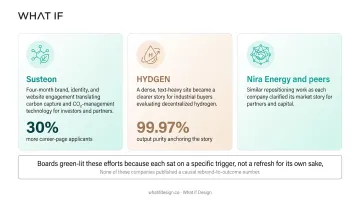
Boards green-lit these efforts because each sat on a specific trigger, not a refresh for its own sake.
Get this right and you get alignment: your team, your investors and your buyers all read the same story the same way. Get a free strategic audit.
6. Frequently asked questions
6.1 What are some successful examples of rebranding?
Dropbox, Slack, and Mailchimp are the most cited examples. Each paired a clear business trigger, like a platform shift or upcoming IPO, with disciplined execution rather than a cosmetic update alone.
6.2 What is the 3-7-27 rule of branding?
It's an informal heuristic: about 3 seconds for a first impression, 7 exposures for recognition, and 27 interactions before trust. It has no verified origin, so don't use it as a hard timeline for board ROI expectations.
6.3 How much should we budget for a rebrand, and how do we present that number to the board?
Use a phased approach: strategy and messaging first, full visual identity second. Frame the number against the cost of inaction, a stalled deal or delayed round, not as a standalone expense.
6.4 How long does a typical rebrand take from strategy to launch?
A full rebrand covering strategy, brand design, and a website typically runs 4 months, based on comparable climate tech engagements. Boards respond better to phased milestones along that timeline than a single end date.
6.5 Should the CEO or the marketing/design lead present the rebrand business case to the board?
The CEO should lead with business framing, since boards weigh the credibility of the messenger heavily on financial asks. Marketing or design leads should support with evidence, visuals, and audit findings.
6.6 What's the difference between a full rebrand and a brand refresh, and which should we propose?
A full rebrand revisits strategy, messaging, and visual identity. A refresh updates the logo, colors, and messaging while keeping the core identity intact. If your business case isn't airtight yet, propose the refresh first.
Ready to take the next step?
If you're weighing a design partner for climate, deep tech, or hard-to-explain products, Book a strategy call with our founders at What if Design, a no-pressure 25-minute conversation about what you're building and where design can help. You can also View our work to see how we've helped teams like yours, or Get a free strategic Audit of your current brand, website, or product experience.