The cost of waiting shows up in slower inbound demos, weaker partnership intros, and credibility hits when buyers and investors judge you in seconds.
Approval gets harder when your decision-maker is a technical co-founder, a spreadsheet-first CFO, or a scientist-led board that distrusts "make it look nicer" requests. They've seen design pitches before. Most were vibes, not evidence.
For climate tech, deep tech, and frontier tech founders, the bar is higher. You're pitching people trained to reject claims without data. The same instinct that makes them strong scientists makes them skeptical of design proposals.
This guide shows you how to build a business case rooted in revenue, risk, and strategic timing. Not aesthetics.
TL;DR: key takeaways
- A strong business case reframes the redesign as a revenue and risk issue, not a cosmetic upgrade
- Conversion rate gaps and lost revenue figures move boards faster than traffic charts or design trends
- Unclear technical websites can stall fundraising and partnerships directly, not just hurt SEO
- Every credible case pairs "why now" with a costed plan, risk mitigation, and an adoption path
1. Why most website redesign proposals get rejected
Most redesign pitches die because they're built on opinion. "It looks outdated" or "our competitors have nicer sites" doesn't register with a data-driven or technical decision-maker. They need evidence they can defend in a budget meeting.
Without a monetary tie-in, leadership sees the redesign as a cost center, not an investment. This is especially true for CFOs and engineering-minded co-founders who evaluate every request in terms of return, not appearance.
Proposals also get stuck when they skip a costed plan or timeline. Ambiguity invites scope debates. Scope debates kill momentum. By the time someone asks "how much, exactly, and by when," an unprepared founder has already lost the room.
What gets proposals approved:
- Replace subjective language with numbers pulled from your own analytics and CRM
- Tie the redesign to a dollar figure, not a design opinion
- Bring a real timeline and cost range before anyone asks for one
2. Building the data-driven case for your redesign
2.1 Calculate the revenue gap
Boards respond to revenue impact, not traffic growth. Start by calculating the average value of a website conversion using your own CRM data. How much is one qualified lead or demo request worth, on average, once it closes?
Next, compare your current conversion rate to an industry benchmark. Unbounce's 2024 SaaS Conversion Benchmark Report found a median conversion rate of 3.8% for SaaS landing pages, based on more than 57 million conversions across over 41,000 pages. If your site converts well below that, you have a gap.
Multiply that gap by your traffic and average deal value. The output is a monthly or annual revenue figure lost by standing still. The single number that makes a board pay attention. It reframes "we need a redesign" into "we're leaving $40,000 a month on the table."
2.2 Audit and present engagement data
Pull GA4 data on engagement time, bounce rate, and session stickiness. Layer in a heatmap or session-recording tool to show exactly where visitors disengage.
Key questions to answer:
- Where do users drop off before reaching a contact form or demo request?
- Which pages have the shortest average engagement time?
- Do technical or product pages perform worse than your homepage?
Screenshot the worst drop-offs and place them next to your revenue-gap figure. Visual proof of friction beside a dollar amount is harder for a board to dismiss than either data point alone.
2.3 Factor in the science communication gap
Technical and climate-focused companies face a failure mode general SaaS companies don't: investors, grant reviewers, and enterprise buyers bounce when they can't parse complex claims quickly.
Technical teams often lead with specifications instead of business impact, and dense, text-heavy pages give visitors little reason to stay. Many decide whether to keep reading in under 30 seconds.
When What if Design audited HYDGEN's previous site, the content was technically rich but lacked the structure and storytelling industrial buyers needed to understand the offering.
Track time-on-page for your technical and product pages specifically. A steep drop-off here is an early warning sign, not a vanity metric.
Buyer research patterns make that drop-off expensive. In Demand Gen Report's 2024 B2B Buyer's Survey, 45% of buyers named vendor websites among their first two research resources, well before any conversation with sales. If your site can't communicate value in that window, you're losing deals you never hear about.
3. Presenting the solution: costs, timeline, and expected ROI
A solution section built on guesswork collapses the moment a CFO or CTO starts asking questions. Show a fully itemized plan before you write the case, and back every line with a real quote from a build partner:
- Design and UX
- Development
- CMS and hosting
- Training
- Ongoing maintenance
Select the CMS or platform first so those figures are grounded, not guessed.
Webflow is a common recommendation for climate and deep tech sites because it combines a visual, no-code interface with CMS collections that scale to 100+ pages for case studies, technical documentation, and whitepapers. Development on a platform like this can cut build time roughly in half compared to traditional coding. That shorter timeline lowers the build cost you put in front of the board.
If your site hasn't kept pace with where the business actually is, we can show you what that's costing you. Get a free strategic audit.
Those cost and timeline figures only hold if the return side is equally disciplined.
3.1 Calculate ROI conservatively
Keep the math simple and defensible:
Current monthly leads × improved conversion rate × average deal value = projected monthly revenue gain
Use conservative improvement estimates, not best-case scenarios. A board will trust a modest, well-sourced number over an inflated one every time.
3.2 Show, don't just tell
Commission quick mockups or wireframes from a design partner. Visually-oriented board members need to see the improvement, not imagine an abstract "better look and feel."
Present the build as a phased roadmap so decision-makers see a bounded commitment:
- Discovery: stakeholder input, goals, audience, and content mapping
- Wireframe: low-fidelity structure and content hierarchy
- Design: high-fidelity, on-brand visual execution
- Development: responsive build with CMS and integrations
- Migration: moving existing content and preserving SEO equity
- Launch: go-live with monitoring in place

Realistic timelines vary by scope. A focused website redesign often runs 4 to 12 weeks. A 4-week engagement covered a solar company's site rebuild. HYDGEN's redesign landed in about two months. A fuller brand-plus-website engagement for a carbon capture and hydrogen company ran closer to four months.
4. Anticipating risks and objections
A board will find the risks even if you don't raise them first. Get ahead of the four that come up most often.
| Risk | Mitigation |
|---|---|
| Stalled internal approvals | Set a hard deadline tied to a funding round or launch date |
| Agency fails to deliver | Vet partners against past work in your sector before signing |
| New site underperforms | Set benchmark metrics pre-launch and review at 30/60/90 days |
| SEO rankings drop post-migration | Map old URLs to new ones and use permanent redirects |
That last risk deserves specifics. Google's own migration guidance notes that significant site changes cause temporary ranking fluctuations while pages get recrawled. On a medium-sized site, most pages typically settle within a few weeks.
Keep the mitigation procedural:
- Map every old URL to its new destination
- Use 301 redirects (avoid redirect chains)
- Update internal links and canonicals
- Keep redirects live for at least a year
Address "why now" directly. Stakeholders who see the current site as "good enough" won't move without a forcing function. Tie the redesign to a specific trigger: a funding round, a grant deadline, or an enterprise pilot. Inertia then has nothing to hide behind.
Include a short adoption plan. A visual CMS like Webflow lets non-technical teammates edit content, publish updates, and manage pages without a developer ticket for every copy change. State that independence explicitly. Boards often worry as much about ongoing dependency as about upfront cost.
5. The business case is different for climate tech and deep tech companies
For a carbon capture, green hydrogen, or ESG-data company, the business case is not only about conversion optimization. Investors, DOE and ARPA-E reviewers, and enterprise partners need to understand and trust complex science within seconds of landing on the site.
The stakes are direct. The same buyer research pattern covered earlier, vendor sites being one of the first stops before any direct contact, applies just as much to investors doing quiet diligence and enterprise partners scoping a pilot before ever picking up the phone. An unclear site isn't a branding issue at that stage. It's a risk to your fundraising or deal timeline.
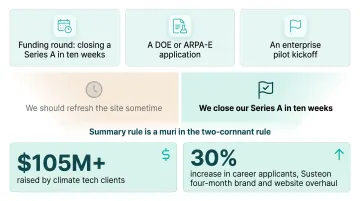
Anchor the case to a real trigger. A hard deadline a board can't quietly deprioritize beats a vague refresh plan every time:
- A funding round (for example, closing Series A in ten weeks)
- A DOE or ARPA-E application
- An enterprise pilot kickoff
"We should refresh the site sometime" never survives a board meeting. "We close our Series A in ten weeks" does.
Hiring senior in-house talent for niche science communication is slow and expensive. Most climate and deep tech companies don't need that role full-time either.
A studio built for the sector shifts that tradeoff. What if Design works exclusively with climate tech, carbon capture, grid interconnection, and green hydrogen companies on senior-level brand, website, and product strategy without in-house overhead. That work has contributed to more than $105 million raised by climate tech clients.
Peer precedent helps. Susteon, a carbon-capture and hydrogen company, ran a four-month brand and website overhaul that clarified its carbon-conversion story for technical and non-technical audiences. The result was a 30% increase in career applicants. Citing comparable companies that invested ahead of a major milestone normalizes the spend for a skeptical technical co-founder.
When the story is clear, the next conversation starts from confidence rather than explanation. Get a free strategic audit.
6. Frequently asked questions
6.1 What are the 7 C's of website design?
The 7 C's: context, content, community, customization, communication, connection, and commerce, come from a customer-interface design framework by Rayport and Jaworski. Anchoring your case to these shows the redesign addresses strategy, not just visuals.
6.2 How do I announce a website redesign?
Announce it in stages: an email to stakeholders and customers, a short social media rollout, and a brief press note if relevant. Frame every message around the benefits delivered, not "we changed how it looks."
6.3 How much should a website redesign cost?
Cost varies widely based on scope, CMS choice, and features, ranging anywhere from a few thousand dollars to well over $50,000 for complex builds. Get a real quote from a build partner before finalizing your business case.
6.4 How long does a website redesign typically take?
Most professional redesigns take 4 to 12 weeks for a focused site, though larger brand-plus-website engagements can run 3 to 4 months. Complexity and content volume drive most of the variation.
6.5 What metrics prove a website redesign was successful?
Conversion rate, bounce rate, session duration, and page speed are the core metrics. For climate tech companies, add investor or partner engagement and grant application traction as sector-specific indicators.
6.6 When is the right time to redesign a website?
Age alone (the common 3-5 year cycle) is a weak signal. A funding round, rebrand, or platform migration is a far more decisive trigger than a calendar date.
Related reading: Why UX failures cost climate and deep-tech startups credibility and B2B website UX.
Ready to take the next step?
If you're weighing a design partner for climate, deep tech, or hard-to-explain products, Book a strategy call with our founders at What if Design, a no-pressure 25-minute conversation about what you're building and where design can help. You can also View our work to see how we've helped teams like yours, or Get a free strategic Audit of your current brand, website, or product experience.