A design system usually gets filed under design and engineering. That undersells it. The real payoff shows up in how fast a team raises money, how quickly new hires get productive, and how few times a founder has to explain the same idea three different ways to three different audiences.
Global climate-tech investment topped $70 billion in 2024, and most of that capital went to teams that could explain complex science simply and consistently. This article breaks down why a design system matters in practice, not just in theory, and what happens to teams that skip it.
TL;DR: key takeaways
A design system is a shared library of reusable components, patterns, and guidelines that keeps design and code consistent across products, teams, and touchpoints.
Three advantages drive the business case:
- Faster time to market and lower cost per release
- Stronger brand consistency and stakeholder trust
- Faster scaling with less redesign drag across teams
Skip it, and costs rise, branding fragments, and every new hire slows the team down. We close with how to keep that value compounding, including build-vs-partner options.
1. What is a design system (brief context)
Strip away the jargon, and a design system is a shared library: reusable UI components, patterns, and rules for how they go together, kept consistent across every product and channel that touches a customer or investor.
For an early-stage climate tech or deep tech team, that typically covers:
- Product UI: dashboards, control panels, web and mobile apps
- Marketing sites: landing pages, careers pages, blog templates
- Pitch and brand materials: decks, one-pagers, grant submissions
A design system is the mechanism that gets a team to speed, trust, and scale faster than rebuilding from scratch every time.
That matters most when the product itself is hard to explain visually, like carbon capture chemistry or grid-interconnection software. The system does the translation work so the founder doesn't have to repeat it in every meeting.
2. Key advantages of a design system
The three advantages below map to numbers teams already track: cost per release, conversion rates, and sprint velocity.
2.1 Faster time to market & cost efficiency
Reusable components mean a team assembles a screen or a flow from existing parts instead of designing and coding it from zero every time. A signup form, data table, or dashboard card, once built and documented, gets reused across ten features instead of ten rebuilds.
Day-to-day, this looks unremarkable: a designer pulls a button component instead of drawing one, a developer pulls the coded version instead of writing new CSS. That small habit removes most of the handoff friction and rework that slows a sprint down.
For a climate-tech team prepping for a DOE grant demo, the difference is concrete. Without a system, every chart gets built, reviewed, and debugged fresh, eating days that should go toward the grant narrative. With one, the chart already has states for loading, error, and empty data.
Why this matters for the business:
- Figma's controlled study found designers completed comparable tasks 34% faster with a relevant, up-to-date design system.
- Figma flags that figure as closer to an upper bound. Real-world savings depend on how often the system fits the work at hand.
- Faster shipping compounds: a feature that ships two weeks earlier reaches investors and customers two weeks sooner, shortening the feedback loop that shapes the next fundraising conversation.
KPIs this affects: design and dev hours per feature, sprint velocity, time-to-launch, cost per release.
When it matters most: ahead of a fundraising deadline, a grant or regulatory submission with a fixed date, or when a team ships more than one product surface at once.
2.2 Brand consistency & stakeholder trust
A design system acts as a single source of truth for how a brand looks and behaves everywhere: a pitch deck slide, a careers page, a product dashboard. That consistency does operational work, not only visual cleanup.
Without one, brand identity scatters fast. A freelancer builds the careers page one way. A contractor builds the product UI another way. Six months later, a company has three shades of the same blue in front of the same investor.
Why this matters for trust, not just aesthetics:
- Marq's survey of more than 400 brand-management professionals found respondents estimate consistent branding drives 10% to 20% higher revenue growth.
- Consistency lowers the cognitive load for evaluators unfamiliar with a technical product, whether that's an investor reviewing carbon-capture chemistry or a regulator reviewing a grid-interconnection filing.
- In due diligence, visual polish often gets read as a proxy for operational maturity. A scattered brand raises quiet doubts about whether the product is as buttoned-up as the pitch claims.
When What if Design rebuilt the brand system for Susteon, a carbon-capture and hydrogen incubator, the four-month engagement covered a logo, icons for technical concepts like electrolysis and carbon capture, and a full brand guide.
The redesigned site drew a 30% increase in applicants for open roles.
KPIs this affects: brand perception, investor and partner conversion rate, customer trust or NPS scores.
If your site hasn't kept pace with where the business actually is, we can show you what that's costing you. Get a free strategic audit.
When it matters most: technical due diligence, multi-stakeholder demos, or a rebrand after a pivot.
2.3 Scalability, collaboration & team efficiency
Modular systems let distributed teams: in-house staff, contractors, and freelance specialists, work from the same standards instead of reinventing decisions on every project. That matters more for lean climate-tech teams than almost anyone else, since many rely on a rotating mix of contractors between funding rounds.
A documented component library shortens onboarding, too. A new designer or developer doesn't need three weeks of tribal knowledge. They open the system and start building.
Why this matters as a team scales:
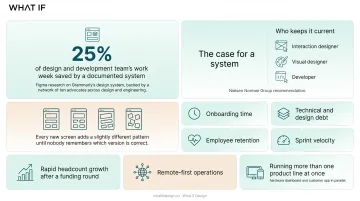
- Figma's research on enterprise adoption found Grammarly's design system saved design and development teams roughly 25% of their work week, supported by a network of ten advocates across design and engineering.
- The Nielsen Norman Group notes a design system is only as good as the team managing it, recommending at least one interaction designer, one visual designer, and one developer to keep it current.
- Without a system, design and technical debt compound quietly. Every new screen adds a slightly different pattern until nobody remembers which version is correct.
KPIs this affects: onboarding time, technical and design debt, employee retention, sprint velocity.
When it matters most: rapid headcount growth after a funding round, remote-first operations, or running more than one product line at once, common for deep-tech companies managing a hardware dashboard and a customer-facing app in parallel.
3. What happens when a design system is missing or ignored
Skip a design system, and the cost doesn't disappear. It moves downstream and gets bigger.
The trust cost: inconsistent visuals across a pitch deck, a website, and a live product erode investor and customer confidence. A mismatched logo or three different button styles reads as a team that hasn't sorted out its own operations, right when a founder needs to project the opposite.
The financial cost: duplicated design and development work adds up fast. Fixing problems late costs far more than fixing them early. NIST's software-testing research found that correcting a requirements-stage error after release costs roughly 15 times more than catching it during requirements. Design debt follows the same curve.
The speed cost: without a shared library, founders and small teams reinvent UI for every new project, pitch, and product surface. That slows fundraising and shipping at the exact moment speed matters most.
None of these costs show up on a single line item. They show up as a slower quarter, a harder due-diligence conversation, and a backlog that never quite clears.
4. How to get the most value from a design system
A design system only pays off if it's used, not just built and filed away. Treat it as a living workflow, something reviewed and adjusted, not a deliverable handed off once and forgotten.
A few practices separate systems that get adopted from ones that gather dust:
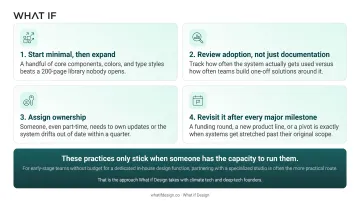
- Start minimal, then expand. A handful of core components, colors, and type styles beats a 200-page library nobody opens. Add to it as real product needs surface.
- Review adoption, not just documentation. Track how often the system actually gets used versus how often teams build one-off solutions around it.
- Assign ownership. Someone, even part-time, needs to own updates or the system drifts out of date within a quarter.
- Revisit it after every major milestone. A funding round, a new product line, or a pivot is exactly when systems get stretched past their original scope.
These practices only stick when someone has the capacity to run them. For early-stage teams without budget for a dedicated in-house design function, partnering with a specialized studio is often the more practical route. It provides senior-level systems thinking without the overhead of full-time hires.
That is the approach What if Design takes with climate tech and deep-tech founders. Most need technical translation that turns complex science into something a non-expert can follow, plus design rigor that holds up under investor and regulatory scrutiny.
5. Conclusion
A design system's real value is control: a fundraising deck, website, and product that tell the same story to investors, regulators, and customers evaluating the team as much as the product.
The advantages compound as the company grows:
- Hours saved in month one become days saved by month twelve
- New features ship on a shared foundation instead of one-off patterns
- New hires ramp faster because the system already defines how work looks
For teams serious about winning credibility over business-as-usual competitors, a design system is an early investment in speed and trust, not a later-stage luxury.
A site that reflects the company you have actually become is the cheapest credibility you can buy, and it puts you back in control of the first impression. Get a free strategic audit.
6. Frequently asked questions
6.1 Can you provide a case study for a design system?
Grammarly's internal survey found its design system saved design and development teams 25% of their work week. After Susteon's four-month brand and website redesign with a technical icon system, career applicants rose roughly 30%.
6.2 How much does it cost to build a design system?
Costs vary widely by scope: adopting an existing system costs the least, adapting one costs more, and building a proprietary system from scratch takes the most design and engineering time. Ongoing maintenance and governance add to the total, so budget for upkeep, not just the initial build.
6.3 How long does it take to build a design system?
A custom build from scratch takes the longest. Working with a specialized partner can compress that timeline significantly. What if Design typically delivers a full visual identity and design system in 4 to 6 weeks, faster for urgent fundraising or grant timelines.
6.4 What's the difference between a style guide and a design system?
A style guide is static documentation of colors, type, and logo usage. A design system is the living parent structure: it includes the style guide plus a coded component library, pattern library, and the people who maintain it.
6.5 Do early-stage startups need a design system?
Yes, once a team has more than one product surface or more than one contributor touching design. Waiting until after a funding round or a hiring wave makes retrofitting far more expensive than building it early.
6.6 What is a good ROI benchmark for a design system?
There's no universal percentage, since ROI depends on team size, system maturity, and how often the system gets reused. The most credible reference points are task-completion studies showing up to 34% faster work, and company-reported savings like Grammarly's 25% weekly time reduction.
Related reading: Brand guidelines vs design systems and Mobile UX design.
Ready to take the next step?
If you're weighing a design partner for climate, deep tech, or hard-to-explain products, Book a strategy call with our founders at What if Design, a no-pressure 25-minute conversation about what you're building and where design can help. You can also View our work to see how we've helped teams like yours, or Get a free strategic Audit of your current brand, website, or product experience.