That instinct is especially strong in climate tech, deep tech, and hard-science startups. When your core innovation involves electrolyzers, carbon capture chemistry, or grid interconnection protocols, explaining it to a generalist investor is already hard enough without spending time on how it looks.
Brand investment is infrastructure, in the same category as your cap table or financial model. This article makes the practical, outcome-based case for treating it that way: grounded in investor meetings, term sheets, and the months after a round closes.
TL;DR: key takeaways
- A clear narrative, deck, and website shorten the time investors need to understand and trust your company
- Brand is one of the few levers founders fully control during diligence
- Skipping it doesn't save money. It resurfaces as slower rounds or reactive rebrands
- The same assets built for fundraising later drive hiring, partnerships, and sales
1. What is brand investment in a funding context
In a raise, brand investment means one thing: a coherent narrative, pitch deck, website, and visual identity that consistently explain what you do, why it matters, and why you'll win.
It shows up across three touchpoints:
- The pitch deck: the first, and often only, chance to make a complex idea land in one sitting
- The company website and data room: where investors verify the story between meetings
- Follow-up materials: one-pagers, decks, and memos sent after the first conversation to keep momentum
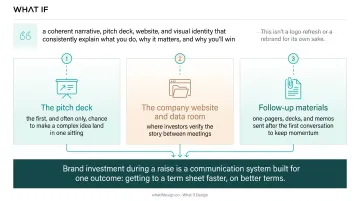
This isn't a logo refresh or a rebrand for its own sake. Brand investment during a raise is a communication system built for one outcome: getting to a term sheet faster, on better terms.
2. Key advantages of brand investment during a funding round
These advantages tie directly to metrics founders and investors already track: time-to-close, meeting-to-meeting conversion, and perceived risk. They matter most for technical founders, where the underlying science is genuinely harder for a generalist partner to evaluate on the first pass.
2.1 Advantage 1: brand clarity shortens the time investors need to say yes
Investors don't have time to reverse-engineer your business. A clear narrative reduces the cognitive load required to grasp a complex product, market, and model. An associate or partner "gets it" in the first meeting instead of needing three follow-ups just to understand the technology.
The attention window is small. DocSend's 2024 deck-review tracker recorded average review times between 2:18 and 2:30 across sampled weeks. That's the entire window to make your value proposition land before the reader moves on.
For technical founders, the stakes are higher. In carbon capture, hydrogen, or grid tech, "the brief is hard to write." Unclear communication gets mistaken for an unclear business, even when the science is sound.
Those gains show up in meetings needed per stage, deck-to-second-meeting conversion, and overall time-to-close. They matter most from pre-seed through Series A, when there's no revenue history to fall back on and the story does most of the persuading.
Akhila Kosaraju, co-founder of What if Design, has spent years helping climate tech and deep tech founders translate carbon capture, hydrogen, and grid-interconnection science into pitch materials a generalist investor can follow. That includes teams backed by the DOE, ARPA-E, and leading climate VCs.
Her work across these categories has contributed to over $105M collectively raised. The pattern is consistent: founders who could already explain their science to each other still needed help translating it for someone hearing it cold.
2.2 Advantage 2: A credible brand reduces perceived risk and protects valuation
Investors price risk into every term sheet. An inconsistent deck, a dated website, or scattered data room materials can unconsciously read as an inconsistent team, even when the underlying technology is strong.
A 2020 study of 885 institutional VCs found that management quality was considered important by 95% of firms, and the single most important factor by 47%. That put it ahead of business model, product, or market, according to research published via the European Corporate Governance Institute.
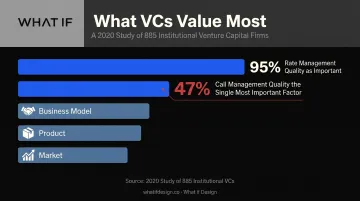
Professional brand execution won't replace fundamentals, but it's often the first data point an investor uses to judge whether a team can execute.
That perception has a direct dollar consequence. Founders who present as lower-risk and more prepared are in a stronger position to negotiate:
💡 Working through this decision right now? If you're a climate-tech or deep-tech founder weighing this trade-off, Book a strategy call with our team, 25 minutes, no pitch, and we'll pressure-test your specific situation.
- Higher pre-money valuation multiples
- Stronger term sheet leverage when multiple investors are circling
- Faster path to a term sheet from a lead who needs less reassurance
LabStart's leadership described their rebrand as something that "improved the confidence of the leadership massively" heading into their fundraising process. That internal conviction shows up externally in how a team pitches.
See how we have approached this in practice: ESG storytelling.
The effect shows up in pre-money valuation, negotiation leverage, and lead-investor speed to term sheet. It matters most in competitive rounds with multiple term sheets, or in categories where investors are less familiar with the underlying technology.
2.3 Advantage 3: brand assets compound value beyond the raise
Fundraising materials don't expire at close. The same narrative, website, and visual system built to raise capital keep working for sales conversations, partnership pitches, and recruiting, if they're built to last past the round.
That reuse creates real efficiency. Instead of rebuilding materials from scratch for each new audience, founders adapt one consistent foundation.
Recruiting is where this shows up fastest. Candidates researching a hard-tech startup before an interview form an impression from your brand before they ever talk to you.
Glassdoor's research found that 83% of job seekers research company reviews and ratings before deciding where to apply. Unclear positioning doesn't just confuse investors. It can cost hiring momentum for the engineers and scientists you need next.
Those assets affect cost per new marketing or sales piece, time-to-hire for key roles, and partner or BD conversion rate. They matter most post-raise, as headcount scales, new markets open, or strategic partnerships develop alongside the next round.
3. What happens when brand investment is missing or ignored during a round
Skipping brand investment only defers the cost, usually to a worse moment in the raise. Founders who come to this realization mid-raise describe a consistent set of symptoms:
- Repeated clarifying questions. The same basic "what does this actually do" question resurfaces across meetings because the core story never fully landed the first time.
- Longer diligence cycles. Investors piece together the value proposition themselves instead of receiving it clearly, adding weeks to an already slow process.
- A rushed rebrand right before (or after) closing. Compressed timelines under investor pressure almost always cost more than doing the work deliberately.
- Difficulty differentiating. In crowded categories like climate tech and EVs, an unclear brand makes you indistinguishable from five other companies raising the same quarter.
- Weaker negotiating position. A company that reads as underprepared gets treated as earlier-stage than it actually is, regardless of the technology underneath.
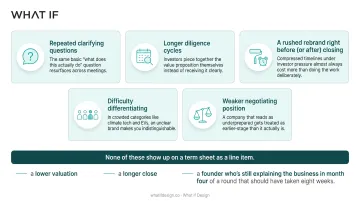
None of these show up on a term sheet as a line item. They show up as a lower valuation, a longer close, or a founder who's still explaining the business in month four of a round that should have taken eight weeks.
4. How to get the most value from brand investment
Timing determines whether brand investment helps or scrambles a raise.
Start before outreach begins, not the week of the first pitch. Materials built under deadline pressure rarely survive contact with a sharp investor question. Building the narrative months ahead gives it time to be tested and refined.
Pressure-test the story outside the founding team. Advisors, portfolio founders, or a specialized design partner will catch where the narrative loses clarity, usually a spot the founders have grown too close to notice.
For technical and scientific categories, the partner matters as much as the process. At What if Design, that means learning the underlying science and market before any visual work begins.
That approach shaped work with companies like Susteon, whose COO said the process "accurately translated our vision to creatively visualize our deeply scientific work."
Scale the investment with the round:
| Stage | Recommended focus | Typical scope |
|---|---|---|
| Pre-seed/Seed | Narrative and deck clarity | 4 to 6 weeks, foundational brand system |
| Series A and beyond | Full website, product UX, data room polish | 4 to 12 weeks depending on scope |
Lighter-touch narrative work early keeps costs proportional. Fuller website and product investment as diligence deepens matches the level of scrutiny investors bring to a larger check.
5. Conclusion
Brand investment during a raise controls how quickly and confidently investors understand and trust what you've built. Once term sheets are in play, that clarity is one of the few variables founders can still influence.
The advantage compounds. The clarity that speeds up a raise is the same clarity that speeds up hiring, partnership conversations, and the next round after this one.
Plan it alongside the cap table and the financial model. Not as a one-time expense before the pitch, but as ongoing fundraising infrastructure.
A site that reflects the company you have actually become is the cheapest credibility you can buy, and it puts you back in control of the first impression. Get a free strategic audit.
6. Frequently asked questions
6.1 At which funding stage should startups invest in brand?
There's no single mandatory round. Brand investment typically starts light at pre-seed/seed with narrative and deck work, then expands into a full website and visual identity ahead of Series A as investor and customer scrutiny increases.
6.2 What should I avoid saying to investors about brand during a raise?
Avoid overstating brand maturity or making vague positioning claims without evidence. Tie every brand-related claim back to a concrete outcome, like faster sales cycles, hiring wins, or specific investor feedback.
6.3 How much should a startup budget for brand investment during a funding round?
Budgets vary widely by stage and scope: from a few hundred dollars for bootstrapped visual identity to well over $30,000 for a funded startup's full website and brand system. Match spend to the assets you need for this raise, not a generic benchmark.
6.4 Does having a strong brand actually increase startup valuation?
Brand itself isn't a direct valuation input. By reducing perceived risk and clarifying the story, it strengthens a founder's negotiating position and can influence deal terms indirectly.
6.5 When is the best time to invest in brand before raising funds?
Start narrative and deck refinement several months before outreach begins. That gives the story time to be tested and refined before it's ever in front of an investor.
6.6 Can founders DIY their brand instead of hiring a design agency?
At the earliest stages, yes. As technical complexity and investor scrutiny increase, a partner who knows your market and technical domain typically pays for itself in time saved and clarity gained.
Ready to take the next step?
If you're weighing a design partner for climate, deep tech, or hard-to-explain products, Book a strategy call with our founders at What if Design, a no-pressure 25-minute conversation about what you're building and where design can help. You can also View our work to see how we've helped teams like yours, or Get a free strategic Audit of your current brand, website, or product experience.