For climate tech and deep tech founders, this creates a specific problem. Many are brilliant scientists or engineers, but they struggle to translate carbon capture chemistry, green hydrogen electrolysis, or grid interconnection logic into a story a generalist investor can follow in minutes.
This article breaks down what "design" actually means at each fundraising stage, from pitch decks and narrative to brand and product UX, and how the right choices at the right time can directly move the needle on closing a round.
TL;DR: key takeaways
- Pre-seed and seed need different proof points; design’s role shifts at each stage
- For climate and deep tech founders, design translates technical depth into investor clarity
- Deck, brand, website, and UX decisions shape credibility and how fast a round closes
- Overinvesting in early polish or underinvesting in clarity are the top funding-limiting mistakes
1. Pre-seed to seed: A quick primer on funding stages
Pre-seed capital funds a company before it has a real product or revenue. Founders use it to validate an idea, build a prototype, and hit the milestones seed investors expect to see.
Carta, which tracks startup fundraising data, places a typical pre-seed round at roughly $250,000 to $1 million, with smaller and larger rounds both common. Carta also recommends raising enough to cover 12 to 18 months of runway.
Seed rounds look different. In short:
- Pre-seed: Idea validation and prototype work; typical checks of roughly $250K, $1M aimed at 12 to 18 months of runway
- Seed: Working MVP plus early traction (pilots, active users, or initial revenue); Carta reports a $3.8 million median as of Q3 2024
That larger median reflects how much more proof investors expect at seed.
1.1 Why deep tech runways run longer
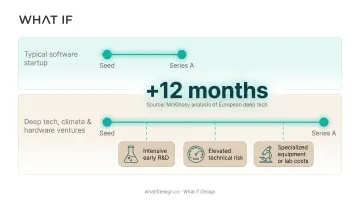
Hardware, climate, and deep tech companies rarely fit this timeline cleanly. According to McKinsey's analysis of European deep tech, these ventures combine intensive early R&D, elevated technical risk, and specialized equipment or lab costs.
McKinsey found deep tech companies often take 12 months longer than typical software startups to move from seed to Series A. That longer, costlier runway is why design and communication carry more weight for these founders: there's more ground to cover before an investor understands what they're actually funding.
2. Why design is a strategic lever for climate and deep tech fundraising
Climate and deep tech founders face a communication gap that SaaS founders rarely deal with. Investors, partners, and even future hires often can't parse the underlying science quickly, which makes design the bridge between technical depth and business clarity.
That bridge matters because investor attention is scarce. DocSend found that VCs spend an average of just 3 minutes and 44 seconds reviewing a seed pitch deck. If your carbon capture mechanism or grid protocol takes ten minutes to explain, it won't get read.
For pre-revenue, pre-product companies, design is often the only tangible signal of execution ability investors have. There's no product to test, no revenue to model, so a sharp deck or a clear website substitutes for proof that doesn't exist yet.
Not every design choice closes that gap the same way:
- Decorative design makes things look polished: gradients, sleek type, finish with no job attached
- Strategic design ties every choice to a business outcome, such as closing a round or improving pilot conversion
- A gradient background is decorative; a deck structured so an investor grasps unit economics in 90 seconds is strategic
What if Design builds its process around this gap. Co-founders Akhila Kosaraju and Tejas Mahajan learn the science and market before designing anything. They have worked with teams backed by the US Department of Energy and ARPA-E across carbon capture, grid interconnection, and green hydrogen, contributing to over $105M raised across their client base.
3. Design that moves the needle at pre-seed
At pre-seed, design's job is to make your idea legible fast. These are the places it matters most.
💡 Working through this decision right now? If you're a climate-tech or deep-tech founder weighing this trade-off, Book a strategy call with our team, 25 minutes, no pitch, and we'll pressure-test your specific situation.
3.1 Pitch deck design
Narrative arc and visual hierarchy do the heavy lifting here. A well-structured deck moves an investor from problem to traction in roughly 10 concise frames, using layout, contrast, and whitespace to direct attention rather than dense paragraphs of technical explanation.
See how we have approached this in practice: Mobile UX design.
3.2 Founder and company narrative
Hard-science founders are frequently stronger on the technology than on the story. Design helps surface the "why now, why us" positioning, pairing a founder's technical authority with a narrative an outside investor can actually follow.
3.3 Lean early branding
You don't need a full brand system at pre-seed. A simple logo, a one-pager, and a basic landing page are usually enough to look credible to investors and early customers without burning runway you'll need later.
3.4 Design for validation
Mockups, landing pages, and rough prototypes exist to generate signal: waitlists, pilot interest, and early conversations that prove problem-solution fit before you've built the full product.
3.5 Cost-efficient access to senior expertise
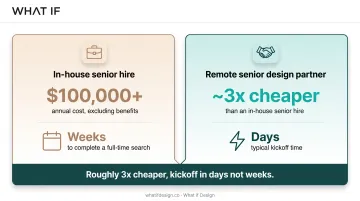
Full-time senior designers commonly cost upwards of $100,000 annually, excluding benefits: a hard number to justify pre-product. That's why more founders now work with remote, senior-level design partners on flexible retainers instead. We give you senior capacity at startup cost rather than an in-house senior hire, with kickoffs in days rather than the weeks a full-time search takes.
4. Design that moves the needle at seed
Once early market signal exists, the bar rises. Seed investors expect a more mature external presence, and design priorities shift with it.
Priorities that matter at seed:
- Full brand system: Logo, type, color, and messaging hierarchy should carry consistently across deck, website, and customer materials. Fragmented identities slow enterprise sales cycles and undermine investor confidence.
- Website as a fundraising and partnership asset: For climate and deep tech buyers, the site has to build technical credibility. Surface grants, VC backing, team expertise, and partnerships clearly.
- Product UX for adoption and retention: Every screen is a business decision. UX choices shape the activation, retention, and engagement metrics seed investors track.
- Evolving pitch and data collateral: Move past the scrappy pre-seed narrative. Seed decks should surface traction, KPIs, and growth charts so market size and momentum read at a glance.
- Systems that scale: ESG tools, fleet platforms, and energy dashboards need reusable components, consistent data-viz patterns, and defined states for the complexity that follows v1.
When What if Design rebuilt Susteon's site to make its carbon capture and hydrogen work clear through visual storytelling, the redesign also drove 30% more applicants for open roles. Credibility signals serve hiring and partnerships as much as fundraising.
5. Avoiding the design mistakes that cost founders funding
Two mistakes show up repeatedly among early-stage climate and deep tech founders.
5.1 Mistake #1: over-investing too early
Spending scarce pre-seed runway on flashy branding or a fully polished product before product-market fit is validated wastes capital on work investors don't need to see yet. An MVP and a lean landing page can test your core assumptions for a fraction of the cost.
5.2 Mistake #2: generic templates and DIY design
Template decks and DIY websites often fall flat with specialized investors who expect founders to demonstrate command of complex subject matter. Common gaps include:
- Dense, text-heavy pages that overwhelm visitors who decide whether to stay in under 30 seconds
- Technical specifications leading the story instead of business impact
- No clear visual hierarchy to guide an investor's eye through the argument
- Inconsistent visual identity across deck, website, and outreach materials
5.3 Choosing a design partner
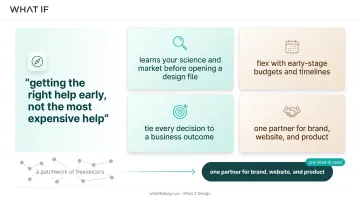
Avoiding both mistakes usually means getting the right help early, not the most expensive help. Look for a partner who learns your science and market before opening a design file. They should flex with early-stage budgets and timelines, and tie every decision to a business outcome.
That is the model we use with climate tech founders moving from pre-seed to seed: one partner for brand, website, and product instead of a patchwork of freelancers.
A site that reflects the company you have actually become is the cheapest credibility you can buy, and it puts you back in control of the first impression. Get a free strategic audit.
6. Frequently asked questions
6.1 How do you get pre-seed investment?
Build a clear pitch deck and narrative, then target investors with a pre-seed track record in your sector. Show early validation, customer interviews or a prototype, even without a finished product.
6.2 How much is pre-seed funding usually?
Pre-seed rounds commonly range from $250,000 to $1 million, depending on sector and geography. Capital-intensive sectors like climate and deep tech often need more, given R&D and prototyping costs.
6.3 Does a pre-seed startup really need professional design?
Lean, strategic design (not a full brand system) helps validate ideas and signals founder credibility before a product exists. It's often the only tangible proof of execution ability investors see this early.
6.4 What's the difference in design needs between pre-seed and seed stage?
Pre-seed focuses on narrative clarity and lean validation assets like a landing page or simple deck. Seed shifts toward a fuller brand system, a credibility-building website, and product UX tied to growth metrics.
6.5 How much should a startup budget for design at pre-seed or seed?
Budgets vary, but many founders use flexible remote design partners to get senior-level expertise without the six-figure cost of an in-house hire.
6.6 Can founders DIY their pitch deck and website at pre-seed?
DIY works for very early validation. But technical, science-heavy startups often benefit sooner from experienced design help, since translating complex R&D into clear investor language is rarely a founder's strongest skill.
Ready to take the next step?
If you're weighing a design partner for climate, deep tech, or hard-to-explain products, Book a strategy call with our founders at What if Design, a no-pressure 25-minute conversation about what you're building and where design can help. You can also View our work to see how we've helped teams like yours, or Get a free strategic Audit of your current brand, website, or product experience.