What happens in the first few weeks after that signature determines whether your design partnership actually delivers, or quietly stalls while you wait for someone to explain what's supposed to happen next. The onboarding process is where partnerships get built or broken.
This article is for founders in climate tech, deep tech, and other technically dense fields who are about to work with a design partner (or just hired one) and want a clear map of what comes next. We'll walk through the step-by-step onboarding flow, what to prepare beforehand, and the mistakes that most often derail early collaboration.
Research from the IPA's BetterBriefs initiative found that marketers estimate 26% of budget is wasted on poor briefs and misdirected work. A structured onboarding process is how you avoid becoming part of that statistic.
TL;DR: key takeaways
- Design onboarding typically unfolds in 5 stages: kickoff, discovery, strategic alignment, first deliverable, and ongoing collaboration
- Deep tech and climate tech projects need deeper discovery because designers must understand the underlying science before producing usable work
- Structured onboarding reduces rework and scope creep; loose onboarding causes early delays and eroded trust
- Preparing technical documentation, brand assets, and stakeholder access in advance directly speeds onboarding
1. What is a design onboarding process?
A design onboarding process is the structured sequence an agency uses to move a signed client from contract to active, productive collaboration. It covers kickoff, discovery, alignment on direction, and the first real deliverable.
The point is mutual clarity before real design work starts:
- Both sides agree on what success looks like
- Timelines and responsibilities are explicit, not assumed
- The designer understands enough about your product and market to make informed decisions
- You know exactly what to expect and when
Here's where founders often get it wrong: they treat onboarding as a single kickoff call. It's not. A kickoff call is one meeting on day one. Onboarding is the full multi-week journey that follows: discovery interviews, alignment workshops, a first draft, feedback cycles, and the eventual handoff into steady-state work.
Skip that journey, or compress it into a single call, and you end up with a designer working from assumptions instead of facts. For a company building carbon capture systems or grid infrastructure, that gap between assumption and fact is where expensive rework starts.
2. Why a structured onboarding process matters for climate tech and deep tech founders
Generalist creative agencies are built to move fast on familiar territory: consumer apps, retail brands, SaaS dashboards. Climate tech and deep tech don't offer that shortcut.
A designer can't translate green hydrogen production economics, battery degradation curves, or carbon accounting methodology into a clear pitch deck or product interface without first understanding how the technology actually works.
Skip that step, and you get generic output: pretty slides that don't survive investor due diligence, or a product UI that doesn't reflect how the system actually behaves.
2.1 The cost of skipping structure
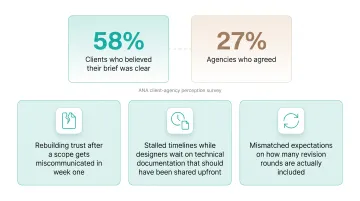
The gap between what clients think they've communicated and what agencies actually understand shows up clearly in research. In an ANA survey of client and agency perceptions, 58% of clients believed their briefs were clear, while only 27% of agencies agreed.
That perception gap plays out in predictable ways without structured onboarding:
- Rebuilding trust after a scope gets miscommunicated in week one
- Stalled timelines while designers wait on technical documentation that should have been shared upfront
- Mismatched expectations on how many revision rounds are actually included
2.2 What technical founders actually need
Founders building complex technology need onboarding that does more than schedule meetings. It needs to:
- Accurately translate jargon into language investors and customers actually understand
- Align design decisions with the narrative you're already using with investors and partners
- Apply systems thinking to interfaces, not just visual polish
At What if Design, onboarding functions as a research phase first. Before any visual work begins, the team invests time learning a founder's science and market context. That approach comes from work with founders backed by programs tied to the Department of Energy and ARPA-E. It's slower on day one. It saves weeks later.
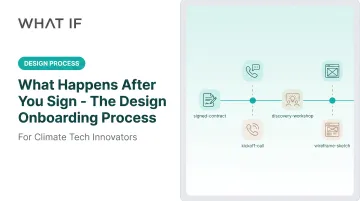
3. What happens after you sign: the step-by-step onboarding process
The high-level flow looks like this: kickoff, deep discovery, strategic alignment, a first deliverable, and the transition into ongoing collaboration. Here's what each stage actually involves.
3.1 Contract confirmation and kickoff
The clock starts immediately. At What if Design, clients typically hear back with next steps within one day of signing, and kickoff happens within three days.
During kickoff, you should expect:
If your site hasn't kept pace with where the business actually is, we can show you what that's costing you. Get a free strategic audit.
- A clear statement of project goals for the engagement
- A 30-day roadmap outlining what happens and when
- An explanation of how the team works and which tools you'll use to collaborate
Nothing should feel ambiguous in week one. If you're left guessing what happens next, that's a red flag.
3.2 Deep discovery on science, market, and brand
This is where climate tech and deep tech onboarding diverges sharply from generalist creative onboarding. Discovery here means understanding your technology, your competitive landscape, your target investors or customers, and any existing brand assets before anyone opens a design file.
For deep tech clients specifically, this step should include a dedicated translation conversation, where you explain the underlying technology in plain terms so the design team can accurately represent it.
That depth matters. In the DOE's Energy I-Corps program, 14 national laboratory teams conducted an average of 70 stakeholder interviews before finalizing their value propositions, often revising them substantially in the process.
3.3 Strategic alignment workshop
Once the design team understands your technology and market, alignment turns that understanding into direction. This stage connects the design work to the actual business goal behind the engagement, whether that's closing a funding round, winning a strategic partnership, or driving product adoption.
Priority messaging gets defined by audience, not treated as one-size-fits-all:
- Investors need data-rich visuals that simplify techno-economics and prove traction
- Regulators need plain-language positioning around compliance
- End customers need commercial value spelled out in practical terms
3.4 First deliverable and design sprint
Before committing to full production, the team produces an early deliverable to validate direction. Depending on the engagement, that might be a visual direction and design system for a pitch deck, or low-fidelity wireframes for a product build.
Feedback should be structured from the outset, not open-ended. What if Design places completed work in a "Ready for Review" stage, collects comments through Figma, Loom, or Slack, and cycles through revisions until the client signs off in writing. Initial output typically lands within 2 to 4 business days.
3.5 Transition to ongoing collaboration
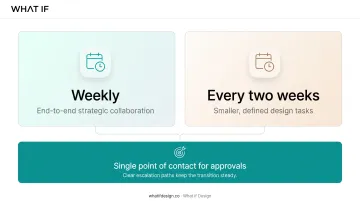
Onboarding ends when the engagement settles into a rhythm. Check-in cadence should match the pace of the work: weekly for end-to-end strategic collaboration, or every two weeks for smaller, more defined design tasks.
Clear escalation paths and a single point of contact for approvals keep this transition from feeling like a cliff edge.
Case study: HYDGEN
HYDGEN needed a brand and website that could carry the weight of green-hydrogen infrastructure, technical enough for engineers, clear enough for policy-makers, credible enough for institutional investors. We built the brand system and website in a compressed sprint aligned to their fundraising milestone. See the full HYDGEN case study.
4. What to prepare before kickoff
The inputs you bring to onboarding directly determine how fast it moves. Founders who show up with documentation ready save real weeks.
Documents that speed things up:
- Existing brand guidelines or style assets
- Pitch decks and technical whitepapers
- Product screenshots, demos, or a working prototype
- Competitive landscape notes, even informal ones
Access that matters just as much:
- One designated approval contact (non-negotiable: most agencies, including What if Design, only act on this person's feedback)
- Technical staff available to answer science questions when they come up
- Login access to existing web or product platforms
4.1 Match onboarding depth to your timeline
A fundraising deadline in six weeks needs a leaner, faster-moving process. A two-to-three-month MVP build can absorb a deeper discovery phase. Say this out loud to your design partner early. It changes how the roadmap gets built.
5. Common onboarding mistakes and misconceptions
Even well-intentioned founders trip over the same handful of issues. Watching for these early saves weeks of frustration.
- Treating onboarding as one call. It's a multi-week process with distinct stages, not a single kickoff meeting followed by silence.
- Withholding technical context. If designers have to guess at your science, they will guess wrong, and that guess becomes expensive rework.
- Confusing revisions with scope changes. A revision refines work inside the agreed scope; a scope change adds work, time, and often cost. Treating every request as a free revision burns both budget and timeline.
- Underestimating internal delays. Legal review, NDA sign-off, and stakeholder availability on your side slow onboarding down just as much as anything on the agency's end.
The fastest onboarding happens when both sides know exactly who's responsible for what, and when, not when the checklist is shortest.
A site that reflects the company you have actually become is the cheapest credibility you can buy, and it puts you back in control of the first impression. Get a free strategic audit.
6. Frequently asked questions
6.1 What are the 5 key stages of the design agency onboarding process?
Kickoff, deep discovery, strategic alignment, first deliverable, and ongoing collaboration. Each stage builds on the last, moving from understanding your business to producing validated work.
6.2 How do you design an onboarding process for a design agency?
Map each stage to a clear output and deadline, and standardize the documentation you request from clients. Build in flexibility for industry-specific complexity, deep tech and climate tech projects often need extra discovery.
6.3 How long does the design onboarding process typically take?
It usually spans one to several weeks depending on technical complexity. Climate tech and deep tech projects often need longer discovery phases since designers must understand the underlying science first.
6.4 What information should founders prepare before onboarding begins?
Brand assets, pitch decks, technical whitepapers, and product demos are the most useful. Also identify your stakeholders in advance: one decision-maker for approvals, and technical staff available for science questions.
6.5 What happens if the project scope changes during onboarding?
New work should go through a structured change request process, not informal scope drift. If the change affects the underlying agreement itself, that amendment needs to be written and signed by both parties.
6.6 How is onboarding different for climate tech or deep tech companies?
It requires a deeper science-and-market discovery phase before any design work starts. Generalist onboarding skips this step because it isn't usually necessary; for complex technology, it's the difference between usable output and generic guesswork.
Related reading: 10 Best SaaS UX Design Agencies For Product Growth In 2026 and Discover the top UI/UX design agencies in Bangalore.
Ready to take the next step?
If you're weighing a design partner for climate, deep tech, or hard-to-explain products, Book a strategy call with our founders at What if Design, a no-pressure 25-minute conversation about what you're building and where design can help. You can also View our work to see how we've helped teams like yours, or Get a free strategic Audit of your current brand, website, or product experience.