For climate tech, deep tech, and frontier tech founders, this problem runs deeper. Investors often can't independently verify the underlying science on a first call, so they lean on brand cues instead: the deck's clarity, the website's polish, how well the founder explains a complex idea. These signals become stand-ins for credibility.
This article breaks down exactly which brand signals investors scrutinize before writing a check, the red flags that stall term sheets, and how founders can build a brand that earns trust faster.
TL;DR: key takeaways
- Brand clarity signals operational discipline when investors can't verify complex tech directly
- Pitch decks, websites, visual identity, and founder presence get judged before any check is written
- Jargon-heavy, inconsistent branding is a common reason diligence slows down or stalls
- A credible brand builds trust faster and cushions you in tough funding cycles
1. Why brand credibility influences funding decisions
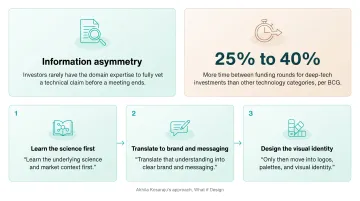
Venture investing runs on incomplete information. Investors rarely have the time, or the domain expertise, to fully vet a technical claim before a first meeting ends. Peer-reviewed research on venture funding identifies this information asymmetry as a core source of inefficiency in VC decision-making, which means clear, verifiable communication helps close that gap.
There's a behavioral piece too. Investors are people making judgment calls under uncertainty, not spreadsheets. A confused deck or a dated website forces them to work harder to trust the founder. A clear, confident brand reduces that mental load.
For climate and deep tech founders, this cuts deeper. Try explaining carbon capture chemistry or grid interconnection protocols to a generalist investor in ten minutes. If the brand around that explanation is confusing, it signals something worse than bad design: it suggests the founder hasn't distilled their own value proposition yet.
This is the exact challenge Akhila Kosaraju, co-founder of What if Design, works through with founders backed by the U.S. Department of Energy and ARPA-E. Her approach starts before any visual work begins:
- Learn the underlying science and market context first
- Translate that understanding into clear brand and messaging
- Only then move into logos, palettes, and visual identity
That order matters. Skipping straight to visuals without understanding the technology tends to produce a brand that looks nice but doesn't close funding conversations.
Deep tech also plays on a longer clock. BCG's analysis of the sector found that deep-tech investments average 25% to 40% more time between funding rounds compared to other technology categories. That longer runway means founders need brand materials that hold up to repeated investor scrutiny over months, not just a single pitch meeting.
2. The brand elements investors scrutinize before writing a check
Investors form an opinion fast, then look for evidence to confirm or challenge it. Here's where that opinion gets shaped.
2.1 Pitch deck design and narrative clarity
Investors don't linger. DocSend's 2024 pitch deck research found an average viewing time of just 2 minutes and 24 seconds per deck. That's not enough time to read every slide carefully. It's barely enough to absorb a well-organized story.
Visual hierarchy isn't decoration, it's function. A deck needs:
- A clear problem-solution-market-team-ask arc that a skimming reader can follow
- Clean data visualization for complex metrics (market size, unit economics, technical benchmarks)
- Minimal text density, with the strongest point on each slide impossible to miss
A deck that requires an investor to slow down and decode it, especially one explaining unfamiliar science, gets set aside for the pile that's easier to evaluate.
2.2 Website and digital presence
For associates and analysts, the company website is often the first informal diligence step, checked before a meeting is even scheduled. A professional, current site signals a team that takes its own business seriously. A generic template, broken navigation, or content that hasn't been updated in a year signals the opposite.
Common issues on early-stage climate tech sites quietly chip away at first impressions:
- Confusing homepages that bury what the company actually does
- Poor mobile experiences (a real problem when investors browse at conferences)
- Technical explanations written like science papers instead of value propositions
2.3 Visual identity and consistency across touchpoints
When the logo, color palette, typography, and tone match across the deck, website, and one-pagers, it signals internal alignment. When they don't, it raises a subtler question: if the team can't coordinate its own materials, how well are they coordinating operations?
In What if Design's work with Susteon, that consistency was built deliberately. A brand book locked down:
💡 Working through this decision right now? If you're a climate-tech or deep-tech founder weighing this trade-off, Book a strategy call with our team, 25 minutes, no pitch, and we'll pressure-test your specific situation.
- An exact color palette and two approved typefaces
- Logo safe-space rules and imagery guidance
Every touchpoint: deck, website, event collateral, stayed unified across a four-month rebrand.
See how we have approached this in practice: ESG storytelling.
2.4 Translating complex technology into an accessible value proposition
Most investors aren't domain scientists. A carbon capture founder or a battery systems company needs to compress deep technical depth into something a generalist can grasp in under a minute, without sounding dumbed down.
Susteon faced exactly this problem: its existing site failed to communicate what the technology actually did. The rebuild used visuals, animations, and infographics to explain CO₂ capture and its ECHO process: over roughly 97% of CO₂ captured from industrial flue gas at a roughly 44% cost reduction, framed as commercial value, not just chemistry.
HYDGEN hit a similar wall. Its redesign moved electrolyzer specs (99.roughly 97% hydrogen purity, 10 kW and 100 kW models) into clear product and use-case sections instead of dense engineering copy.
2.5 Team and founder credibility signals
Founder bios, LinkedIn activity, and public thought leadership all feed into background checks investors run before and during diligence. A founder's past entrepreneurial track record is one of the factors VCs weigh most heavily, according to a large-scale survey of 885 institutional venture capitalists.
Beyond credentials, public communication matters. If a founder's online presence reinforces the same clarity as their pitch, it strengthens the brand story. If it doesn't, it undercuts it.
2.6 Data room and supporting materials design
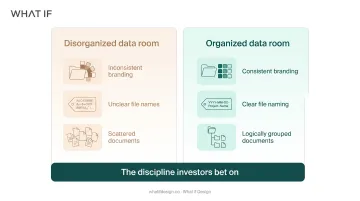
A well-organized data room won't win a deal on its own, but a disorganized one adds friction at exactly the moment investors are trying to move fast. Consistent branding, clear file naming, and logically grouped documents signal a founder who runs things with discipline. The same quality investors bet on when they write a check.
3. Red flags that erode investor confidence
Some brand mistakes do more damage than others. These show up most often in climate and deep tech pitches:
- Inconsistent messaging across deck, website, and social, investors read this as a team misaligned on strategy
- Jargon-heavy, untranslated technical language that suggests the founder hasn't clarified the value proposition
- Outdated templates, stock imagery, or generic design, which signal under-investment in the business itself
That last point stings more in competitive rounds. If a competitor walks in with a sharper brand and a similar technical story, the polished one often gets the benefit of the doubt first.
4. How strong branding speeds up due diligence and term sheets
Investors are evaluating multiple deals at once. When a startup's materials are clear and consistent, that clarity becomes an efficiency filter in the founder's favor. Investors move through diligence faster and with more confidence in what they're reading.
Organized documentation reinforces the same signal. Carta notes that a well-structured data room streamlines diligence and improves transparency for everyone involved.
Standardized, clearly written agreements do similar work on the legal side. The NVCA's model financing documents exist specifically to cut transaction time and cost by setting consistent norms both sides can trust.
Brand credibility built during fundraising doesn't vanish once the round closes. It becomes a buffer of trust for harder moments ahead:
- Bridge rounds where investors need reassurance quickly
- Delays in hitting milestones
- Market downturns that test founder communication
Teams that already look credible get more patience through these moments than teams still trying to prove basic competence.
5. Building an investor-ready brand: where to start
Building a brand that holds up under investor scrutiny isn't a design sprint the week before a raise. It starts earlier, and in a different order than most founders expect.
- Understand the technology and market first. Branding built on a shallow grasp of the science often looks polished and says little. Research the competitive landscape and audience before any visual work starts.
- Audit existing materials for consistency gaps. Look across the deck, website, and one-pagers. Do they tell the same story in the same voice? Small mismatches add up.
- Prioritize narrative clarity over decoration. A simple, confident story consistently outperforms a beautifully designed but confusing one.
- Treat brand as an evolving asset. It is not a one-time pitch deck project: revisit it at each funding stage as the company, market, and story mature.
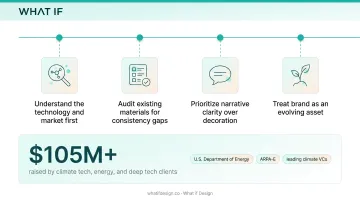
What if Design built its practice around this same sequence for climate tech, energy, and deep tech founders. The team has worked with startups backed by the U.S. Department of Energy, ARPA-E, and leading climate VCs across carbon capture, hydrogen, and grid technologies, on pitch decks and brand work tied to more than $105M raised.
The starting point is always the same: learn the science and the market, then design.
A site that reflects the company you have actually become is the cheapest credibility you can buy, and it puts you back in control of the first impression. Get a free strategic audit.
6. Frequently asked questions
6.1 What are the qualities of a good investor?
Look for transparency around terms, relevant sector or technical experience, and patience through rough patches. The best investors also add strategic value beyond the check itself, not just capital.
6.2 What should an investor expect in return?
Investors expect equity or returns aligned with the deal terms, regular and honest updates, and a founder who communicates clearly and delivers on stated milestones. Specific reporting cadence and rights are usually negotiated per round.
6.3 How much does branding actually affect a startup's ability to raise funding?
Branding doesn't replace strong fundamentals like traction or technology, but it directly affects how quickly and confidently investors process and trust a pitch. Weak branding slows that trust-building down.
6.4 What brand mistakes make investors lose confidence in a startup?
The most common issues are inconsistent messaging across materials, jargon-heavy communication that hides the actual value proposition, and generic or outdated design that signals under-investment in the business.
6.5 Should early-stage startups invest in professional branding before their first raise?
Even lean, pre-seed startups benefit from narrative clarity and basic visual consistency. First impressions form fast, and a confusing early brand can undercut an otherwise strong pitch.
6.6 How is branding different for climate tech or deep tech startups compared to other startups?
These founders face an added translation challenge: turning complex, often unproven science into a value story that non-technical investors can understand and trust quickly. Getting that translation wrong is far costlier than in most other sectors.
Ready to take the next step?
If you're weighing a design partner for climate, deep tech, or hard-to-explain products, Book a strategy call with our founders at What if Design, a no-pressure 25-minute conversation about what you're building and where design can help. You can also View our work to see how we've helped teams like yours, or Get a free strategic Audit of your current brand, website, or product experience.