Website costs for this sector swing much wider than for a typical business. A restaurant or law firm can get away with a $2,000 template. A company explaining electrolyzer efficiency or carbon capture chemistry to a Series B investor usually can't.
This article breaks down realistic pricing tiers, what drives cost up or down, and how to budget a site that actually supports fundraising and growth, not just fills a placeholder domain.
TL;DR: key takeaways
- Website costs range from roughly $2,000 to $150,000+, depending on company stage and technical depth.
- Translating complex science into clear visuals costs more than a standard SaaS site.
- Multi-audience sites (investors, regulators, buyers) need heavier content architecture.
- Interactive tools like ROI calculators or project maps are common upsells, not baseline features.
- Budget for ongoing updates as milestones hit, founders underfund this most often.
1. How much does a website cost for a renewable energy company? (pricing overview)
There's no fixed price for a renewable energy website. Cost depends on your funding stage, how technical your product is, and whether the same site needs to satisfy a due diligence checklist and a residential customer in the same visit.
Three things commonly go wrong when founders misjudge this budget:
- Underbudget the strategic work of turning deep science into a story a non-technical investor can follow in 30 seconds
- Pick a generic template that undersells years of R&D and makes a hard-tech company look like a lifestyle brand
- Skip ongoing budget for updates after every closed round, milestone, or new product line
What companies in this space typically spend:
| Tier | Typical Range | Best For |
|---|---|---|
| Entry-level / template | $2,000, $8,000 | Pre-seed startups needing a placeholder presence |
| Mid-range / custom-designed | $12,000, $45,000 | Seed-to-Series A companies preparing to fundraise |
| High-end / full brand-to-website | $50,000, $150,000+ | Companies raising large rounds or facing regulatory scrutiny |
These figures include design, copy, development, and basic SEO setup. They usually exclude ongoing content updates, paid ad campaigns, and advanced integrations like real-time data feeds, which get quoted separately.
1.1 Entry-level / template site
This tier uses stock templates with minimal customization: a handful of pages, a logo, and basic copy. It works as a temporary placeholder while you focus on product and fundraising.
Best for: Very early pre-seed startups that just need a URL to point people to while they focus on product and fundraising fundamentals.
1.2 Mid-range / custom-designed site
This includes custom UX/UI, a real brand system, investor-ready messaging, and a content management system your team can actually update. Susteon's brand and website redesign for carbon capture and hydrogen production storytelling sits in this territory, built over roughly four months.
Best for: Seed-to-Series A companies preparing for fundraising, partnerships, or their first major enterprise pilots.
1.3 High-end / full brand-to-website engagement
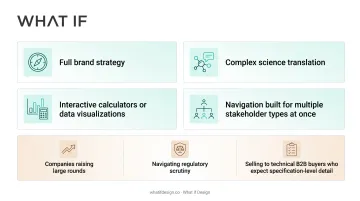
This tier includes full brand strategy, complex science translation, interactive calculators or data visualizations, and navigation built for multiple stakeholder types at once.
Best for: Companies raising large rounds, navigating regulatory scrutiny, or selling to technical B2B buyers who expect specification-level detail.
2. Key factors that affect the cost of a renewable energy website
Pricing here depends on technical, operational, and audience-related factors that don't show up on a typical SaaS or retail site quote.
2.1 Complexity of the technical story
Explaining electrolysis, carbon capture chemistry, or grid interconnection in plain, visual terms takes real strategic work, not just design polish. That translation step is easy to under-scope. What if Design starts by learning the science before any wireframes; generalist agencies that skip it often ship sites that look fine but explain nothing.
2.2 Number of stakeholder audiences
A site serving investors, regulators, enterprise customers, and policymakers simultaneously needs more content layers than one built for a single audience. HYDGEN's redesign, for example, had to speak to investors, partners, and enterprise buyers from the same homepage, a very different brief than a consumer landing page.
2.3 Interactive tools and data features
Calculators, project maps, and dashboards add real cost. Industry benchmarks from DesignRush put interactive multimedia elements at $250 to $10,000 and database-backed features (dashboards, project maps) at $2,000 to $25,000.
Shine Billing's ROI calculator and Batteryze's battery health dashboard fall into this category.
2.4 Compliance, certification, and ESG content
Pages covering certifications, sustainability reporting, or regulatory disclosures add development time and often need legal review before publishing. Generalist web shops rarely scope that line item in.
2.5 Level of customization vs. template use
Off-the-shelf builders are cost-effective but limited. Fully custom-coded or Webflow-based builds cost more upfront but flex with your brand and roadmap as you scale.
2.6 Team structure (freelancer vs. agency vs. in-house)
A freelancer may quote less per hour but often needs more revision cycles. A senior-level agency team tends to get the messaging right faster because they've solved similar translation problems before, which usually means fewer rounds of "this still doesn't sound like us."
If your site hasn't kept pace with where the business actually is, we can show you what that's costing you. Get a free strategic audit.
3. Cost breakdown of a renewable energy company website
Total cost goes well beyond the initial design invoice. Here's where the money typically goes:
| Component | Timing | What It Covers |
|---|---|---|
| Discovery & strategy | One-time | Market research, messaging framework, sitemap, science-to-narrative translation |
| Design & development | One-time | UI/UX design, front-end/back-end build, CMS setup |
| Copywriting & technical content | One-time or periodic | Translating R&D into investor- and customer-friendly language |
| Hosting, domain & maintenance | Recurring | Annual hosting, security, uptime monitoring |
| Content updates & feature additions | Periodic | New case studies, funding milestones, compliance updates as you scale |
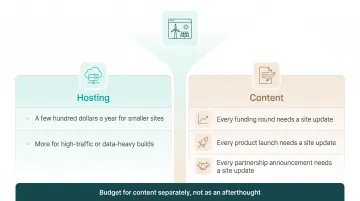
Hosting itself is relatively cost-effective, often a few hundred dollars a year for smaller sites and more for high-traffic or data-heavy builds.
The bigger recurring cost most founders miss is content. Every funding round, product launch, or partnership announcement needs a site update. Budget for that separately, not as an afterthought.
4. startup-scale vs high-cost renewable energy website, what's the difference?
The gap between a budget template and an investor-grade custom build isn't just visual polish. It shows up in three places:
| Factor | Lower-Cost Site | Higher-Cost Site |
|---|---|---|
| Storytelling depth | Generic copy, thin explanation of the technology | Strategist-led narrative that makes complex science clear to non-technical readers |
| Credibility signals | Few visuals, minimal proof points | Data visualizations, case studies, partnership logos, compliance pages |
| Scalability | Hard to update as the company pivots or grows | Built on a flexible CMS that scales through funding rounds |
LabStart's redesign shows the credibility gap clearly. Instead of a vague claim like "we support climate innovation," the site leads with a specific headline backed by concrete proof points: nonprofit status, decades of collective team expertise, and recognizable institutional logos.
That kind of specificity is nearly impossible to fake with a $2,000 template.
5. How to estimate the right budget for your website
The right budget depends on your stage and goals, not the lowest quote you receive. Before setting a number, weigh these factors:
- Fundraising stage: Does the site need to hold up under investor due diligence, or is it just a placeholder while you build product?
- Stakeholder complexity: How many distinct audiences (investors, regulators, enterprise buyers, consumers) does the site need to serve at once?
- Feature needs: Do you actually need a calculator or dashboard, or would a well-written explainer page do the job for less?
- In-house resources: Do you have design and content talent internally, or do you need a partner who already understands both climate tech and design strategy?
Common mistakes to avoid:
- Focusing only on the upfront quote and ignoring ongoing update costs
- Over-investing in interactive features that don't support your current fundraising or growth goals
- Choosing the cheapest option when you're mid-raise and need the site to hold up under scrutiny
A pre-seed startup with no active fundraising doesn't need a $60,000 site. A company three months from closing a Series A, explaining a novel electrolyzer to technical investors, probably shouldn't gamble on a $3,000 template.
Get this right and you get alignment: your team, your investors and your buyers all read the same story the same way. Get a free strategic audit.
6. Frequently asked questions
6.1 How much does it cost for renewable energy?
This usually refers to physical system costs (solar panels, wind turbines, or storage), which vary widely by technology and scale. This article specifically covers the cost of building a renewable energy company's website; see the pricing overview above for those ranges.
6.2 What is the 20% rule for solar?
It's actually the 120% rule (NEC): the main breaker plus solar breaker can't exceed 120% of the busbar rating, per Exactus Energy. It governs electrical installation, not website budgeting.
6.3 How much should a renewable energy startup budget for a new website?
It depends on funding stage. Pre-seed companies can often get by with $2,000: $8,000, while companies preparing to raise a Series A should budget $12,000, $45,000 for a custom, investor-ready build.
6.4 Do renewable energy websites need special features like calculators or interactive maps?
Only if they support a real business goal, like sales conversion or investor due diligence. Shine Billing's ROI calculator made sense for sales; a pre-seed startup usually doesn't need one yet.
6.5 Is it worth hiring a specialized design agency versus a freelancer for a climate tech website?
Freelancers can be cheaper upfront but often mean coordinating separate people for copy, development, and strategy. A specialist agency that understands the science tends to need fewer revision cycles to get the story right.
6.6 How long does it take to design and launch a renewable energy company website?
Timelines vary by scope: template sites can launch in days, while custom builds typically take 4 to 12 weeks. WebFX notes custom projects average around 12 weeks, with complex builds stretching to 3 to 12 months.
Related reading: Eight strategies to boost your renewable energy marketing strategy and LEED certification and renewable energy standards.
Ready to take the next step?
If you're weighing a design partner for climate, deep tech, or hard-to-explain products, Book a strategy call with our founders at What if Design, a no-pressure 25-minute conversation about what you're building and where design can help. You can also View our work to see how we've helped teams like yours, or Get a free strategic Audit of your current brand, website, or product experience.