AI tools have pushed simple-site costs down roughly 60%-roughly 85% in some cases, while custom development, deep integrations, and investor-grade storytelling still command premium rates. That gap has never been wider.
Cost depends on your business stage, design complexity, platform, and technical requirements. Page count barely matters. This article breaks down 2026 pricing tiers, the real cost drivers, the hidden recurring costs, and how to budget based on where your business actually stands.
TL;DR: key takeaways
- Most professional sites in 2026 cost $3,000, $50,000; DIY starts under $500, enterprise can exceed $500,000
- Design complexity, platform, integrations, and content drive price, not page count
- Small businesses can stay lean; funded startups and technical teams should budget for investor-grade sites
- Spend more when the site must generate leads, support fundraising, or convert high-intent traffic
1. How much does website design & development cost in 2026? (pricing overview)
There's no fixed number here. A $500 DIY build and a $50,000 custom build solve different problems for different businesses, comparing them head-to-head misses the point.
Three mistakes trip up most budgets:
- Underbudgeting for a "simple" site. Then discovering the CMS can't handle the content you actually need
- Choosing a platform that can't scale. Forcing a costly rebuild within 18 months
- Ignoring content and maintenance costs. The invoice is never the full price
1.1 Typical 2026 cost ranges
| Website Type | Typical Cost |
|---|---|
| DIY/basic template | $16-$300/month (subscription-based) |
| Professional small-business site | $3,000-$10,000+ |
| Custom lead-generation site | $10,000-$50,000+ |
| eCommerce website | $25,000-$150,000+ |
| Enterprise/technical/investor-facing | $100,000-$500,000+ |
A 2026 GoodFirms survey of 300+ web providers across 31 countries puts basic websites or MVPs at $1,000-$3,000, mid-sized CMS-based sites at $5,000-$20,000, and enterprise-level builds at $20,000-$50,000. Agencies quote higher when strategy, custom integrations, and investor-facing storytelling enter the scope.
1.2 DIY/basic website
Best for personal sites and businesses still validating an offer. You get a template, a handful of pages, and self-managed content. Wix's Business plan runs about $39/month on annual billing; Squarespace's Core plan is $29/month. WordPress.com's Business plan runs $25/month billed annually.
This tier works until you need custom functionality, a unique visual identity, or content structured for search, then it becomes a ceiling, not a foundation.
1.3 Professional small-business or custom website
Typically includes discovery, a custom design system, CMS setup, forms, analytics, and basic SEO. A GoodFirms survey of 200+ agencies and freelancers puts the average professional small-business site around $3,200, with a two-month build timeline.
This tier suits established local or service businesses that need credibility and a site that actually converts visitors into inquiries.
1.4 Enterprise, eCommerce & technical/investor-facing websites
This is where cost jumps fastest, because the work isn't just design anymore. It's custom integrations, complex data architecture, brand strategy, and investor- or partner-facing storytelling.
Climate tech and deep-tech companies sit squarely here. Their sites have to translate carbon capture chemistry or hydrogen electrolysis into something a VC partner or enterprise buyer understands in under two minutes. That's a specialty, not a template job.
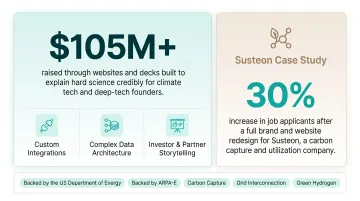
This is where What if Design operates. The studio has worked with organizations backed by the US Department of Energy and ARPA-E, and with climate VCs across carbon capture, grid interconnection, and green hydrogen. That work has helped founders raise over $105M through websites and decks built to explain hard science credibly.
Its work with Susteon, a carbon capture and utilization company, produced a full brand and website redesign that drove a 30% increase in job applicants after launch.
2. Key factors that affect the cost of website design & development
Price is driven by technical complexity, content demands, and business requirements, not a flat per-page rate. Here's what actually moves the number.
2.1 Design complexity & customization
A template gets you a working site fast. A fully custom visual system (unique layouts, motion design, brand-specific components) costs more because every element is built, not assembled.
Off-the-shelf design suits simple presence sites. Custom UI/UX becomes necessary when your product or story is complex, such as translating a technical or scientific concept for a non-technical audience like investors or enterprise buyers.
2.2 Platform choice
Your platform choice affects upfront cost, ownership, and how far the site can scale:
- WordPress powers 40.8% of all websites (59.0% of sites with a known CMS) per W3Techs: flexible, well supported, cheaper to staff.
- Shopify starts at $29/month (Basic, annual billing) and scales to Shopify Plus at $2,300/month for high-volume ecommerce.
- Wix and Squarespace bundle hosting, design, and features into one plan: fast to launch, limited to customize.
- Custom or headless builds cost more upfront but scale further, since you're not fighting a platform's built-in constraints.
CMS platforms reduce build time. Custom stacks cost more but remove the ceiling.
2.3 Features & integrations
CRM syncs, payment gateways, booking systems, and investor data rooms all add development and QA hours. GoodFirms reports that third-party integrations routinely run 2-3 times over initial estimates, largely due to documentation gaps, rate limits, and authentication issues that only surface during implementation.
2.4 Content, copywriting & visual assets
If your site hasn't kept pace with where the business actually is, we can show you what that's costing you. Get a free strategic audit.
Professional copywriting, custom photography, and SEO-structured content are the most underestimated cost centers in any project. Missing copy, product data, or legal text delays launches more often than technical work does, plan for content earlier than you think you need to.
2.5 Team type: DIY vs. freelancer vs. agency vs. specialized studio
Rates vary widely by who's building your site:
- DIY builders: $16-$300/month, no design or dev cost
- Freelancers/small agencies: roughly $1,000-$5,000 upfront, plus ongoing costs, at $50-$200/hour
- Generalist agencies: review-based averages run higher, with Clutch reporting an average project cost of $66,499 across agency reviews
- Specialized boutique studios: premium hourly rates, but built for complex, hard-to-brief projects
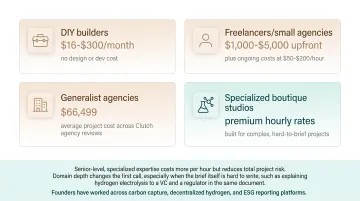
Senior-level, specialized expertise costs more per hour but reduces total project risk. That matters when the brief is hard to write, such as explaining hydrogen electrolysis to a VC and a regulator in the same document.
Domain depth changes the first call. What if Design's founders have worked across carbon capture (Susteon), decentralized hydrogen (HYDGEN), and ESG reporting platforms, experience most generalist agencies do not bring on day one.
2.6 Geography of the team
Where your team sits changes hourly rates significantly:
| Region | Hourly Rate |
|---|---|
| US, UK, Germany, Spain | $50-$100 |
| Netherlands, Italy | $100-$150 |
| Eastern Europe (Poland, Romania, Ukraine, etc.) | $50-$100 |
| India | $10-$15 |
These figures come from GoodFirms' 2026 provider survey. A remote-first team spanning both a high-cost and startup-scale market (for example, San Francisco and Bangalore) can offer senior strategic input at a blended rate below a pure-US agency shop.
3. Cost breakdown: where the website budget actually goes
Total cost of ownership includes far more than the invoice you sign at kickoff. Most of the build budget lands in design and engineering. Recurring costs look small line by line, then compound.
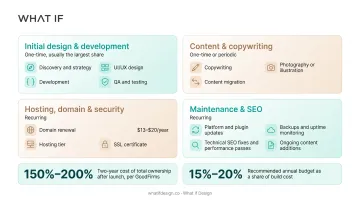
Initial design & development (one-time, usually the largest share):
- Discovery and strategy: scope, sitemap, and requirements that prevent rework later
- UI/UX design: layouts, components, and responsive states
- Development: front-end, CMS, and integrations
- QA and testing: browsers, devices, and launch checks
Content & copywriting (one-time or periodic):
- Copywriting: page narrative, CTAs, and messaging hierarchy
- Photography or illustration, original assets vs. licensed stock
- Content migration, moving and restructuring legacy pages
Hosting, domain & security (recurring):
- Domain renewal (roughly $13, $20/year)
- Hosting tier: traffic, uptime, and staging needs drive the bill
- SSL certificate, often bundled with hosting; confirm before you double-pay
Maintenance & SEO (recurring):
- Platform and plugin updates
- Backups and uptime monitoring
- Technical SEO fixes and performance passes
- Ongoing content additions
One-time build fees are only the start. GoodFirms estimates a professionally built site’s two-year cost often hits roughly 150%: roughly 200% of the initial invoice after hosting, maintenance, and content updates. Budget roughly 15%, roughly 20% of build cost per year so the site stays secure, fast, and current.
4. startup-scale vs high-cost websites, what's the difference?
The real split is fit-for-purpose versus a mismatch that costs you later.
Design & UX quality: Template constraints work fine for a presence site. Custom, conversion-focused design earns its cost when the site needs to persuade: a lead form, a demo request, an investor inquiry.
Technical performance & scalability: Speed isn't cosmetic. Deloitte's mobile analysis found that a 0.1-second speed improvement lifted retail conversion by 8.4% and travel conversion by 10.roughly 1%.
Google's research on 11 million landing pages found that moving from a 1-second to 10-second load time raised predicted bounce probability by roughly 123%. A cost-effective host or bloated template can tank your conversion rate.
Long-term value: A cost-effective site with weak SEO or clunky UX often costs more eventually, through a rebuild, lost leads, or both. A higher upfront investment in structure and performance tends to compound instead of decay.
5. How to estimate the right budget for your website
Match your budget to your business stage and the site's actual job, not to the lowest quote you received.
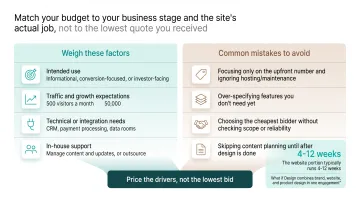
Weigh these factors:
- Intended use: informational, conversion-focused, or investor-facing
- Traffic and growth expectations: a site expecting 500 visitors a month has different needs than one expecting 50,000
- Technical or integration needs: CRM, payment processing, data rooms
- In-house support: can your team manage content and updates, or does that need to be outsourced too?
Common mistakes to avoid:
- Focusing only on the upfront number and ignoring hosting/maintenance
- Over-specifying features you don't need yet
- Choosing the cheapest bidder without checking scope or reliability
- Skipping content planning until after design is done
Those factors matter even more when the story is technical. Climate tech, deep tech, and other frontier-tech startups usually need a strategic design partner, not only a builder.
What if Design combines brand, website, and product design in one engagement. The website portion typically runs 4-12 weeks, so technical companies can show up credibly to investors and customers without juggling three separate vendors.
Website cost varies widely by type and scale because sites do different jobs. Price the drivers above instead of the lowest bid, and the budget is far more likely to hold.
A site that reflects the company you have actually become is the cheapest credibility you can buy, and it puts you back in control of the first impression. Get a free strategic audit.
6. Frequently asked questions
6.1 How much should a full website design cost?
Most businesses should expect $3,000-$50,000+ depending on customization, features, and platform. Enterprise or highly technical builds, especially investor-facing sites, often go higher.
6.2 Is web design still worth it in 2026?
Yes. AI tools have lowered costs for simple sites, but they've also raised visitor expectations. A well-designed site tied to clear goals (leads, credibility, fundraising) remains one of the highest-ROI investments a business can make.
6.3 How much does a website cost per month after launch?
Expect ongoing costs for hosting (often bundled into platform subscriptions), domain renewal (roughly $13-$20/year), maintenance, and technical SEO. Budget roughly 15%-roughly 20% of your initial build cost annually.
6.4 Is it cheaper to build a website yourself than hire a professional?
DIY is cheaper upfront, but it shifts time, SEO structure, and scalability risk onto you. That trade-off works for a personal site and rarely works for a business relying on the site for leads.
6.5 How much does it cost to build a website for a technical or funded startup?
These builds often run $50,000-$500,000+ due to complex storytelling, credibility requirements, and investor-facing design needs. That's often where a specialized studio justifies its rate over a generalist agency.
6.6 Why do website design quotes vary so much for similar-looking projects?
Quotes differ based on what's actually included: strategy, custom content, integrations, QA, and post-launch support, not just the visual output. Two similar-looking sites can have wildly different scopes behind them.
Related reading: Low-carbon web design and 8 critical usability issues in web design (and how to fix them).
Ready to take the next step?
If you're weighing a design partner for climate, deep tech, or hard-to-explain products, Book a strategy call with our founders at What if Design, a no-pressure 25-minute conversation about what you're building and where design can help. You can also View our work to see how we've helped teams like yours, or Get a free strategic Audit of your current brand, website, or product experience.