Many founders have been burned by open-ended timelines that turn into budget overruns and stalled launches. A designer says "a few weeks," and three months later you're still waiting on final files while your runway shrinks.
This guide breaks down realistic timelines, what actually happens at each stage, and the specific factors, including technical complexity, that stretch or compress a brand identity project.
TL;DR: key takeaways
- Standalone brand identity projects typically run 4-12 weeks, depending on scope and agency structure
- Full branding with strategy and a website extends to 3-6 months
- Stakeholder count and feedback speed shape timelines as much as the agency's process does
- Technical companies in climate tech or deep tech often need extra discovery time before design work starts
- Rushing brand identity work to hit a deadline usually produces generic results that undercut credibility
1. What's the average timeline for a brand identity project?
A dedicated brand identity project: logo, color palette, typography, and guidelines, generally takes 6-12 weeks. Benchmarks from agencies like Ramotion put a basic identity at 3-4 weeks and a comprehensive package at 6-12 weeks or more.
Here's the scope confusion that trips up most founders: "brand identity" and "branding process" get used interchangeably online, but they're not the same thing.
- Brand identity = logo, color, type, guidelines (the visual system)
- Branding process = strategy, positioning, messaging, identity, and often a website
That distinction is why timeline estimates online range from three weeks to eighteen months. They're often describing completely different scopes.
1.1 Breaking down timelines by project size
| Project Type | Typical Duration |
|---|---|
| Basic logo/visual refresh | 2-5 weeks |
| Comprehensive identity system | 6-12 weeks |
| Full branding + website | 3-6 months |
| Enterprise rebrand with global rollout | 6-18 months |
What if Design's standard package, Minimum Viable Brand, runs 4-6 weeks. It covers logo, visual identity, iconography, color palette, and a brand guidelines mini-book with a press kit. That sits on the faster end of the industry range, largely because a senior boutique team makes decisions directly instead of routing work through layers of account managers.
On fuller engagements, climate tech clients like Susteon and LabStart: who needed strategy, identity, and a full website, typically finished in about 4 months. That lines up with the 14-27 week range MetaBrand publishes for comprehensive brand development spanning discovery, strategy, verbal identity, visual identity, and activation.
These are planning bands, not guarantees. What actually determines your delivery date is covered next.
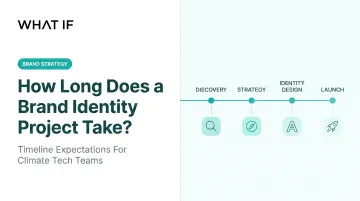
2. The brand identity process, step by step
Here's what actually happens between kickoff and final files delivered.
2.1 Discovery & strategic foundation (1-3 weeks)
This phase covers kickoff calls, business and audience research, and competitive audits that inform the creative brief. For most companies, one to two weeks is enough.
For technical or scientifically complex businesses, this phase often stretches longer. The brief itself is hard to write until the designer actually understands the underlying science. You can't position a carbon capture platform or a green hydrogen system the same way you'd position a consumer app.
2.2 Concept & visual exploration (2-4 weeks)
Designers move from strategy into visuals. Logo directions, color, typography, and imagery develop together rather than as isolated moodboards. HYDGEN's website redesign, for example, ran through multiple concept directions. The team refined them with client feedback before locking a final approach.
2.3 Refinement & feedback rounds (1-3 weeks)
Most agencies cap revisions at two to three rounds. A small, decisive feedback group of two to three people keeps this phase moving.
Splash Creative notes that two logo-revision rounds are typical, with five rounds usually signaling a problem upstream, like an unclear brief or too many decision-makers weighing in.
2.4 Guidelines & final delivery (1-2 weeks)
The final phase delivers:
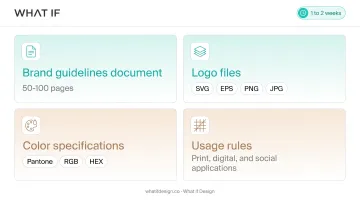
- A brand guidelines document (often 50-100 pages)
- Logo files in vector formats (SVG, EPS) and raster formats (PNG, JPG)
- Color specifications across Pantone, RGB, and HEX
- Usage rules for print, digital, and social applications
If your site hasn't kept pace with where the business actually is, we can show you what that's costing you. Get a free strategic audit.
3. Key factors that affect your timeline
Four variables move your delivery date more than anything the agency controls:
- Number of stakeholders. Every additional decision-maker adds a feedback loop. One clear approver keeps things moving; five approvers with conflicting opinions can double your timeline.
- Brief clarity. A vague starting point means the team spends time guessing instead of designing. A tight brief with clear business objectives shortens discovery significantly.
- Feedback speed. This is the single biggest cause of slippage. A two-day turnaround on review rounds keeps a project on schedule; a two-week turnaround stretches a six-week project into three months.
- Scope of deliverables. A logo-only request moves faster than a full system with packaging, collateral, and web assets layered in.
When these slip, the schedule gets compressed. Frontify's research on rebranding pitfalls notes that rushed schedules typically cut research and refinement first. The work that makes a brand stick.
4. Why technical & climate tech brands often need a different timeline
Founders in climate tech, deep tech, and other frontier categories usually sell something that's hard to explain in plain language. Positioning and messaging take longer than for a typical consumer brand because the technology has to be understood before it can be simplified without becoming inaccurate.
At What if Design, this shapes how projects with US Department of Energy and ARPA-E backed founders are structured. Co-founder and lead design strategist Akhila Kosaraju has worked across carbon capture, grid interconnection, and green hydrogen with teams that have collectively raised over $105M.
That work only happens once the designer has learned the science and the market well enough to translate it visually.
Skip that step and a generic identity built on a shallow brief fails with the audiences technical founders need most:
- Investors evaluating technical risk
- Scientific partners assessing rigor
- Enterprise buyers who need clarity, not jargon
If you're building something technical, budget extra time upfront. One to two additional weeks to turn complex technology into a clear creative brief, before design begins, prevents rework and saves far more time later.
5. How to keep your brand identity project on track
You control more of the timeline than you might think. Four habits make the biggest difference:
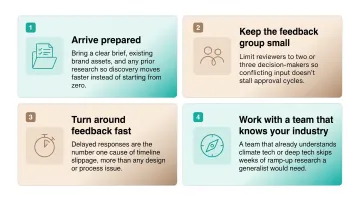
- Arrive prepared. Bring a clear brief, existing brand assets, and any prior research so discovery moves faster instead of starting from zero.
- Keep the feedback group small. Limit reviewers to two or three decision-makers so conflicting input doesn’t stall approval cycles.
- Turn around feedback fast. Delayed responses are the number one cause of timeline slippage, more than any design or process issue.
- Work with a team that knows your industry. A team that already understands climate tech or deep tech skips weeks of ramp-up research a generalist would need.
A site that reflects the company you have actually become is the cheapest credibility you can buy, and it puts you back in control of the first impression. Get a free strategic audit.
6. Frequently asked questions
6.1 How long should a branding project take?
A standalone brand identity project runs 4-12 weeks depending on scope and agency. A full branding process with strategy and a website typically takes 3-6 months or longer.
6.2 What are the steps involved in the brand identity design process?
The process covers four phases: discovery and strategy, concept and visual exploration, refinement rounds, and guidelines and final delivery. Each phase builds on the last, so skipping one usually causes rework later.
6.3 What are the 5 p's of brand identity?
There's no single verified "5 P's" framework used across the industry. The American Marketing Association instead defines brand identity through five concrete elements: name, logo, color scheme, typography, and design elements.
6.4 How long does a logo design alone take?
A logo-only project can take as little as 2-4 weeks, faster than a full identity system since it skips broader strategy and guidelines work. With quick feedback turnaround, many logo projects wrap in about four weeks.
6.5 Can a brand identity project be rushed for a funding round or launch deadline?
Timelines can be compressed with a tight brief and fast feedback turnaround. However, skipping discovery entirely to save time risks a weaker, less strategic identity that doesn't hold up under investor or partner scrutiny.
6.6 What's the difference between a brand identity project and a full rebrand?
Brand identity covers the visual system: logo, color, typography, and guidelines. A full rebrand also includes strategy, messaging, positioning, and typically a website, so it takes longer.
Related reading: Brand guidelines vs brand identity and ESG storytelling.
Ready to take the next step?
If you're weighing a design partner for climate, deep tech, or hard-to-explain products, Book a strategy call with our founders at What if Design, a no-pressure 25-minute conversation about what you're building and where design can help. You can also View our work to see how we've helped teams like yours, or Get a free strategic Audit of your current brand, website, or product experience.