This gets harder for climate tech and deep tech founders. You're not just asking investors to fund a product, you're asking them to trust science most of them didn't study. Carbon capture, green hydrogen, grid interconnection. These are hard stories to tell in a 10-slide deck, and a bad visual translation can cost you a meeting you'll never get back.
Design costs for seed-stage startups run the full spectrum: free DIY templates on one end, five-figure agency engagements on the other. This article breaks down the pricing tiers, the factors that move the price, and how to build a budget that fits your stage without overspending or underspending before a raise.
TL;DR: key takeaways
- DIY tools: ~$10, $160/month; freelance logos: $500, $750; agency brand/UX: $10,000, $49,999.
- Technical complexity, not deliverable count, is what pushes seed-stage design costs up.
- Pre-funding founders should lean on templates; founders raising a priced round need investor-grade polish.
- Bundled brand + deck + website + product work protects consistency and usually costs less than separate hires.
- Scale design spend to investor- and customer-facing touchpoints, not a fixed percent of your round.
1. How much does design cost for a seed-stage startup? (pricing overview)
Design has no fixed price tag. What you pay depends on the deliverable, the scope, and, for technical startups, how much translation work is needed before a designer can even start.
Three things go wrong most often when founders misjudge this:
- Underbudgeting design entirely, treating it as a nice-to-have instead of part of the fundraising toolkit
- Hiring the cheapest freelancer for an investor-facing deck, then discovering they can't structure a technical narrative
- Ignoring that a website or product needs design support after the raise, not just before it
The three main tiers break down like this:
| Tier | Logo/Brand | Pitch Deck | Website | Product/UX |
|---|---|---|---|---|
| DIY/Template | Free, $10/mo (Canva) | Free, $50 (templates) | $16, $159/mo (builders) | Rarely realistic DIY |
| Freelancer | ~$500, $750 | $1,200, $6,000 | Varies widely by scope | Hourly, project-based |
| Agency | Often $10,000, $50,000+ (Clutch avg. $71,651) | Bundled into full-service scope | ~$7,139/mo average agency cost | Often $10,000, $50,000+ (Clutch avg. $84,973) |
These figures, drawn from Clutch's 2025 agency pricing data, cover the design labor itself. They generally exclude source files, ongoing updates, and stock licensing unless you negotiate those in upfront.
1.1 Price range 1: DIY / template tools
Logo generators, Canva-style deck templates, and no-code website builders fall here. You're paying for software access, not strategy or custom design.
Best for: Pre-seed founders testing an idea before any funding has landed in the bank. If you're still validating whether the business exists, this is the right tier.
1.2 Price range 2: freelance / solo designer
This tier covers a custom logo, a basic brand guide, one-off pitch deck polish, or a simple website build. A freelance logo alone typically runs 10-15 hours at $25-$75/hour.
Best for: Founders on a tight budget who need a professional look for early investor conversations, but only need one deliverable done well.
1.3 Price range 3: full-service boutique / specialist agency
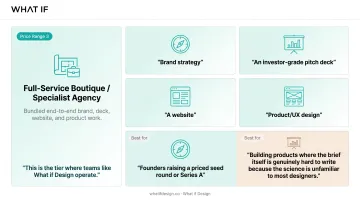
This is end-to-end work: brand strategy, an investor-grade pitch deck, a website, and product/UX design, bundled so everything looks and feels consistent. This is the tier where we operate. They specialize in translating deeply technical products (carbon capture, hydrogen, grid tech) into a visual narrative non-technical investors can follow.
Best for: Founders raising a priced seed round or Series A, or building products where the brief itself is genuinely hard to write because the science is unfamiliar to most designers.
2. Key factors that affect the cost of design
Cost is driven by what you're designing, how complex your story is, and who you hire to do it. Here's what moves the number.
2.1 Type of design deliverable
Brand identity, pitch decks, websites, and product/UX work each carry different price points, timelines, and required skill sets. A logo and a full UX research sprint are not comparable line items, even though founders often budget for them the same way.
2.2 Scope and number of deliverables
Bundling brand, deck, and website together protects visual consistency and often costs less in total than buying each piece from a different freelancer. Piecemeal purchasing tends to produce mismatched fonts, colors, and tone across touchpoints.
2.3 Technical and scientific complexity of the product
This is the factor most founders underestimate. When a product is genuinely unfamiliar (deep tech or hard science), investors can be skeptical simply because they don't understand the idea. TechCrunch's reporting on deep tech fundraising recommends sequential visuals, component breakdowns, and sometimes a separate product explainer beyond the deck itself.
💡 Working through this decision right now? If you're a climate-tech or deep-tech founder weighing this trade-off, Book a strategy call with our team, 25 minutes, no pitch, and we'll pressure-test your specific situation.
See how we have approached this in practice: Mobile UX design.
Designers who need to learn the science before they can simplify it visually will cost more. That premium pays for the real labor of translation, not an arbitrary markup.
2.4 Level of customization vs templates
Fully custom illustration, data visualization, and iconography cost meaningfully more than a reskinned template. If your product has moving parts that are hard to picture (a reactor, a molecule, a grid), custom visuals usually pay for themselves in investor comprehension.
2.5 Talent tier: freelancer vs studio vs full-service agency
Senior strategists and specialized agencies charge more per project, but they can replace the need for a costly in-house design hire entirely. What if Design's model, for instance, runs roughly 3× cheaper than hiring senior in-house designers, while still functioning as a full design team.
2.6 Timeline and urgency
Rush timelines ahead of a demo day or term sheet deadline carry a pricing premium almost everywhere in the industry. Some studios can turn around iterations in 48-hour loops, but expect to pay for that speed.
2.7 Budget vs premium design: what really changes
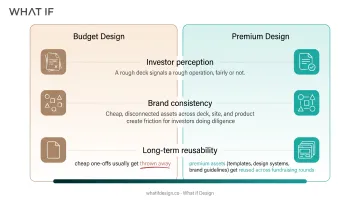
The differences aren't just cosmetic:
- Investor perception: a rough deck signals a rough operation, fairly or not
- Brand consistency: cost-effective, disconnected assets across deck, site, and product create friction for investors doing diligence
- Long-term reusability: premium assets (templates, design systems, brand guidelines) get reused across fundraising rounds; cost-effective one-offs usually get thrown away
Case study: HYDGEN
HYDGEN needed a brand and website that could carry the weight of green-hydrogen infrastructure, technical enough for engineers, clear enough for policy-makers, credible enough for institutional investors. We built the brand system and website in a compressed sprint aligned to their fundraising milestone. See the full HYDGEN case study.
3. Cost breakdown of a seed-stage design budget
Total design spend rarely stops at a logo fee. It spans four categories across fundraising and building, each with a different payment rhythm:
| Category | Payment rhythm | When it matters |
|---|---|---|
| Brand identity | One-time | Logo, guidelines, and color system. Deck, site, and product all inherit it. |
| Pitch deck design | One-time, updated each round | Often the highest-leverage spend for the cost: a strong deck helps win the next meeting. |
| Website design and build | One-time build + ongoing maintenance | Needed once outbound outreach and investor diligence start, not before. |
| Product/UX design | Recurring | Tied to sprints, investor demos, and a story that keeps changing after a raise. |
Some agencies sell product/UX as a monthly retainer instead of a fixed project. What if Design’s Design Supercharger, for example, runs $6,999/month (or $4,999/month billed quarterly) with a flexible backlog rather than a locked scope.
4. How to estimate the right design budget for your startup
There's no flat percentage rule here. The right budget fits your fundraising stage and how hard your story is to explain, not a formula copied from another startup's blog post.
Weigh these four factors:
- Stage of fundraising: Pre-seed investors expect a clear, skimmable deck with proof, not polish. Seed and Series A investors expect more visual and product maturity.
- Technical difficulty of the product: The harder your science is to explain, the more strategic design translation you need, and the more that work is worth.
- Timeline to the next raise or demo day: Rush jobs cost more. Building in lead time saves money.
- In-house capacity vs. partner model: Founders with no design skills need a senior partner, not full-time hire overhead. What if Design uses this model with climate and deep tech teams that can't spend six months staffing in-house.
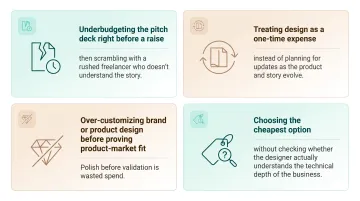
4.1 Common budgeting mistakes seed-stage founders make
- Underbudgeting the pitch deck right before a raise, then scrambling with a rushed freelancer who doesn't understand the story
- Treating design as a one-time expense instead of planning for updates as the product and story evolve
- Over-customizing brand or product design before proving product-market fit. Polish before validation is wasted spend
- Choosing the cheapest option without checking whether the designer actually understands the technical depth of the business
5. Conclusion
Design costs for seed-stage startups vary widely by deliverable, complexity, and talent tier. A logo generator and a full-service agency engagement solve very different problems, and neither is automatically the wrong choice.
Understanding the cost breakdown and what actually drives price gives you a defensible number to bring to your own budget planning, rather than a guess. The right design budget balances investor credibility, a realistic timeline, and assets you can reuse as the company scales, not just assets that get you through the next pitch.
Clarity here is what turns a defensive conversation into a confident one. Get a free strategic audit.
6. Frequently asked questions
6.1 What is seed stage funding?
Seed funding is typically the first major institutional capital a startup raises after pre-seed, used to validate product-market fit and build a repeatable growth model. It's the bridge between an early idea and Series A-level traction.
6.2 What is a good amount for seed funding?
US seed rounds had a median of $2.5 million in 2024, according to Carta's seed funding data. The right amount depends on the runway you need to hit Series A milestones.
6.3 How much should a seed-stage startup budget for design?
Budget by tier:
- DIY tools: $10, $160/month
- Freelance: a few hundred to a few thousand per deliverable
- Full-service agency: typically $10,000, $49,999
Deliverable count and technical complexity shift the total significantly.
6.4 What percentage of seed funding should go toward design and branding?
No authoritative source sets a standard percentage. Design spend should scale with how investor-facing and customer-facing your touchpoints are, not with an arbitrary share of the round.
6.5 Should a seed-stage startup hire a freelancer or a design agency?
Freelancers work well for a single, budget-conscious deliverable like a logo. Agencies make more sense for bundled, investor-grade work that needs technical storytelling across brand, deck, and product together.
6.6 When does it make sense to invest in a full-service design partner instead of DIY tools?
Invest once you're raising a priced round or shipping a technically complex product that needs specialist translation into visuals. DIY tools work fine pre-funding, but they rarely carry a hard-to-explain science story on their own.
Ready to take the next step?
If you're weighing a design partner for climate, deep tech, or hard-to-explain products, Book a strategy call with our founders at What if Design, a no-pressure 25-minute conversation about what you're building and where design can help. You can also View our work to see how we've helped teams like yours, or Get a free strategic Audit of your current brand, website, or product experience.