That gap gets expensive for climate tech and deep tech companies specifically. When Susteon needed to explain its carbon capture and utilization technology, the science wasn't the barrier, its website was. Investors and partners couldn't parse what the company actually did, because nothing had translated the technology into something a non-technical audience could understand. That's a design failure, not a marketing footnote.
This article covers what percentage of your marketing budget should realistically go to design, what counts as "design spend," how that number shifts by company stage, and how to build a budget your board will actually approve.
TL;DR: key takeaways
- Creative/brand design is usually the smallest explicit budget line, yet it heavily shapes brand and conversion results
- Real design footprint exceeds the headline percentage; it sits inside content, ads, and product work too
- Climate and deep tech often need a higher relative design allocation to make complex science fundable
- A senior fractional design partner often beats full in-house cost for the same senior-level output
- Frameworks like 70/20/10 omit a design bucket because design is a horizontal cost across every channel
1. What percentage of your marketing budget should go to design?
There's no clean industry number for this. No Gartner, Deloitte, or HubSpot report publishes a line item labeled "design as % of marketing budget."
The closest public proxy comes from the Fall 2024 CMO Survey, which found long-term brand-building claims 31.2% of marketing budgets, even though CMOs say the ideal split should be closer to 50/50 with short-term performance spend. That's a strategy allocation, not a design labor line, but it's a useful anchor.
Here's the part that matters more: design's actual footprint is larger than whatever percentage you write down.
Every paid ad needs creative. Every case study needs layout. Every sales deck needs design polish. So even if "creative and branding" shows up as a modest single-digit line, the real design touch running through your budget is higher once you count everything it silently supports.
1.1 How this shifts by stage
- Pre-seed/seed: You're building brand, website, and product from nothing. Design should claim a disproportionately higher share while everything else is still small.
- Growth stage: Systems exist. Budget shifts toward paid acquisition and content volume, while design work becomes more maintenance and iteration than ground-up creation.
- Later stage: Design spend settles as a smaller share of a larger budget, focused on system consistency, conversion lifts, and campaign velocity.
To make this tangible: a pre-seed climate tech founder running a $10,000/month marketing budget might reasonably allocate around $4,000/month to design. That covers a smaller retainer for landing pages, pitch decks, and core collateral.
A growth-stage company running a $50,000/month budget might put about $7,000/month into a more comprehensive design retainer covering UX, brand strategy, and website work. The percentage drops as the company scales, even though the dollar figure grows.

1.2 Why climate and deep tech need to over-invest early
Translating carbon capture chemistry, green hydrogen electrolysis, or grid interconnection into something an investor or enterprise buyer immediately understands takes more design iteration than a typical consumer app redesign.
BCG found deep-tech ventures take 25 to 40% longer between funding stages from seed through Series D, partly because evaluators need more time and context to understand the technology itself. Good design compresses that comprehension gap. Bad design widens it.
Stop treating your first brand or website project as a sunk cost you pay once. Design should function like a retainer, not a one-time invoice. The companies that keep iterating on how they explain their technology are the ones that keep closing rounds faster.
2. What's actually included in "design spend"? A full breakdown
"Design spend" isn't one thing. It's a bundle of distinct sub-categories, and lumping them together is how budgets get mismanaged.
Core sub-categories:
- Brand/visual identity: logo, color system, typography, messaging hierarchy
- Website design: site architecture, wireframes, conversion copy, build (typically Webflow for early-stage teams)
- Product/UX design: interface design, prototyping, usability testing
- Marketing collateral: decks, one-pagers, sales enablement material
- Campaign creative: ad graphics, social assets, seasonal refreshes
- Tools and licensing: Figma, prototyping software, stock assets, font licenses
For B2B and technical companies, pitch decks and fundraising materials punch above their cost. In 2021, What if Design built a pitch deck for an Accel portfolio company that spread far beyond its intended audience and became a reference point for strong technical decks. One well-designed deck can generate visibility that outlasts the raise it supported.
💡 Working through this decision right now? If you're a climate-tech or deep-tech founder weighing this trade-off, Book a strategy call with our team, 25 minutes, no pitch, and we'll pressure-test your specific situation.
Tools and licenses are usually a small slice of total spend, but track them separately from labor or agency fees. They're easy to lose inside a lump-sum "design" line.
2.1 One-time costs vs. ongoing retainers
| Cost type | Examples | Typical timeline |
|---|---|---|
| One-time | Brand launch, first website build | 4 to 12 weeks |
| Ongoing | Product UX iteration, campaign refreshes | Monthly retainer |
Budget for both inside the same annual design allocation. Weight shifts with stage:
- Pre-launch startups: heavier on brand and website; those assets don't exist yet
- Scaling product companies: heavier on product UX; retention and adoption matter more than first impressions
See how we have approached this in practice: Mobile UX design.
3. Design budget benchmarks by company stage and type
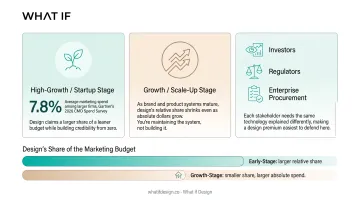
High-growth/startup stage: Total marketing budgets already run high relative to revenue at this point. Gartner's 2026 CMO Spend Survey shows overall marketing spend around 7.roughly 8% of company revenue among larger firms.
Early-stage companies typically run leaner but more design-heavy budgets, since they're building credibility from zero. Design should claim a proportionally larger slice of that early spend than it will later.
Growth/scale-up stage: As brand and product systems mature, design's relative share of the marketing budget typically shrinks even as absolute dollars grow. You're no longer building the system. You're maintaining and extending it.
Climate tech, deep tech, and hard-to-explain technical products: These companies face a wider set of stakeholders than a typical B2C product: investors, regulators, and enterprise procurement teams, each needing the same technology explained differently. That complexity is where a design premium over consumer peers is easiest to defend.
Specialized partners matter here. We work specifically on translating carbon capture, hydrogen, and grid technology into brands and websites that hold up under investor and regulatory scrutiny, not just consumer attention.
4. Where design fits into popular marketing budget frameworks
4.1 What is the 70/20/10 rule, and where does design fit?
The 70/20/10 rule allocates spend across roughly 70% proven channels, roughly 20% emerging channels, and roughly 10% experimental bets. It's a risk-allocation model for channels, not for design.
Design sits outside those buckets as a horizontal capability. It produces the creative assets every channel tier still needs: ad creative for proven paid, landing pages for experimental bets, and everything in between.
4.2 Funnel-stage budgeting and design's role
Design work shows up differently at each funnel stage:
- Awareness: brand assets, social creative, ad visuals
- Consideration: nurture content design, case study layout, webinar decks
- Decision: conversion-focused landing pages, product demos, pricing pages
Rather than forcing design into one bucket of any single framework, treat it as a fixed percentage of total budget that supports every stage and channel at once. That matches how design gets used far better than a single spreadsheet row.
5. How to build and justify a design budget that gets approved
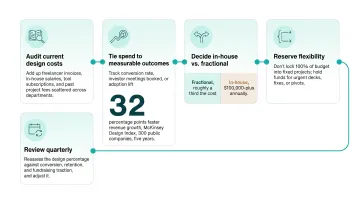
Step 1: Audit current design costs. Add up freelancer invoices, in-house salaries, tool subscriptions, and past project fees. Most teams underestimate this number because it's scattered across departments.
Step 2: Tie spend to measurable outcomes. Website conversion rate, investor meetings booked off a pitch deck, or product adoption lift from a UX overhaul all work. McKinsey's Design Index tracked 300 public companies over five years and found top-quartile design performers grew revenue 32 percentage points faster than industry peers. Cite that correlation when you need finance to approve the line item.
Step 3: Decide in-house vs. fractional. A full-time senior designer typically costs upwards of $100,000 annually before benefits, tools, and management overhead. Fractional partners can run at roughly a third of that effective cost while still delivering senior-level strategy.
For climate and deep tech teams, weigh domain fluency as much as rate. When the brief itself is hard to write, a partner who already works in technical categories ramps faster than a generalist hire learning the science from scratch.
Step 4: Reserve flexibility. Don't lock roughly 100% of the budget into fixed projects. Set aside a portion for urgent fundraising decks, fast website fixes, or campaign pivots that can't wait for the next planning cycle.
Step 5: Review quarterly. Reassess the design percentage against actual results the same way you'd review any other channel. If it's not producing conversion, retention, or fundraising traction, adjust it.
Get this right and you get alignment: your team, your investors and your buyers all read the same story the same way. Get a free strategic audit.
6. Frequently asked questions
6.1 What is the 70/20/10 rule for marketing budget?
It allocates roughly 70% of budget to proven tactics, roughly 20% to newer or emerging tactics, and roughly 10% to experimental bets. It's a channel-risk framework, not a design-specific rule.
6.2 What are the 7 parts of a marketing plan?
A typical plan covers situation analysis, goals, target audience, strategy, budget, tactics/channels, and measurement. Design decisions touch nearly every one of these parts, especially tactics and budget.
6.3 What percentage of a marketing budget should specifically go to design?
There's no single industry-verified number, but standalone creative/design lines typically run single-digit to low double-digit percentages. The effective share is higher once embedded design work across ads and content is counted.
6.4 Should design be budgeted as a fixed cost or an ongoing percentage?
An ongoing percentage, retainer-style, tends to work better than a one-off project fee. It gives you predictable capacity instead of treating design as a project you finish once and never revisit.
6.5 Do climate tech and deep tech companies need to spend more on design than other industries?
Often, yes. Technical complexity and a wider mix of stakeholders: investors, regulators, enterprise buyers, usually justify a higher relative design allocation to make the technology understandable.
6.6 Is it cheaper to hire an in-house designer or work with a design agency/partner?
A full-time senior designer often costs over $100,000 annually before benefits and overhead. A fractional partner can deliver similar seniority at a fraction of that effective cost, which is why many lean, early-stage teams choose it.
Ready to take the next step?
If you're weighing a design partner for climate, deep tech, or hard-to-explain products, Book a strategy call with our founders at What if Design, a no-pressure 25-minute conversation about what you're building and where design can help. You can also View our work to see how we've helped teams like yours, or Get a free strategic Audit of your current brand, website, or product experience.