Where What if Design fits in We're a senior-led creative studio built specifically for climate tech, clean tech, and deep tech founders. Since 2020, we've partnered with teams like HYDGEN, Ribbit Network, and Susteon to turn hard-to-explain technology into brands, websites, and product experiences that raise capital and win adoption. This comparison reflects how we evaluate the trade-offs when a founder asks us which route to take.
Every growing company eventually hits the same wall: the brand no longer matches the business. This hits climate tech and deep tech startups especially hard. A pivot, new funding round, or positioning shift can make yesterday's brand feel obsolete overnight, and leave a technical story that no longer lands with investors or partners.
The question that follows is rarely simple. Do you hire a specialized rebrand agency, or build the capability in-house?
This decision shapes more than your budget. It affects how fast you can move, and for companies raising capital, it shapes the first impression investors and partners get of your business.
Rebranding also carries real risk. It can disrupt the familiarity customers and stakeholders have with your current identity, so the resourcing call matters as much as the creative one.
This article breaks down the trade-offs between agencies and internal teams so you can match the model to your stage, budget, and timeline.
TL;DR: key takeaways
- Choose an agency for outside expertise, speed, and objectivity; keep work internal for culture fit and product depth
- You trade fresh perspective and senior skill for daily availability and lower ongoing cost, or the reverse
- High-stakes, time-boxed rebrands favor agencies; ongoing brand maintenance favors internal teams
- Budget structure, deadline pressure, and whether a fundraise is on the calendar should drive your choice
1. Rebrand agency vs internal team: quick comparison
Here's how agencies and internal teams compare on cost, speed, expertise, and culture fit.
| Dimension | Rebrand Agency | Internal Team |
|---|---|---|
| Cost | Project or retainer-based, no payroll overhead | Fixed salary and benefits, cheaper for ongoing production |
| Speed | Dedicated focus, moves fast on large strategic work | Often competes with day-to-day business priorities |
| Expertise | Cross-industry patterns, senior specialists, fresh eyes | Deep product knowledge, but prone to internal tunnel vision |
| Culture fit | Needs onboarding time to learn voice and mission | Instant cultural connection and stakeholder history |
Cost and speed usually drive the final call, so those two get a closer look below.
1.1 Cost: what you're actually paying for
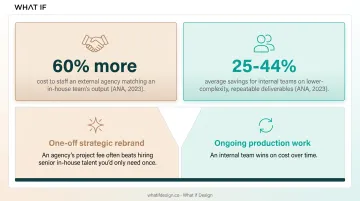
The math isn't as simple as "agencies cost more." According to ANA research on in-house agency value, staffing an external agency to match an internal team's output costs 60% more on average.
Internal teams save 25-44% on lower-complexity, repeatable deliverables (ANA, 2023).
Translation: for one-off strategic rebrands, an agency's project fee often beats hiring senior in-house talent you'd only need once. For ongoing production work, an internal team wins on cost over time.
1.2 Speed: dedicated focus vs. competing priorities
Internal teams deliver the same assets roughly 25% faster on average than external agencies, per the same ANA research. But that stat assumes the internal team isn't also managing five other launches that week.
A rebrand tied to a funding deadline rarely has that luxury. Agencies put a senior team on one project, so they often move faster on time-boxed, high-stakes work despite the average speed gap.
2. What is a rebrand agency?
A rebrand agency is an outside team hired to reshape a company's identity, positioning, and market-facing story. For most brands, this means updating a logo and messaging.
For climate tech and deep tech companies, it means something harder: translating carbon capture chemistry, grid interconnection software, or green hydrogen production into language a non-technical investor or partner can actually understand. The brief itself is often the hardest part to write.
Core benefits of hiring an agency:
- Senior-level strategic thinking without the cost of a full-time hire
- Faster execution on time-boxed, high-stakes strategic work
- Pattern recognition from working across multiple technical sectors
- The ability to turn deep science into a clear, credible market story
2.1 Types of rebrand agencies
Not all agencies work the same way:
- Full-service agencies handle brand, website, and product design together
- Boutique sector specialists focus on one industry, such as climate or deep tech
- Freelance collectives assemble contractors project by project
What if Design falls into the specialist category, working exclusively with climate tech, sustainability, and deep tech companies. Its model combines brand strategy, website design, and product UX under one senior team rather than handing a project between departments. That structure cuts the onboarding time a generalist agency needs to learn technical subject matter.
2.2 Where rebrand agencies fit best
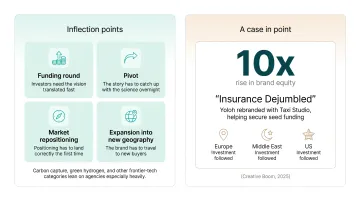
Agencies earn their fee at inflection points: a funding round, a pivot, a market repositioning, or an expansion into a new geography. These are moments where the brand has to work hard, fast, and correctly the first time.
Carbon capture, green hydrogen, and other frontier-tech categories lean on agencies especially heavily. Founders in these spaces are often brilliant scientists and engineers who need help translating their work for people who aren't.
The stakes show up clearly in the numbers. When UK insurtech platform Yoloh rebranded with Taxi Studio around the positioning "Insurance Dejumbled," the new identity was credited with fueling a tenfold rise in brand equity and helping secure seed funding (Creative Boom, 2025).
💡 Working through this decision right now? If you're a climate-tech or deep-tech founder weighing this trade-off, Book a strategy call with our team, 25 minutes, no pitch, and we'll pressure-test your specific situation.
Investment followed from Europe, the Middle East, and the US. The report doesn't disclose exact funding figures or measurement methodology, but it shows brand work and capital raising often move together.
See how we have approached this in practice: 10 Best SaaS UX Design agencies for product growth in 2026.
How we evaluated the options
Every recommendation here comes from actual client work, brand systems shipped, websites launched, and product experiences delivered under fundraising deadlines. We compared the options against five criteria that matter most for technical founders:
- Total cost of ownership across the first 12 months (not just the sticker price)
- Speed to a usable output given a typical Series A runway
- Quality of the technical translation, can they explain your science without oversimplifying it?
- Rework risk, how often teams re-hire because the first choice couldn't scale
- Ability to move with the roadmap without a re-onboarding tax every quarter
Where we cite numbers or trade-offs below, they come from projects we've delivered or watched founders navigate first-hand.
3. What is an internal team?
An internal, or in-house, team handles brand and marketing work as employees rather than outside contractors. This ranges from a single in-house designer to a full creative department embedded inside marketing or product.
Core benefits of an internal team:
- Constant availability for day-to-day requests
- Deep, built-in knowledge of product, culture, and stakeholders
- Long-term cost efficiency for repetitive, high-volume production
Internal teams are now standard at scale. Among ANA-member companies surveyed in 2023, 82% reported operating a formal in-house agency, up from 78% in 2018 and just 42% in 2008 (ANA, 2023). That growth reflects how much routine creative and marketing production larger organizations now handle themselves.
3.1 Where internal teams shine
Internal teams are built for the work that never stops: campaign execution, brand consistency across channels, and cross-department collaboration that requires someone always in the room. This model dominates at larger organizations with predictable, high-volume marketing needs.
Most companies with in-house teams still use outside agencies too. The same ANA survey found roughly 92% of respondents with an in-house agency also worked with external partners, typically to cover capacity gaps or specialized skills the internal team doesn't have. Few companies run a purely one-or-the-other model.
4. Rebrand agency vs internal team: which is right for you?
Four factors should drive this decision:
- Budget structure - Do you have capital for a one-time project, or ongoing headcount budget?
- Timeline urgency - Is there a hard deadline, such as a funding close or partnership signing?
- Brief complexity - How difficult is it to explain what your company actually does?
- Business milestone - Is this rebrand tied to a raise, pivot, or market entry?
Choose an agency when you need outside expertise, speed, and objectivity for a high-stakes, time-boxed rebrand.
Lean on an internal team when the work is ongoing, predictable, and already culturally embedded.
Many companies land somewhere in between: internal team for daily consistency, agency for the big strategic moments.
4.1 Real-world example: translating deep tech for investors
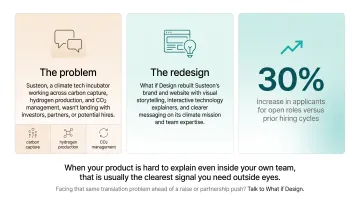
Susteon, a climate tech incubator working across carbon capture, hydrogen production, and CO2 management, faced a common deep tech problem. Its technology portfolio and mission weren't landing with the people who mattered most: investors, partners, and potential hires.
The real challenge was translating highly technical, multi-track innovation for non-specialists without oversimplifying or losing credibility.
What if Design rebuilt Susteon's brand and website with visual storytelling, interactive technology explainers, and clearer messaging on its climate mission and team expertise.
The result: a 30% increase in applicants for open roles versus prior hiring cycles. Clearer communication expanded who could understand, and want to join, the company.
When your product is hard to explain even inside your own team, that is usually the clearest signal you need outside eyes. Facing that same translation problem ahead of a raise or partnership push? Talk to What if Design.
Which option is right for your stage
The right answer depends less on the two options themselves and more on where you are as a company.
Pre-seed / seed (0–$3M raised): Speed and story matter more than polish. A focused boutique-agency sprint usually beats an in-house hire, because the founder still needs to control the narrative. We've seen this pattern with early climate-tech teams, a 4-to-6-week engagement to get brand, website, and pitch coherent is more valuable than a full-time designer.
Series A ($5–20M raised): This is where a senior-led agency partner pays for itself. You need a brand system that will survive three product pivots, a website that converts enterprise buyers, and pitch materials that hold up in board meetings. In-house is still premature unless you're planning to ship design-heavy product weekly.
Series B and beyond ($20M+ raised): Hire in-house design leadership and keep an agency partner for concentrated bursts (rebrands, launches, category shifts). The two aren't substitutes at this stage, they solve different problems.
Growth-stage climate tech specifically: The stakes shift once you're commercializing. Your brand needs to hold up to procurement diligence, regulatory scrutiny, and investor updates simultaneously. A specialist studio that already speaks the science, like our team, reduces the translation tax that generalists impose on every deliverable.
5. Conclusion
Neither model wins by default. Choose based on three factors:
- Your company's stage
- How complex your brand story is to tell
- Whether this rebrand is a one-time push or an ongoing operational need
What matters is tying that choice to real outcomes: faster fundraising, lower long-term costs, or stronger day-to-day brand consistency. Get the framing right before you get the design right, and the resourcing question answers itself.
When the story is clear, the next conversation starts from confidence rather than explanation. Get a free strategic audit.
6. Frequently asked questions
6.1 What is an in-house agency?
An in-house agency is a dedicated internal creative team that works exclusively on one company's brand, sitting inside the marketing, design, or product org rather than serving outside clients.
6.2 What are the different types of rebranding?
Partial rebrands refresh visuals like color and logo; full rebrands overhaul name, identity, and positioning; and merger or pivot-driven rebrands respond to structural change. Scope usually determines whether an agency or internal team fits better.
6.3 How much does hiring a rebrand agency cost compared to building an internal team?
Agencies are typically project- or retainer-based with no payroll overhead, while internal teams carry fixed salary and benefits costs. Internal hires pay off mainly when the workload is ongoing and high-volume.
6.4 How long does a rebrand usually take with an agency versus an internal team?
Agencies often finish faster thanks to dedicated bandwidth: 4-6 weeks for a focused identity project, 3-4 months for a full brand-and-website rebuild. Internal teams usually take longer when rebrand work competes with day-to-day priorities.
6.5 Can a small startup afford a specialized rebrand agency?
Yes. Boutique agencies scoped to a niche, like climate or deep tech, often price for early-stage budgets and can cost roughly a third of hiring a senior in-house designer outright.
6.6 Is a hybrid model of agency plus internal team a good option?
Yes. Many companies use an internal team for day-to-day brand consistency and bring in an agency for major strategic rebrands, fundraising-related repositioning, or specialized technical translation work.
Ready to take the next step?
If you're weighing a design partner for climate, deep tech, or hard-to-explain products, Book a strategy call with our founders at What if Design, a no-pressure 25-minute conversation about what you're building and where design can help. You can also View our work to see how we've helped teams like yours, or Get a free strategic Audit of your current brand, website, or product experience.