Where What if Design fits in We're a senior-led creative studio built specifically for climate tech, clean tech, and deep tech founders. Since 2020, we've partnered with teams like HYDGEN, Ribbit Network, and Susteon to turn hard-to-explain technology into brands, websites, and product experiences that raise capital and win adoption. This comparison reflects how we evaluate the trade-offs when a founder asks us which route to take.
For a growth-stage B2B or climate tech company, the website isn't marketing decoration. It's often the single biggest sales, fundraising, and recruiting asset the company owns.
Investors check it before a first call. Enterprise buyers vet it before a demo. Candidates read it before accepting an offer.
So who builds and maintains that site on Webflow becomes a real operational decision, not an afterthought. Get it wrong, and you either burn cash on the wrong hire or watch your site stall right when a funding round or product launch needs it most.
This comparison affects three things directly: cost, speed to launch, and whether your site can keep pace with fundraising milestones. Below, we break down real cost ranges, expertise trade-offs, control versus flexibility, and a simple framework for deciding which path fits your stage.
TL;DR: key takeaways
- Agencies deliver an on-demand multidisciplinary team (design, dev, SEO/CRO, PM) with zero hiring risk.
- In-house developers offer full-time control, same-day turnaround, and deep product context.
- Speed-to-launch and project-shaped work usually favor agencies; in-house wins once demand is continuous and high-volume.
- The most overlooked risk is continuity. One in-house hire creates a "bus factor of one."
- Many scaling companies land on a hybrid model: a lean internal owner plus a specialist agency retainer for bigger initiatives.
1. Webflow agency vs. in-house developer: quick comparison
1.1 Cost
Agency pricing runs two ways: project-based or retainer.
According to a 2026 pricing analysis by Amply, which compiled published rates from 12 agencies, one-off Webflow projects typically run $5,000 to $25,000, or $100 to $200 per hour, depending on scope and seniority. Ongoing retainers start around $3,000 per month.
In-house costs stack up differently. Glassdoor's 2026 salary data puts the average base pay for a US Webflow Developer at $143,037 a year, climbing to $225,934 at the 90th percentile. That's before payroll tax, benefits, software licenses, and the management time it takes to onboard and supervise them.
| Factor | Agency | In-House |
|---|---|---|
| Pricing model | Project ($5K-$25K) or retainer ($3K+/mo) | Salary + tax + benefits + tools |
| Base cost visibility | Fixed scope, known upfront | $143K+ average base, before overhead |
| Hidden costs | None beyond scope creep | Recruiting, onboarding, management time |
1.2 Speed / time to value
Agencies start fast. There's no recruiting cycle, no job posting, no interviews, just an existing team with component libraries and workflows ready to go. Most projects go live within weeks.
In-house hiring moves slower before it moves fast. SHRM's benchmarking data pegs median time-to-fill for nonexecutive roles at 39 calendar days, and that clock starts after you've written the job description. Onboarding then continues for months before the hire reaches full productivity.
Once ramped, though, an in-house developer delivers same-day turnaround on small requests, something no agency scope document can match.
1.3 Expertise depth
Agencies bring a bench, not a single skillset:
- Designer
- Webflow developer
- SEO/CRO strategist
- Project manager
All for roughly the cost of one senior hire.
In-house, you get one person's skillset and aesthetic. That's genuine strength when it comes to context and consistency, but it's a real limitation the moment you need SEO strategy, motion design, or CRO testing outside their wheelhouse.
1.4 Control & communication
Agencies offer elastic capacity, scale up before a launch, scale down after. That flexibility requires clear scope documents and a defined communication cadence.
In-house developers sit in your standups. You can reprioritize instantly, no scope document required. That real-time access is the single biggest argument for hiring in-house once your web work is genuinely continuous.
1.5 Risk & continuity
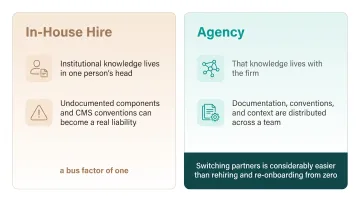
With an in-house hire, institutional knowledge lives in one person's head. If they leave, undocumented components and CMS conventions can become a real liability: a "bus factor of one."
With an agency, that knowledge lives with the firm. Documentation, conventions, and context are distributed across a team, which makes switching partners considerably easier than rehiring and re-onboarding from zero.
2. What is a Webflow agency?
A Webflow agency is an external, multidisciplinary team (designers, Webflow developers, SEO/CRO specialists, project managers) engaged on a project or retainer basis. For lean B2B and climate tech teams, this model gives marketing a CMS they own outright, without depending on an engineering team's sprint calendar.
Operational benefits include:
- Faster time-to-launch ahead of fundraising or product milestones
- No hiring or onboarding overhead
- Built-in QA, SEO, and CRO expertise a single hire rarely covers alone
Agencies also come in different shapes. Some do one-off project builds. Others run monthly retainers. A growing number offer subscription or task-based design queues : submit a request, get it back in 48 hours, revise until satisfied.
Then there are boutique niche specialists. What if Design, for example, focuses on translating deep tech and climate science into investor-ready brands and websites. Its subscription model runs on prioritized design queues, one workflow at a time, with turnaround as fast as 48 hours. Founders get senior-level design and UX strategy without the overhead of three separate in-house hires.
2.1 Use cases of a Webflow agency
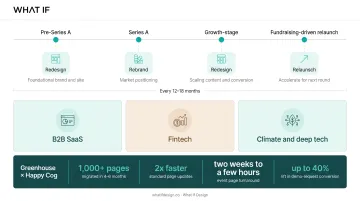
Agencies fit best at specific inflection points: pre-Series A through growth-stage companies doing a redesign, rebrand, or fundraising-driven relaunch, typically every 12-18 months. That includes climate and deep tech teams that need to explain complex science to investors and customers.
💡 Working through this decision right now? If you're a climate-tech or deep-tech founder weighing this trade-off, Book a strategy call with our team, 25 minutes, no pitch, and we'll pressure-test your specific situation.
Common industries:
- B2B SaaS
- Fintech
- Climate and deep tech
The payoff can be substantial. Greenhouse, the hiring platform serving 7,000+ companies, worked with Certified Webflow Enterprise Partner Happy Cog on a 4-6 month migration of 1,000+ pages.
Afterward, standard page updates shipped noticeably faster, event pages dropped from two weeks to a few hours, and Webflow Optimize testing lifted demo-request conversion.
See how we have approached this in practice: Top B2B website design agencies delivering rapid Webflow sprints in 2026.
How we evaluated the options
Every recommendation here comes from actual client work, brand systems shipped, websites launched, and product experiences delivered under fundraising deadlines. We compared the options against five criteria that matter most for technical founders:
- Total cost of ownership across the first 12 months (not just the sticker price)
- Speed to a usable output given a typical Series A runway
- Quality of the technical translation, can they explain your science without oversimplifying it?
- Rework risk, how often teams re-hire because the first choice couldn't scale
- Ability to move with the roadmap without a re-onboarding tax every quarter
Where we cite numbers or trade-offs below, they come from projects we've delivered or watched founders navigate first-hand.
3. What is an in-house Webflow developer?
An in-house Webflow developer is a full-time or long-term contract employee embedded in the company, owning the site end-to-end: front-end dev, light design, CMS structure, and marketing-stack integrations. This fits companies with constant, high-frequency web work.
Core operational benefits:
- Same-day turnaround on small requests
- Deep institutional and product knowledge
- Tighter alignment with the marketing and product roadmap
There are variations within the role itself. Some companies hire a dedicated Webflow specialist. Others hire a broader "growth engineer" who handles Webflow alongside analytics and experimentation. Arrangements range from full-time employees to long-term contractors.
3.1 Use cases of an in-house Webflow developer
This model fits mature, high-growth companies publishing multiple new pages or running many landing-page experiments weekly, where the website functions less like a brochure and more like part of the product experience.
There's no single revenue or headcount threshold that cost-justifies this hire. It depends on workload volume, not company size alone.
Ramp-up cost is clearer to measure. SHRM What we see in practice is a median 39-day time-to-fill for nonexecutive roles, and SHRM onboarding guidance notes that full strategic productivity can take up to 12 months. That's a long runway before an in-house hire delivers full value.
4. Webflow agency vs. in-house developer: which is better?
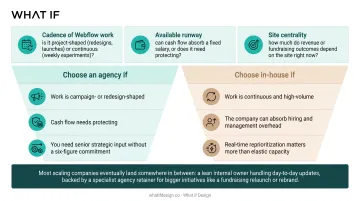
There's no universal answer here. Three factors drive the decision:
- Cadence of Webflow work: is it project-shaped (redesigns, launches) or continuous (weekly experiments)?
- Available runway: can cash flow absorb a fixed salary, or does it need protecting?
- Site centrality: how much do revenue or fundraising outcomes depend on the site right now?
Choose an agency if:
- Work is campaign- or redesign-shaped
- Cash flow needs protecting
- You need senior strategic input without a six-figure commitment
Choose in-house if:
- Work is continuous and high-volume
- The company can absorb hiring and management overhead
- Real-time reprioritization matters more than elastic capacity
Most scaling companies eventually land somewhere in between: a lean internal owner handling day-to-day updates, backed by a specialist agency retainer for bigger initiatives like a fundraising relaunch or rebrand.
4.1 Real-world example
LabStart, a climate-tech venture studio, needed a complete rebrand and website redesign ahead of a fundraising push. They did not have the time or budget to build an internal design and development team from scratch.
What if Design ran the engagement end-to-end: brand strategy, brand design, a Figma-designed and iterated website, marketing-automation connections, and deployment on Webflow. The project ran four months.
The outcome: leadership went into fundraising with a finished brand and site, and more confidence in how they presented the company. For a founder, that beats walking into investor meetings with a half-finished website.
If your website needs to be investor-ready before your next raise and you don't have three specialists on payroll to make that happen, book a free consultation call with What if Design to talk through your situation.
Which option is right for your stage
The right answer depends less on the two options themselves and more on where you are as a company.
Pre-seed / seed (0–$3M raised): Speed and story matter more than polish. A focused boutique-agency sprint usually beats an in-house hire, because the founder still needs to control the narrative. We've seen this pattern with early climate-tech teams, a 4-to-6-week engagement to get brand, website, and pitch coherent is more valuable than a full-time designer.
Series A ($5–20M raised): This is where a senior-led agency partner pays for itself. You need a brand system that will survive three product pivots, a website that converts enterprise buyers, and pitch materials that hold up in board meetings. In-house is still premature unless you're planning to ship design-heavy product weekly.
Series B and beyond ($20M+ raised): Hire in-house design leadership and keep an agency partner for concentrated bursts (rebrands, launches, category shifts). The two aren't substitutes at this stage, they solve different problems.
Growth-stage climate tech specifically: The stakes shift once you're commercializing. Your brand needs to hold up to procurement diligence, regulatory scrutiny, and investor updates simultaneously. A specialist studio that already speaks the science, like our team, reduces the translation tax that generalists impose on every deliverable.
5. Conclusion
The right choice between a Webflow agency and an in-house developer depends on how often your website needs work, what stage your company is at, and how strategically important the site is to revenue and fundraising right now. A company doing a fundraising-driven relaunch every 12-18 months has a different need than one running dozens of landing-page experiments weekly.
Agencies protect cash flow and reduce hiring risk for lean, purpose-driven teams. In-house hires reward companies with continuous, high-volume web work. Most growth-stage companies eventually blend both, and that hybrid model is where real cost efficiency and speed-to-launch gains show up.
Get this right and you get alignment: your team, your investors and your buyers all read the same story the same way. Get a free strategic audit.
6. Frequently asked questions
6.1 Is Webflow still relevant for agencies?
Yes. Webflow's 2024 Customer Awards represented over 300,000 organizations, from startups to Fortune 500 companies, and its Certified Partner program remains active in 2026. Agencies continue relying on it for fast, marketer-friendly B2B sites.
6.2 Is a Webflow agency really cheaper than hiring in-house?
Often, yes, for project-based work. In-house averages $143,037 in base salary alone before tax, benefits, and tools, while agency projects typically run $5,000-$25,000. Ongoing high volume can flip that math.
6.3 How big does a company need to be before hiring an in-house Webflow developer?
There's no universal revenue or headcount threshold. The real trigger is workload: once weekly page updates and experiments consistently exceed what a retainer can absorb, in-house starts making sense.
6.4 Can a freelancer replace a Webflow agency or in-house developer?
Freelancers cost less but carry real trade-offs: limited skill coverage outside their specialty and a single point of failure if they become unavailable. Agencies combine multiple skill sets to handle larger, more complex projects.
6.5 What happens to my site if I switch agencies or lose my in-house developer?
The real risk mitigator is documentation, not the switch itself. Clear CMS ownership, component documentation, and offboarding clarity determine whether a transition is smooth or painful.
6.6 Is a hybrid model of agency plus in-house common?
Yes. It's the most common landing point for scaling companies. A lean internal owner handles routine updates while a specialist agency retainer covers bigger initiatives that need deeper strategic or design capability.
Ready to take the next step?
If you're weighing a design partner for climate, deep tech, or hard-to-explain products, Book a strategy call with our founders at What if Design, a no-pressure 25-minute conversation about what you're building and where design can help. You can also View our work to see how we've helped teams like yours, or Get a free strategic Audit of your current brand, website, or product experience.