That's worth fixing. The model you choose affects three things that matter more than the number on the invoice: how predictable your cash flow stays through a fundraising cycle, how fast your team can move when priorities shift, and whether your design partner is incentivized to think long-term about your product or just close tickets and move on.
This guide breaks down both models specifically for design work, branding, web, and product/UX, and shows how to match the pricing structure to your company's stage.
TL;DR: key takeaways
- Fixed fee locks one price for a scoped deliverable (pitch deck, site, brand), best when requirements are set.
- Retainer buys monthly design-team access for ongoing product and brand work.
- Neither model is inherently cheaper, choose by scope clarity and how long you need support.
- Many teams use both: fixed fee to launch, then a retainer for ongoing design partnership.
1. Fixed fee vs retainer: quick comparison
Here's how the two models stack up on the factors that matter most for a growing company.
| Factor | Fixed Fee | Retainer |
|---|---|---|
| Cost structure | Single upfront or milestone-based price agreed before work starts | Recurring monthly payment for a set scope of hours or deliverables |
| Budget predictability | Highly predictable for the defined project, but scope changes trigger a costly change order | Predictable month to month, though total cost scales with engagement length |
| Flexibility to change scope | Low. Scope is locked once signed | High. Priorities can shift month to month |
| Best suited for | One-off deliverables with a clear finish line: a pitch deck, a logo, a single website | Ongoing needs: product iteration, brand evolution, continuous marketing assets |
| Relationship with the agency | Transactional, project in, project out | Partnership-style, the agency learns your business over time |
According to Promethean Research's digital agency benchmark, roughly 75% of digital agencies now run on retainers. The most common average lands below $5,000 per month, and roughly 42% of engagements run longer than two years.
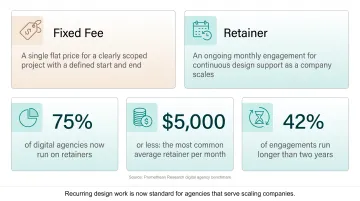
Recurring design work is now standard for agencies that serve scaling companies.
2. What is a fixed fee for design projects?
A fixed fee means the agency estimates the total hours a project will take, then quotes one number before any work begins. You sign, you know exactly what you're paying, full stop.
Budget certainty is the core benefit. That's why fixed fee is popular with founders raising on a locked runway or working against a hard deadline. There's no open-ended cost creep to explain to a board or a co-founder watching the burn rate.
The tradeoff: fixed fee only works when the brief is genuinely stable. Add a new requirement mid-project, an extra deck version or a new page template, and you're reopening the price conversation through a change order.
Fixed fee typically shows up in two structures:
- Milestone-based: paid in phases (discovery, design, delivery), with payment released as each phase is approved.
- Single lump-sum: one payment, often split into a deposit and a final balance on delivery.
2.1 Use cases of fixed fee
Fixed fee fits best when there's a single deliverable with a hard finish line:
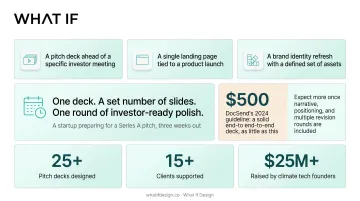
- A pitch deck ahead of a specific investor meeting
- A single landing page tied to a product launch
- A brand identity refresh with a defined set of assets
Take a startup preparing for a Series A pitch three weeks out. The scope is narrow (one deck, a set number of slides, one round of investor-ready polish) and the deadline doesn't move. That's a textbook fixed-fee scenario.
Pricing for this kind of work varies widely by quality bar. DocSend's 2024 deck design guidelines note that design resources can produce a solid end-to-end pitch deck for as little as $500.
Founders working with a dedicated strategy-and-design team should expect more once narrative, positioning, and multiple revision rounds are included.
That same pattern is how we support climate tech founders on fundraising deadlines. We've designed more than 25 pitch decks for 15+ clients, contributing to over $25M raised. Each scoped and priced around a specific investor deadline, not an open-ended engagement.
3. What is a retainer for design projects?
A retainer works like a subscription. You pay a recurring fee each month for a set amount of dedicated design capacity, rather than paying per project.
The core benefit is continuity and speed. A design team that already understands your product and market moves faster on new requests than one starting from zero on a fresh fixed-fee scope every time. There's no re-explaining the science behind your carbon capture process for the third time this year.
If your site hasn't kept pace with where the business actually is, we can show you what that's costing you. Get a free strategic audit.
The tradeoff: if your pipeline of work dries up in a given month, you still pay. Retainers make sense only when there's consistently enough design work to fill the time.
According to AIGA, a true retainer guarantees an ongoing relationship, typically for a 6 to 12 month minimum, rather than simply dividing a project fee into monthly installments. A "retainer" that's just a fixed-fee project split into three payments isn't really a retainer.
Retainers generally come in two flavors:
- Hours-based: a bank of design hours per month, used flexibly across whatever's most urgent.
- Deliverable-based: a set number of assets committed each month.
This is the model What if Design uses most with climate tech and deep-tech clients. These companies rarely need just one thing. They need continuous support across fundraising decks, product UX, and brand assets as they move through funding rounds, each one shifting the brief slightly as the science and market mature.
3.1 When retainers fit best
Retainers fit companies with recurring design needs tied to product development, investor updates, or ongoing marketing, not a single deliverable:
- SaaS companies iterating on product UX every sprint
- Climate tech and deep-tech companies raising multiple rounds, each needing updated investor materials
- Growth-stage teams running continuous marketing and brand campaigns
Design consistency compounds over time in a way disconnected fixed-fee projects can't match. A different team touching your brand every few months tends to fragment it rather than refine it.
Akhila Kosaraju, What if Design's co-founder and lead design strategist, has worked with teams backed by the US Department of Energy and ARPA-E across carbon capture, grid interconnection, and green hydrogen, contributing to more than $105M raised.
That span: fundraising decks, product design, and brand evolution as the science matures, is exactly what a retainer is built for.
Case study: Ribbit Network
Ribbit Network, a distributed CO₂ sensing initiative, needed to explain a technically dense proposition to a mix of citizen scientists, climate researchers, and grant-makers. We designed the brand, website, and product interface so a first-time visitor could grasp the mission in under 30 seconds while a scientist could still find the depth. Read the Ribbit case study.
4. Fixed fee vs retainer: which is better for your project?
The right choice comes down to four questions:
- How well-defined is the scope? If you can write the full brief today, fixed fee works. If the brief will change as you learn more, it won't.
- How long will you need design support? A few weeks points to fixed fee. Several months or longer points to retainer.
- How fast do your priorities shift? Fast-moving startups, especially deep tech where the product itself is still evolving, tend to outgrow fixed-fee scopes quickly.
- Do you have internal capacity to manage change orders? Every scope change under a fixed fee needs someone to negotiate and approve it.
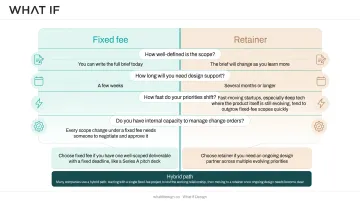
Choose fixed fee if you have one well-scoped deliverable with a fixed deadline, like a Series A pitch deck. Choose retainer if you need an ongoing design partner across multiple evolving priorities.
Many companies use a hybrid path: starting with a single fixed-fee project to test the working relationship, then moving to a retainer once ongoing design needs become clear. It's a low-risk way to see how an agency thinks before committing to a longer engagement.
4.1 Real-world example
A carbon capture startup that What if Design worked with shows why climate tech and deep tech teams often outgrow a single fixed-fee project. Their challenge wasn't one asset. It was an evolving product.
The company needed a way to make sense of large volumes of real-time monitoring data, information that mattered for both operators and investors. A one-off deliverable wouldn't cut it: the dashboards, the visualizations, and the user experience needed to evolve alongside the underlying technology.
What if Design ran a UX audit and built a custom web application with real-time data monitoring and visualization, designed for both technical operators and less technical stakeholders reviewing the same information.
The result: a roughly 30% increase in operational efficiency and higher user satisfaction from a shorter learning curve for new users.
That pattern shows up across climate tech and deep tech. As the science and market mature, the brief keeps changing, and that recurring, high-stakes design work fits a retainer far better than a string of disconnected fixed-fee projects.
If your design needs keep shifting with your product and funding stage, talk to a partner whose pricing is built for that reality, not one that bills every change as a surprise.
5. Conclusion
There's no universal winner between fixed fee and retainer. Fixed fee suits a single, clearly scoped deliverable: a pitch deck, a website, a brand refresh, where the finish line is obvious from day one. Retainers suit companies that need continuous design partnership as they grow, raise capital, or iterate on product.
Getting this decision right prevents budget surprises mid-project and keeps momentum on fundraising and product timelines. It also keeps your design partner aligned with where your business is headed, rather than just closing tickets one at a time.
Clarity here is what turns a defensive conversation into a confident one. Get a free strategic audit.
6. Frequently asked questions
6.1 How much does a design agency cost?
Costs vary by scope and model. Fixed-fee projects range from a few thousand dollars for a single deliverable to tens of thousands for complex builds. Retainers are typically monthly, often under $5,000 for smaller engagements.
6.2 What are the types of pricing models?
The main models are hourly, fixed fee, retainer, value-based, and hybrid time-and-materials arrangements. Fixed fee and retainer are the two most common for design work specifically.
6.3 What is the best pricing model?
There isn't a single best model. It depends on how defined your scope is and whether your need is one-time or ongoing, match the model to your project stage.
6.4 What is the difference between a retainer and a fixed fee?
A fixed fee locks in one price for a defined scope with a clear finish line. A retainer is a recurring fee for ongoing, flexible access to a design team, without a fixed end date.
6.5 Can I switch from a fixed fee to a retainer later?
Yes. Many companies start with a fixed-fee project, like a pitch deck or MVP design, to test the working relationship, then move to a retainer once ongoing design needs emerge.
6.6 Which pricing model works best for a pitch deck or MVP design?
A fixed fee usually works best for a single pitch deck or MVP, since the scope and deadline are clear. A retainer becomes more relevant once design needs continue across multiple funding rounds or product iterations.
Related reading: 10 Best SaaS UX Design Agencies For Product Growth In 2026 and Discover the top UI/UX design agencies in Bangalore.
Ready to take the next step?
If you're weighing a design partner for climate, deep tech, or hard-to-explain products, Book a strategy call with our founders at What if Design, a no-pressure 25-minute conversation about what you're building and where design can help. You can also View our work to see how we've helped teams like yours, or Get a free strategic Audit of your current brand, website, or product experience.