Where What if Design fits in We're a senior-led creative studio built specifically for climate tech, clean tech, and deep tech founders. Since 2020, we've partnered with teams like HYDGEN, Ribbit Network, and Susteon to turn hard-to-explain technology into brands, websites, and product experiences that raise capital and win adoption. This comparison reflects how we evaluate the trade-offs when a founder asks us which route to take.
Every climate tech founder has the same origin story. Month one, before the lab results or the pilot data, someone spent a weekend building a Squarespace or Wix site just to look real. It was never meant to be permanent.
Fast forward eighteen months. That same template is now the first thing a VC associate, a DOE program officer, or an enterprise procurement lead sees before a single call gets booked. That first impression carries more weight than most founders expect.
This piece covers the warning signs your site has outgrown its builder and the hidden cost of waiting too long to move. You'll also see what migration looks like for technical, mission-driven companies that can't afford to get this wrong.
TL;DR: key takeaways
- Templated sites work at validation stage but become a liability when raising rounds or courting enterprise partners
- The real cost is credibility and storytelling lost with technical stakeholders, not the monthly fee
- Migrating off a builder doesn't require losing SEO rankings or starting from zero
- Climate and deep tech sites must translate real science, not just list features
1. Signs your templated site builder is holding your startup back
Buyers and evaluators do their homework before they ever talk to you. HubSpot's research found that 96% of prospects research a company before engaging with anyone on the sales or partnerships side. For a climate tech founder, that means your website is doing the pitching before you get in the room.
1.1 The accelerator cohort look-alike problem
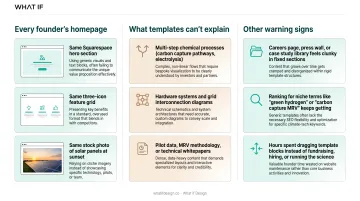
Spend an afternoon browsing startups from the same fellowship or VC portfolio and you'll notice something: they all look identical. Same Squarespace hero section. Same three-icon feature grid. Same stock photo of solar panels at sunset.
When every company in your cohort uses the same template sections, differentiation becomes nearly impossible. Reviewers who see dozens of these sites a month start to mentally file them together, regardless of how different the underlying science actually is.
That sameness is only half the problem. Templates also weren't built to explain real science. Generic template blocks handle software features fine. They struggle with:
- Multi-step chemical processes (carbon capture pathways, electrolysis)
- Hardware systems and grid interconnection diagrams
- Pilot data, MRV methodology, or technical whitepapers
Without the visuals to carry that weight, founders end up over-explaining everything on every call instead of letting the site do the work.
Other warning signs worth watching for:
- Adding a careers page, press wall, or case study library feels clunky or impossible within fixed template sections
- Ranking for niche technical terms like "green hydrogen" or "carbon capture MRV" keeps getting harder as competition increases
- Spending hours dragging template blocks around instead of fundraising, hiring, or running the actual science
2. The real cost of staying on a template
Here's the uncomfortable part: a generic-looking site doesn't just look unfinished. It signals that the company itself might be less serious, less funded, or less far along than it actually is, regardless of how strong the underlying technology is.
That judgment happens fast. Research by Lindgaard and colleagues found that visual appeal ratings formed within 50 milliseconds correlated strongly with ratings formed after 500 milliseconds, meaning first impressions of design quality are locked in almost instantly and rarely change afterward. A DOE reviewer or VC associate has already formed an opinion before reading a single sentence of your copy.
There's also an opportunity cost. Every hour a founder spends fighting a template's fixed sections is an hour not spent on the fundraise, the hiring pipeline, or the technical roadmap.
2.1 When the website can't carry the story, the founder has to
Weak storytelling on the site pushes the entire explanation burden onto pitch decks and calls. Every conversation starts from zero instead of building on what a visitor already understood.
Susteon, a carbon capture and utilization company, hit exactly this wall. Its existing site wasn't communicating the technology or mission clearly to investors and partners.
What if Design rebuilt the brand and website over a four-month engagement. Visual storytelling, interactive elements, and clearer mission framing carried the technical weight the old site couldn't. The result: a 30% increase in career applicants and, in the COO's words, a site that "accurately translated our vision."
Templates also weren't built for the proof points technical audiences care about most:
- Pilot results and performance data
- Patents and IP
- Government backing and grants
- Rigorous technical documentation
Those formats need real information architecture, not a stock "features" section.
If your site hasn't kept pace with where the business actually is, we can show you what that's costing you. Get a free strategic audit.
How we evaluated the options
Every recommendation here comes from actual client work, brand systems shipped, websites launched, and product experiences delivered under fundraising deadlines. We compared the options against five criteria that matter most for technical founders:
- Total cost of ownership across the first 12 months (not just the sticker price)
- Speed to a usable output given a typical Series A runway
- Quality of the technical translation, can they explain your science without oversimplifying it?
- Rework risk, how often teams re-hire because the first choice couldn't scale
- Ability to move with the roadmap without a re-onboarding tax every quarter
Where we cite numbers or trade-offs below, they come from projects we've delivered or watched founders navigate first-hand.
3. What moving off a site builder actually involves
Migration should start with a content audit, not a redesign. Before anyone touches a design file, catalog what already exists:
- Existing copy and messaging: what's working, what's outdated
- Case studies, whitepapers, and technical documentation: what needs a real home
- Current keyword performance: what's already ranking and shouldn't be lost
3.1 Translate the science before you design the site
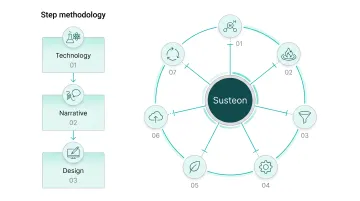
The strongest migrations translate the underlying technology into a visual narrative first, so the design follows a clear story instead of decorating one after the fact. For a company like Susteon, that meant turning a technology portfolio spanning seven distinct processes into an ecosystem diagram anyone could follow in under a minute.
3.2 Fully custom vs. semi-custom: the real decision
Not every company needs a fully hand-coded site. The choice usually comes down to:
- Integration needs: CRMs, data rooms, investor portals
- Technical complexity: interactive diagrams, calculators, CMS-driven case studies
- Budget and timeline: semi-custom on a flexible platform (e.g. Webflow) ships faster with room for tailored layouts, custom code, and CMS collections
That semi-custom lane is where specialist studios earn their keep. What if Design, a remote-first studio for climate tech, deep tech, and frontier tech founders, works with teams backed by Accel, the U.S. Department of Energy, ARPA-E, Y Combinator, and Sequoia. The team learns the underlying science and market before opening a design file, so the site holds up with a DOE reviewer or climate VC.
Lean founding teams also get senior-level design and UX strategy without hiring in-house mid-fundraise. A full-time senior designer typically runs well over $100,000 a year before benefits.
Migration scope should stretch past the site build itself. Brand, website, and product experience need to tell the same story. Susteon's engagement, for example, started with a strategy workshop that shaped messaging before a single pixel was designed.
4. Templated builder vs custom website at a glance
| Factor | Templated Builder | Custom / Semi-Custom Website |
|---|---|---|
| Cost structure | Fixed monthly subscription | Project fee or ongoing partnership (often ~$3,999, $6,999/month) |
| Timeline | Live in days | Typically 4-12 weeks depending on scope |
| Design flexibility | Fixed template sections | Fully tailored information architecture |
| Technical storytelling | Stock icons, generic text blocks | Custom diagrams, interactive visuals, room for whitepapers and grant documentation |
| Scalability & integrations | Limited by plan tier and template structure | Connects to CRMs, data rooms, and investor portals |
Templated builders aren't a bad choice at the validation stage. They optimize for speed. The tradeoff is less room for the technical depth a Series A or DOE application demands.
5. How to transition without losing momentum or SEO
The fear of losing search rankings keeps a lot of founders stuck on a builder longer than they should be. You can protect rankings if you plan the move before you build.
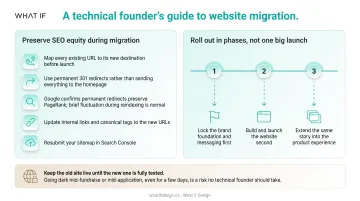
Preserve SEO equity during migration:
- Map every existing URL to its new destination before launch
- Use permanent 301 redirects rather than sending everything to the homepage
- Google confirms permanent redirects preserve PageRank; brief fluctuation during reindexing is normal
- Update internal links and canonical tags to the new URLs
- Resubmit your sitemap in Search Console
Roll out in phases, not one big launch:
- Lock the brand foundation and messaging first
- Build and launch the website second
- Extend the same story into the product experience
Keep the old site live until the new one is fully tested. Going dark mid-fundraise or mid-application, even for a few days, is a risk no technical founder should take.
Get this right and you get alignment: your team, your investors and your buyers all read the same story the same way. Get a free strategic audit.
Which option is right for your stage
The right answer depends less on the two options themselves and more on where you are as a company.
Pre-seed / seed (0–$3M raised): Speed and story matter more than polish. A focused boutique-agency sprint usually beats an in-house hire, because the founder still needs to control the narrative. We've seen this pattern with early climate-tech teams, a 4-to-6-week engagement to get brand, website, and pitch coherent is more valuable than a full-time designer.
Series A ($5–20M raised): This is where a senior-led agency partner pays for itself. You need a brand system that will survive three product pivots, a website that converts enterprise buyers, and pitch materials that hold up in board meetings. In-house is still premature unless you're planning to ship design-heavy product weekly.
Series B and beyond ($20M+ raised): Hire in-house design leadership and keep an agency partner for concentrated bursts (rebrands, launches, category shifts). The two aren't substitutes at this stage, they solve different problems.
Growth-stage climate tech specifically: The stakes shift once you're commercializing. Your brand needs to hold up to procurement diligence, regulatory scrutiny, and investor updates simultaneously. A specialist studio that already speaks the science, like our team, reduces the translation tax that generalists impose on every deliverable.
6. Frequently asked questions
6.1 How do I know if my startup has outgrown its Squarespace or Wix website?
Common signs include:
- Investors or partners start scrutinizing the site more closely
- You struggle to add technical content like case studies or docs
- You look interchangeable with competitors on the same template
6.2 Will I lose my SEO rankings if I move off a website builder?
Rankings can be preserved with proper URL redirects and content migration planning. Some temporary fluctuation during reindexing is normal.
6.3 How long does it typically take to move from a template to a custom website?
Most full design and development engagements run 4-12 weeks depending on scope and complexity. A phased approach reduces risk compared to one big relaunch.
6.4 Is it worth investing in a custom website before raising a Series A?
If investors or technical partners will evaluate your site as part of diligence, the credibility gain usually outweighs the cost. A weak site forces you to over-explain in every meeting.
6.5 Can I reuse content from my existing builder site during the migration?
Yes. Copy, case studies, and documentation can usually be carried over and refined rather than rewritten, as long as you set up proper URL redirects.
6.6 What's the difference between a fully custom website and a "semi-custom" build?
Full custom code offers maximum flexibility at a higher cost. A semi-custom build on a platform like Webflow moves faster and still allows tailored design, just within some platform constraints.
Related reading: Landing page design for climate and deep-tech founders and Low-carbon web design.
Ready to take the next step?
If you're weighing a design partner for climate, deep tech, or hard-to-explain products, Book a strategy call with our founders at What if Design, a no-pressure 25-minute conversation about what you're building and where design can help. You can also View our work to see how we've helped teams like yours, or Get a free strategic Audit of your current brand, website, or product experience.